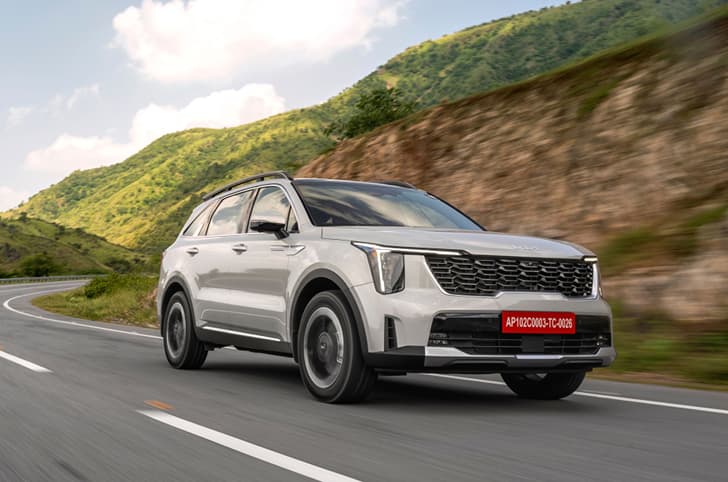

The Kia Sorento strong hybrid 4WD (₹38–47L, ~17.7–19.6 km/l ARAI) is a premium 7-seat SUV; the Maruti Grand Vitara strong hybrid (₹19–22.77L, 27.97 km/l ARAI) is a compact 5-seat SUV — different segments, different use cases.
The Kia Sorento strong hybrid with AWD starts at approximately ₹38 lakh ex-showroom in India and carries an ARAI-claimed fuel efficiency of around 17.7–19.6 km/l, while the Maruti Suzuki Grand Vitara strong hybrid — a 2WD-only compact SUV — is ARAI-rated at 27.97 km/l and priced from roughly ₹19 lakh. These two cars are not direct rivals: the Sorento is a three-row, executive-class SUV; the Grand Vitara is a five-seat compact. But they share a technology label, strong hybrid, and many buyers genuinely ask whether the Sorento's AWD and premium cabin justify paying nearly twice as much for less fuel efficiency. This guide answers that question with real numbers.
At a Glance: Kia Sorento Hybrid vs Maruti Grand Vitara Strong Hybrid vs Toyota Urban Cruiser Hyryder
| Feature | Kia Sorento Strong Hybrid (AWD) | Maruti Suzuki Grand Vitara Strong Hybrid (2WD) | Toyota Urban Cruiser Hyryder Strong Hybrid (2WD) |
|---|---|---|---|
| Hybrid type | Strong hybrid (drives on battery alone) | Strong hybrid (drives on battery alone) | Strong hybrid (drives on battery alone) |
| Engine | 1.6L turbo-petrol + 65hp e-motor | 1.5L Atkinson-cycle petrol + e-motor | 1.5L Atkinson-cycle petrol + e-motor |
| Combined power | 230hp / 380Nm | ~116hp (combined) | ~116hp (combined) |
| ARAI mileage | ~17.7–19.6 km/l (manufacturer claim) | 27.97 km/l | ~27.97 km/l |
| Real-world mileage | Not yet independently tested in India | Petrol-AT: 13.45 km/l (Autocar India tested) | ~18–20 km/l (real-world estimates) |
| Price range (ex-showroom) | ₹33.31–₹47.06 lakh | ₹19–₹22.77 lakh | ₹19–₹22 lakh (approx.) |
| AWD available? | Yes (on select variants) | No | No |
| Seating | 6 or 7 seats (3 rows) | 5 seats (2 rows) | 5 seats (2 rows) |
| Boot space (all rows up) | 179 litres | ~373 litres | ~373 litres |
| Gearbox | 6-speed torque-converter AT | e-CVT | e-CVT |
| Key weakness | Pricey; third row cramped; 179L boot with all rows up | No AWD; no turbo performance; boot shrinks vs petrol variant due to hybrid battery | Same platform/powertrain as Grand Vitara; no AWD |
What Does "Strong Hybrid" Actually Mean — and Does the Sorento Qualify?
A strong hybrid is defined as a vehicle that can propel itself on electric power alone, without the combustion engine running, for meaningful distances at low speeds — typically in urban stop-start traffic. The battery is recharged by the engine and by regenerative braking, not from the grid. This distinguishes a strong hybrid from a mild hybrid, which uses a small battery only to assist the engine and cannot drive on electricity alone.
Both the Kia Sorento and the Maruti Suzuki Grand Vitara meet this definition. The Sorento's hybrid system pairs a 1.6-litre turbocharged direct-injection petrol engine (180hp, 265Nm) with a permanent magnet synchronous electric motor producing 65hp and 264Nm. Combined output is 230hp and 380Nm, routed through a 6-speed torque-converter automatic. The Grand Vitara's strong hybrid uses a naturally aspirated 1.5-litre Atkinson-cycle petrol engine with a smaller electric motor, producing around 116hp combined, through an e-CVT. The Sorento's system is more powerful and turbocharged — a different performance proposition — but the Grand Vitara's simpler, lighter setup is what delivers its class-leading 27.97 km/l ARAI figure.
Maruti Suzuki also sells mild hybrids under its Smart Hybrid branding — the XL6 petrol and the Fronx 1.0 turbo, for instance. A mild hybrid is defined as a system where the battery-motor unit only assists the combustion engine and cannot independently drive the wheels. These are meaningfully less efficient than strong hybrids and should not be confused with the Grand Vitara's full strong hybrid system.
How Does the Sorento Hybrid's Mileage Stack Up in the Real World?
The Sorento's ARAI-claimed fuel efficiency for the strong hybrid variant sits in the 17.7–19.6 km/l range depending on the variant and whether AWD is engaged. These are manufacturer claims, and independent real-world testing in Indian conditions has not yet been published at the time of writing. Given the Sorento's kerb weight (well above 1,900kg with AWD hardware), a real-world figure of 13–16 km/l in mixed city-highway driving would be a reasonable expectation — consistent with how other large strong hybrids perform when tested outside the ARAI cycle.
The Grand Vitara's story is more detailed. Its 27.97 km/l ARAI claim is for the strong hybrid variant, but Autocar India's real-world test of the petrol-automatic (non-hybrid) returned just 13.45 km/l. The strong hybrid's real-world figure is not yet independently published, but user-reported numbers and comparable Toyota Hyryder data suggest 18–22 km/l in mixed conditions — still comfortably ahead of the Sorento's likely real-world returns.
The efficiency gap is structural, not incidental. The Grand Vitara's Atkinson-cycle engine is optimised purely for efficiency, running on a longer expansion stroke that sacrifices peak power for thermal efficiency. The Sorento's turbocharged engine is tuned for performance — 230hp combined is nearly double the Grand Vitara's output — and the AWD system adds mechanical drag. You cannot have both the highest mileage and the most performance from a hybrid system of this type; the Sorento has made a clear choice.
What Does the Sorento Hybrid Cost in India, and Is the Price Justified?
The Kia Sorento is priced from ₹33.31 lakh to ₹47.06 lakh (on-road Delhi) across its full range of diesel and hybrid variants. The strong hybrid AWD variants occupy the upper end of that range. The diesel HTE DCT 7-seat starts at ₹33.31 lakh, while the top hybrid HTX AWD variant pushes past ₹47 lakh on-road.
The Grand Vitara strong hybrid, by contrast, ranges from ₹19 lakh to ₹22.77 lakh ex-showroom across its hybrid variants. That is a price gap of ₹15–25 lakh between comparable strong hybrid variants of the two cars — a chasm that reflects the difference in segment, size, and positioning rather than any inefficiency in Kia's pricing.
Kia has been transparent about its localisation strategy. The Sorento's body is stamped and welded at Kia's Anantapur plant, and the dashboard and seats are manufactured in India — a level of localisation that has made the ₹27.99 lakh entry price (for the diesel base variant) possible for a car of this size and specification. Without that investment, the Sorento would likely cost ₹5–8 lakh more. Even so, the top hybrid AWD variant is expensive by any measure. The HTX variant carries no 2WD option, meaning buyers who want the hybrid must also pay for AWD at the top trim level.
How Does the Sorento's AWD System Compare to What's Available in the Grand Vitara Segment?
AWD is one of the Sorento's genuine differentiators in the Indian hybrid market. The Grand Vitara strong hybrid is 2WD only — Maruti does not offer an AWD version of the strong hybrid variant. Toyota's Urban Cruiser Hyryder strong hybrid is similarly 2WD only. In the compact SUV segment, if you want a strong hybrid with all-wheel drive, there is currently no option under ₹25 lakh in India.
The Sorento fills that gap, but at a significant price. Its AWD system is paired with terrain modes, giving it genuine capability on loose surfaces and in wet conditions. The Autocar India review confirms terrain modes are available on the hybrid AWD variants. This makes the Sorento relevant for buyers in hilly regions — Himachal Pradesh, Uttarakhand, the Northeast — where AWD is a practical requirement rather than a marketing feature.
For buyers who want AWD in a hybrid SUV but cannot stretch to the Sorento's price, the segment does not currently serve them. The AWD hybrid SUV space under ₹20 lakh in India is essentially empty as of late 2026.
What Is the Sorento's Cabin Like Compared to the Grand Vitara?
The Sorento's cabin stands out in its class. The Autocar India review describes it as offering "a mix of quality, equipment and ergonomics that nothing at this price can match." Soft-touch materials cover every surface you are likely to contact, physical buttons click with engineered precision, and the 12.3-inch infotainment system is logically laid out with climate controls on a separate touch-sensitive bar below the screen.
The feature set is extensive: 12.3-inch digital driver's display, head-up display, 12-speaker Bose audio, dual-zone climate control, powered tailgate, 64-colour ambient lighting, digital rear-view mirror, ventilated front and second-row captain's chairs, 10 airbags, 360-degree camera, front and rear dashcams, remote parking assist, and Level 2+ ADAS. The top HTX variant even gets real-time generative AI — a first for any Sorento globally, according to Kia.
The Grand Vitara's cabin is well-finished for its segment and price, but it is a compact SUV interior. Soft-touch materials are limited to key touchpoints, the feature list is shorter, and there is no third row. The comparison is not really fair — the Sorento is competing with the Toyota Fortuner, MG Gloster, and Jeep Meridian on cabin quality, not the Grand Vitara.
Where the Sorento genuinely disappoints is the third row. The seat base sits almost flat on the floor, providing no under-thigh support, and the seating position is knees-up. Autocar India's review is direct: "Treat it as a space for children or short hops." Boot space with all three rows in use is just 179 litres — barely enough for a weekend bag per passenger. Fold the third row and it grows to 813 litres, which is generous, but that defeats the purpose of a seven-seater. The Grand Vitara, as a five-seater, has no such compromise: its boot is usable in everyday configuration.
How Does the Sorento Hybrid Ride and Drive?
The Sorento's 19-inch wheels wear 235/55 R19 tyres — tall sidewalls for this size of alloy, and Autocar India notes that this is a deliberate engineering choice rather than a styling compromise. The result is a ride that the review describes as "outstanding" for the class. The multi-link rear suspension absorbs broken tarmac well, and the car feels settled at highway speeds.
The hybrid powertrain's character is city-friendly. Electric motor torque is available instantly from rest, the transition from electric to petrol is close to smooth through the 6-speed torque-converter automatic, and the combined 380Nm means the Sorento never feels sluggish despite its weight. The review notes it is "not as engaging to drive as European rivals" — a fair observation for a car that prioritises comfort and refinement over driver involvement.
The Grand Vitara's strong hybrid drives very differently. The e-CVT is tuned for efficiency rather than engagement, and the naturally aspirated engine's modest power means the car feels adequate rather than brisk in urban traffic. Its strength is the seamlessness of electric-only running at low speeds, where the petrol engine stays off and the cabin is genuinely quiet. On the highway, the Grand Vitara's smaller engine needs to work harder, and the efficiency advantage over the Sorento narrows.
Who Should Buy the Sorento Hybrid, and Who Should Buy the Grand Vitara Strong Hybrid?
These two cars serve genuinely different buyers, and the overlap is smaller than the shared "strong hybrid" label suggests.
The Sorento hybrid AWD makes sense for a buyer who needs three rows of seating, wants AWD for hilly terrain or wet-weather confidence, values a premium cabin with executive-class features, and has a budget of ₹38–47 lakh. The running cost argument is real — at 17–19 km/l real-world, the Sorento will cost significantly less to run than a diesel Fortuner or a petrol Meridian over 80,000–1,00,000 km. The hybrid premium over the diesel Sorento is meaningful, but the smoother, quieter powertrain and lower long-term maintenance costs make it defensible for high-mileage users.
The Grand Vitara strong hybrid makes sense for a buyer in the ₹19–23 lakh segment who wants the best possible fuel efficiency from a compact SUV, does not need AWD or a third row, and wants Maruti's service network — the widest in India — behind them. At 27.97 km/l ARAI (real-world likely 18–22 km/l), it is the most fuel-efficient non-plug-in hybrid SUV in India. The hybrid premium over the Grand Vitara petrol-manual (₹12.49 lakh base) is roughly ₹7–10 lakh depending on variant, which takes several years of fuel savings to recover, but the driving experience is smoother and quieter than the petrol-only versions.
If you are cross-shopping these two cars directly, the decision is almost certainly already made by budget. A buyer with ₹22 lakh cannot stretch to a Sorento hybrid. A buyer with ₹45 lakh is unlikely to find the Grand Vitara's compact cabin and 116hp adequate. The genuine comparison for the Sorento hybrid in India is the Toyota Innova Hycross strong hybrid — another three-row strong hybrid, priced from around ₹25–30 lakh, with a more practical third row and a proven service network.
How Does the Sorento Hybrid Compare to the Innova Hycross Strong Hybrid?
The Toyota Innova Hycross is a strong hybrid MPV — defined as a vehicle that can drive on battery power alone at low speeds — using a 2.0-litre Atkinson-cycle petrol engine with an e-CVT. It produces around 186hp combined and is ARAI-rated at approximately 21.1 km/l. Priced from ₹25–32 lakh ex-showroom, it undercuts the Sorento hybrid significantly while offering a genuinely usable third row with proper seat height and under-thigh support, something the Sorento cannot match.
The Sorento counters with more power (230hp vs 186hp), AWD availability, a more premium cabin feel with ventilated second-row captain's chairs, and a more aggressive exterior design. The Innova Hycross has the better third-row experience, a more established service network, and a lower price. For most Indian families buying a three-row hybrid, the Hycross is the more practical choice. The Sorento is the more aspirational one.
What Are the Sorento Hybrid's Honest Weaknesses?
The Autocar India review lists three clear negatives: the third row is best suited to small children due to the flat floor-mounted seat base; it is not as engaging to drive as European rivals at this price; and the top HTX variant is expensive with no 2WD option. To these, a buyer should add:
The 179-litre boot with all rows in use is genuinely limiting for a family of six or seven on a road trip. The hybrid battery pack takes up underfloor space that a diesel or petrol Sorento would use for luggage. This is a structural trade-off of the strong hybrid architecture in a three-row SUV — the same issue affects the Innova Hycross, though Toyota manages it slightly better.
The Sorento is also late in its global life cycle. Kia has confirmed it is the fourth-generation (MQ4) model, due for international replacement next year, while India will continue with this generation. That is not necessarily a problem — a mature platform is a debugged platform — but it means the Sorento will not receive the next-generation hybrid system improvements that its global successor will carry.
Finally, Kia's service network, while growing rapidly, is not as dense as Maruti Suzuki's in tier-2 and tier-3 cities. For buyers outside major metros, this is a practical consideration.
Is There a Plug-In Hybrid (PHEV) Version of the Sorento Available in India?
No. The Kia Sorento is available in India only as a strong hybrid (non-plug-in) and a diesel. The plug-in hybrid (PHEV) version of the Sorento — which charges from the grid and offers a longer electric-only range — is sold in international markets but has not been launched in India as of October 2026. A plug-in hybrid is defined as a vehicle with a larger battery that can be charged from an external power source, enabling extended electric-only driving before the combustion engine is needed. The Indian Sorento's hybrid system recharges only through the engine and regenerative braking.
This matters because some buyers comparing the Sorento to the Grand Vitara may have seen PHEV Sorento specifications online and assumed those figures apply to the Indian model. They do not. The Indian Sorento hybrid's ARAI figures of 17.7–19.6 km/l are for the non-plug-in strong hybrid only.
The Bottom Line: Sorento Hybrid 4WD vs Grand Vitara Strong Hybrid in 2026
The Kia Sorento strong hybrid AWD and the Maruti Suzuki Grand Vitara strong hybrid occupy different rungs of the Indian market, separated by roughly ₹15–25 lakh and a full vehicle class. The Sorento is the more powerful, more premium, and more capable car — 230hp, AWD, three rows, and a cabin that rivals European executive SUVs on material quality. The Grand Vitara is the more efficient car, at 27.97 km/l ARAI versus the Sorento's 17.7–19.6 km/l, and the more accessible one at roughly half the price.
If your budget is ₹20–25 lakh and fuel efficiency is the priority, the Grand Vitara strong hybrid remains the benchmark in its segment — and the Toyota Urban Cruiser Hyryder offers the same powertrain at a similar price if you prefer Toyota's service network. If your budget is ₹35–47 lakh and you need AWD, three rows, and a genuinely premium cabin, the Sorento hybrid is the only strong hybrid option in India that delivers all three simultaneously. The Innova Hycross is the closest rival on price and seating, but it lacks AWD and the Sorento's performance headroom.
Neither car is wrong. They are answers to different questions. The mistake would be buying the Grand Vitara expecting Sorento-level space, or buying the Sorento expecting Grand Vitara-level efficiency.
For buyers still weighing options across the hybrid spectrum, our guides on best hybrid cars under ₹25 lakh and best 7-seater hybrid MUVs under ₹30 lakh cover the full space with updated 2026 pricing.
Sources
- Kia Sorento review: Kia's big hybrid and diesel bet | Autocar India
- Maruti Suzuki Grand Vitara Mileage (2026) - ARAI & Autocar Tested Mileage | Autocar India
- Kia Sorento Specifications - Dimensions, Features, and Boot Space | Autocar India
- Kia India Official Website
- Maruti Suzuki Grand Vitara Official Page