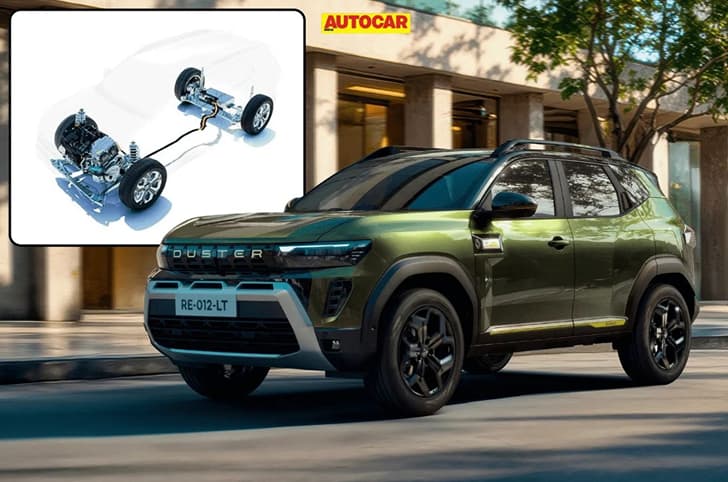

Renault's Duster Strong Hybrid E-Tech 160 claims 29 km/l ARAI, edging the Maruti Grand Vitara strong hybrid's 27.97 km/l, with a launch date of October 17, 2026.
The Renault Duster Strong Hybrid E-Tech 160 arrives on October 17, 2026 with an ARAI-certified fuel efficiency of 29 km/l — the highest claimed figure in the mid-size SUV segment and a meaningful step above the Maruti Suzuki Grand Vitara strong hybrid's 27.97 km/l ARAI rating. Both are defined as strong hybrids: vehicles that can propel themselves on electric power alone, without any external charging connection. That shared classification makes this a genuine apples-to-apples contest for efficiency-focused buyers shopping in the ₹18–₹25 lakh band.
At a Glance: Duster Hybrid vs Grand Vitara Strong Hybrid vs Hyryder Strong Hybrid
| Feature | Renault Duster E-Tech 160 (Strong Hybrid) | Maruti Suzuki Grand Vitara (Strong Hybrid) | Toyota Urban Cruiser Hyryder (Strong Hybrid) |
|---|---|---|---|
| Hybrid type | Strong hybrid (no external charging) | Strong hybrid (no external charging) | Strong hybrid (no external charging) |
| Engine | 1.8L NA petrol + 2 electric motors | 1.5L Atkinson petrol + 1 electric motor | 1.5L Atkinson petrol + 1 electric motor |
| Combined output | 160 PS / 172 Nm | ~116 PS (system) | ~116 PS (system) |
| Battery capacity | 1.4 kWh | 0.60 kWh | 0.60 kWh |
| Transmission | Multi-mode automatic (fixed gear ratios) | e-CVT | e-CVT |
| ARAI mileage | 29 km/l | 27.97 km/l | 27.97 km/l |
| Real-world mileage | TBD (launch Oct 17, 2026) | ~18–20 km/l (user reported) | ~18–20 km/l (estimated) |
| Price range (ex-showroom) | TBD (expected ~₹22–25 lakh) | ₹18.58–₹22.77 lakh | ₹19.99–₹24.49 lakh (approx.) |
| Key weakness | Gear-shift feel vs e-CVT; no diesel | Smaller battery; boot space reduced | Smaller battery; no AWD option |
What exactly is a strong hybrid, and why does it matter for this comparison?
A strong hybrid is a powertrain where the vehicle can be driven exclusively on electric motor power — without the petrol engine running — for meaningful stretches, particularly at low speeds and during light acceleration. The battery recharges through regenerative braking and through the petrol engine acting as a generator; no plug-in charging is required or possible.
Both the Renault Duster E-Tech 160 and the Maruti Suzuki Grand Vitara's top-spec powertrain fall into this category. This differs fundamentally from a mild hybrid, where the electric motor only assists the petrol engine and cannot drive the vehicle independently. Maruti's Smart Hybrid technology — fitted to models like the XL6 petrol and the Fronx 1.0 turbo — is a mild hybrid: useful for reducing fuel consumption at idle and during light loads, but incapable of pure EV running.
The distinction matters because strong hybrids deliver meaningfully higher real-world fuel savings in city traffic, where stop-start conditions let the electric motor do most of the work. That is precisely the use case Renault is targeting with the Duster E-Tech 160, claiming that up to 80% of city driving can be completed in electric mode.
How does the Duster's E-Tech powertrain actually work?
The Duster Strong Hybrid E-Tech 160 combines a naturally aspirated 1,789cc four-cylinder petrol engine with two electric motors. One motor is a generator producing 20 hp; the second motor drives the wheels and produces 49 hp. Combined system output is rated at 160 PS and 172 Nm. The 1.4 kWh lithium-ion battery pack is more than twice the capacity of the 0.60 kWh unit used in the Toyota-Maruti e-CVT hybrid system shared by the Grand Vitara, the Maruti Victoris, and the Urban Cruiser Hyryder.
The transmission uses fixed gear ratios — a notable departure from the e-CVT architecture used by the Toyota-derived system. In practice, the Duster's hybrid will exhibit gear engagements as it transitions between electric-only drive, petrol-only drive, and combined operation. Autocar India notes that engine rpm is expected to rise and fall more like a conventional automatic, and gear shifts will be perceptible. Buyers who prefer the smooth, rubber-band feel of an e-CVT may find this a trade-off worth noting.
Renault draws a direct line between the E-Tech system and its Formula 1 experience — the multi-motor architecture and energy recovery strategy share conceptual DNA with F1's hybrid units, even if the scale and application are entirely different. The company is positioning the Duster hybrid as a diesel alternative, which is pointed messaging: the current-generation Duster dropped diesel entirely when it relaunched in India, and the hybrid is meant to fill that efficiency gap for buyers who covered long distances on diesel's low running costs.
How does the 29 km/l ARAI claim compare with the Grand Vitara's 27.97 km/l?
On paper, the Duster's ARAI-certified 29 km/l is 1.03 km/l better than the Grand Vitara strong hybrid's 27.97 km/l ARAI figure. That is a 3.7% advantage in the certification test — real but not major.
The more important caveat is that ARAI figures come from a standardised test cycle that does not replicate Indian road conditions. Autocar India's real-world test of the Grand Vitara petrol automatic returned 13.45 km/l — roughly 35% below its ARAI figure. The strong hybrid variant typically returns 18–20 km/l in mixed city and highway use based on user-reported data. Renault has not yet published a real-world figure for the Duster hybrid, and none will be available until independent tests are conducted after the October 17 launch.
Treat both ARAI numbers as benchmarks for comparison, not as predictions of what you will see at the pump. The Duster's larger 1.4 kWh battery gives it more electric range per charge cycle, which could translate to better city efficiency — but the heavier multi-mode gearbox and the larger 1.8L engine (versus the Grand Vitara's 1.5L Atkinson unit) could offset some of that advantage on the highway.
What is the Maruti Suzuki Grand Vitara strong hybrid, and where does it fit?
The Grand Vitara strong hybrid is Maruti's flagship powertrain in the mid-size SUV segment, co-developed with Toyota and shared with the Urban Cruiser Hyryder. It pairs a 1.5-litre Atkinson-cycle petrol engine with a single electric motor and a 0.60 kWh nickel-metal hydride battery, driving through an e-CVT. The system produces approximately 116 PS combined.
Autocar India lists the Grand Vitara strong hybrid range from ₹18.58 lakh to ₹22.77 lakh (ex-showroom), with the top-spec Alpha+ (O) AT commanding the highest price. The strong hybrid's ARAI mileage of 27.97 km/l is the highest in the Grand Vitara lineup — the petrol manual manages 21.11 km/l and the petrol automatic 20.58 km/l.
The Grand Vitara strong hybrid has real drawbacks: the battery pack sits under the boot floor, reducing cargo space compared to the petrol variant. The smaller 0.60 kWh battery means shorter pure-EV windows than the Duster's 1.4 kWh pack. System output of ~116 PS is noticeably lower than the Duster hybrid's 160 PS, which matters if you carry four adults and luggage regularly.
The Maruti Victoris strong hybrid — Maruti's newer mid-size SUV — uses the same Toyota-derived e-CVT hybrid system and competes in the same price band. If the Grand Vitara hybrid is on your shortlist, the Victoris is worth evaluating alongside it for its slightly more contemporary styling and feature set.
How does Renault's E-Tech compare with Toyota's hybrid system used in the Grand Vitara and Hyryder?
This is the technical heart of the comparison. Autocar India explains that Toyota's full hybrid uses an e-CVT and a power-split device for a largely step-free driving feel, while Renault's E-Tech uses fixed gear ratios and can shift between them. The two systems reach similar efficiency outcomes via different engineering routes.
Toyota's power-split device is mechanically elegant: it blends engine and motor torque continuously, producing the smooth acceleration that e-CVT hybrids are known for. The trade-off is that the system is tuned for efficiency over outright performance — the Grand Vitara and Hyryder strong hybrids are not quick cars by any measure.
Renault's multi-mode automatic is more conventional in feel but brings a larger battery and a higher-output motor to the table. The 160 PS combined figure gives the Duster hybrid a meaningful power advantage — roughly 38% more than the Toyota-derived system. Whether that translates to a better driving experience will depend on how smoothly the transmission manages its gear changes in real-world traffic. Only post-launch road tests will confirm this.
The Duster's 1.4 kWh battery also enables longer electric-only running at city speeds, which is where strong hybrids deliver their biggest efficiency gains. In theory, this should give the Duster an edge in dense urban traffic — but the Toyota system's smaller, lighter battery has been refined over many years and is proven in Indian conditions. Renault's E-Tech is new to India, and early reliability data will take time to accumulate.
What is the expected price of the Duster hybrid, and how does it compare with the Grand Vitara?
Renault has not announced pricing ahead of the October 17 launch. Bookings are open at ₹21,000 through Renault's website and dealerships. ETAuto reports the launch is set for October 17, 2026.
Based on the existing Duster petrol range — which starts at ₹10.49 lakh for the 1.0L turbo — and the typical price premium that strong hybrid powertrains command in India, the Duster hybrid is expected to be positioned in the ₹22–₹25 lakh band. This would place it squarely against the Grand Vitara strong hybrid's ₹18.58–₹22.77 lakh range and the Toyota Urban Cruiser Hyryder's comparable strong hybrid variants.
If Renault prices the Duster hybrid below ₹23 lakh for the base strong hybrid variant, it would represent genuine value given the higher power output and larger battery. If it lands above ₹24 lakh, buyers will need to weigh the 29 km/l ARAI claim and 160 PS output against the Grand Vitara's proven reliability record and Maruti's unmatched service network across India.
For buyers considering the best hybrid cars under ₹25 lakh, the Duster hybrid's arrival meaningfully expands the options in this segment.
How has the Duster performed in sales since its relaunch?
The third-generation Duster's return to India has been commercially significant. Autocar Professional reports that the Duster sold 2,359 units in April 2026 — its second month on sale — making it Renault India's No. 1 model and accounting for 44% of the company's total dispatches of 5,413 passenger vehicles that month. The Duster's two-month total of 3,761 units gave it a 36% share of Renault India's PV sales in March-April 2026.
However, Times of India Auto notes that Duster sales declined for four consecutive months from May to August 2026 — a pattern common to newly launched models that see an initial surge followed by a correction as early adopters are satisfied. The hybrid launch on October 17 is clearly timed to reinvigorate demand and attract a different buyer profile: one who was waiting for the efficient powertrain before committing.
This context matters. The Duster hybrid is not just a powertrain addition — it is a sales strategy. Renault needs the hybrid to sustain momentum in a segment where the Grand Vitara, Hyryder, Hyundai Creta, and Kia Seltos command enormous volumes.
Is the Duster hybrid a diesel replacement, and does that argument hold up?
Renault's marketing has been explicit: the Duster hybrid is positioned as an alternative to diesel. The company's teaser — "Dear Diesel, thank you for the ride, we will take it from here" — leaves little ambiguity. The current-generation Duster does not offer a diesel engine in India, and the hybrid is meant to serve buyers who valued diesel's fuel economy and low running costs.
The argument has merit in city conditions. A strong hybrid running predominantly on electric power in stop-start traffic can match or beat diesel running costs per kilometre, particularly as diesel prices in India remain elevated. The 29 km/l ARAI claim, if it translates to even 20 km/l in real-world mixed use, would deliver running costs comparable to a diesel SUV at current fuel prices.
On the highway, the case is less clear. Diesel engines are most efficient at sustained highway speeds, where their thermodynamic advantage over petrol is greatest. A strong hybrid's electric assist is less useful at 80–100 km/h, and the 1.8L naturally aspirated petrol engine — without turbocharging — may feel less effortless than a diesel at those speeds. Buyers who do significant highway mileage should wait for independent real-world highway fuel economy tests before making a decision.
What about the Maruti Victoris and Toyota Innova Hycross — do they compete here?
The Maruti Victoris strong hybrid is a direct segment rival to the Grand Vitara hybrid and, by extension, to the Duster hybrid. It uses the same Toyota-derived e-CVT strong hybrid system as the Grand Vitara, with similar efficiency figures. If you are comparing the Grand Vitara hybrid, the Victoris deserves a look — particularly if you prefer its styling or feature set.
The Toyota Innova Hycross strong hybrid is a different proposition: it is a three-row MPV priced above ₹25 lakh, targeting family buyers who need seven seats. It uses a 2.0L Atkinson petrol engine with a strong hybrid system and an e-CVT. If you need seven seats and hybrid efficiency, the Innova Hycross is the benchmark — but it is not a direct competitor to the Duster or Grand Vitara in terms of size, price, or use case. For a detailed look at that segment, see our guide to best 7-seater hybrid MUVs under ₹30 lakh.
The Honda City e:HEV is another strong hybrid worth mentioning for completeness — it uses a two-motor strong hybrid system in a sedan body, with an ARAI claim of around 26.5 km/l. It does not compete in the SUV segment but is relevant for buyers who prioritise efficiency over body style.
Which strong hybrid SUV should you actually buy?
The honest answer is: wait until after October 17, 2026 for independent road tests of the Duster hybrid before committing.
Here is the framework for making the decision:
Choose the Duster Strong Hybrid E-Tech 160 if: you want the highest claimed mileage in the segment, the most power (160 PS), and a larger battery that promises more electric running in city traffic. You are comfortable being an early adopter of a new powertrain in India, and you are willing to wait for Renault's service network to demonstrate reliability with the E-Tech system.
Choose the Maruti Grand Vitara strong hybrid if: you value a proven, refined powertrain with years of real-world data from Indian roads, Maruti's unmatched service network (the largest in India), and the smooth e-CVT driving experience. The Grand Vitara's 27.97 km/l ARAI figure is only marginally behind the Duster's claim, and in real-world conditions the gap may narrow further. The price range of ₹18.58–₹22.77 lakh also gives you more variant choice at lower entry points.
Consider the Toyota Urban Cruiser Hyryder strong hybrid if: you want the same proven Toyota hybrid system as the Grand Vitara but prefer Toyota's dealer experience or specific features available on the Hyryder.
For buyers considering mild hybrids as a lower-cost entry point — such as the Maruti XL6 petrol with Smart Hybrid or the Fronx 1.0 turbo with Smart Hybrid — it is worth being clear that those systems cannot drive on electric power alone and will not deliver the same fuel savings in city traffic. The strong hybrid premium is real but so is the efficiency benefit, particularly for high-mileage urban drivers. Our guide to best hybrid cars under ₹25 lakh covers the full spectrum.
The Duster hybrid's arrival is genuinely good news for Indian buyers: it introduces a new strong hybrid architecture, raises the efficiency bar, and forces the Grand Vitara and Hyryder to compete harder on value. The segment is more interesting in October 2026 than it has been in years.
Sources
- Renault Launches Fuel-Efficient Duster Strong Hybrid E-Tech 160 with 29 km/l, ETAuto
- Renault Duster hybrid launch on October 17, Autocar India
- Maruti Suzuki Grand Vitara Mileage (2026) – ARAI & Autocar Tested, Autocar India
- Duster Brings Renault Back Into the SUV Game, Outsells Triber to Become No. 1 Model in April, Autocar Professional
- Renault Duster Strong Hybrid Launch On October 17: 158 BHP E-Tech To Take On Grand Vitara, Hyryder, Times of India Auto
- Maruti Suzuki Grand Vitara – Official Model Page
- Renault Duster – Official Model Page