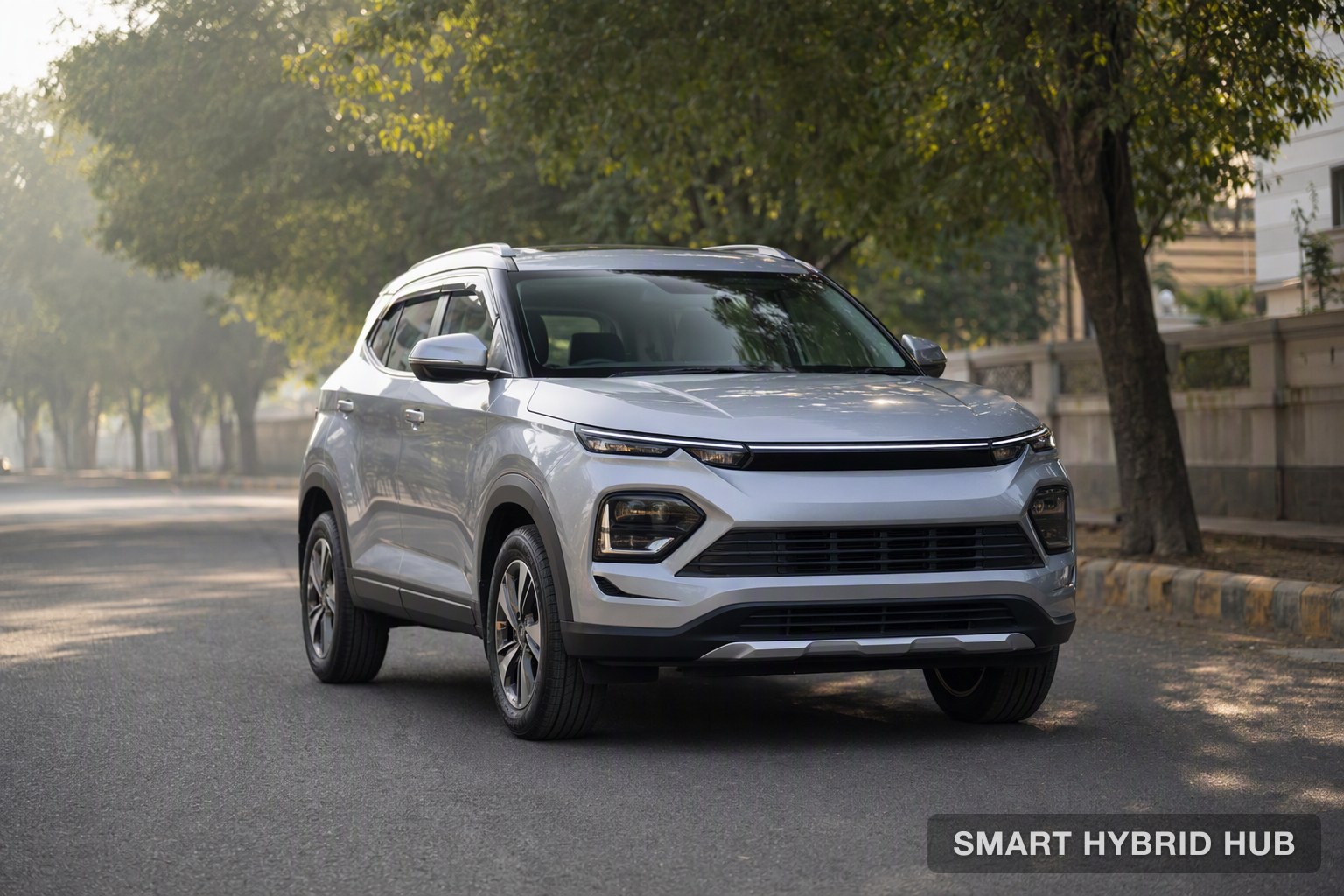
Best Hybrid Cars Under ₹15 Lakh in India (2026)
No strong hybrid sells under ₹15 lakh in India, so the shortlist here is mild hybrids. The Maruti XL6 spans ₹11.62 lakh to ₹14.58 lakh on the 1.5-litre K15C Smart Hybrid, rated 20.90 km/l manual and 20.27 km/l automatic, with 6 airbags standard but no sunroof and no head-up display. The Maruti Fronx 1.0 Turbo at ₹11.98 lakh is the other, at 21.5 km/l manual and 20.01 km/l automatic; note Maruti attaches Smart Hybrid to the turbo rather than the 1.2. The Maruti Ertiga also qualifies on the same engine from ₹8.90 lakh, and the Toyota Rumion is a non-Maruti mild-hybrid option. For a strong hybrid you need about ₹17.18 lakh.
Two cars clear the bar without an asterisk: the Maruti XL6 at ₹11.62-14.58 lakh, and the Maruti Fronx turbo, whose top Alpha Turbo AT trim lands at ₹11.98 lakh. Both are Smart Hybrids (mild hybrids), certified at 20.90 km/l and 21.5 km/l respectively as manuals, 20.27 km/l and 20.01 km/l as automatics. What ₹15 lakh does not buy, as of September 2026, is a strong hybrid, the kind that can move the car on battery alone. The cheapest one covered here is the Toyota Urban Cruiser Hyryder at ₹17.18 lakh, roughly ₹2.2 lakh past the ceiling. Widen the filter to mild hybrids generally and the field is bigger than two: the Maruti Ertiga runs the same 1.5-litre Smart Hybrid engine from ₹8.90 lakh.
Ask five people what a "hybrid car" actually does, and you'll usually get five different answers. At least two of them will describe a car that can drive on batteries alone. That's a real thing, but it isn't what most hybrid badges under ₹15 lakh mean, and the gap between the two has led plenty of buyers to expect more than their car actually delivers.
This list sticks to what's genuinely on sale at this budget, says clearly what kind of hybrid each car is, and points out where the two cars covered in detail sit against the pricier, more capable hybrids that exist just outside this range.
Key takeaways
-
Maruti XL6: the only six-seater with captain chairs and any form of hybrid assist under ₹15 lakh, and the Smart Hybrid setup still certifies 20.90 km/l as a manual (20.27 km/l as the automatic) despite the extra size and the individual second-row seats.
-
Maruti Fronx: the more spirited pick, with the only turbo-petrol engine on this list paired to the same idle-stop hybrid assist.
-
Mild hybrids go cheaper than this list suggests; strong hybrids don't reach it at all. The Maruti Ertiga uses the same K15C Smart Hybrid engine from ₹8.90 lakh, and the Toyota Rumion is that car with a Toyota badge on it. No strong hybrid on sale in India in September 2026 is priced under ₹15 lakh.
Best hybrid cars under ₹15 lakh compared
| Model | Price (ex-showroom) | Hybrid type | Engine | ARAI mileage | Seating | Boot space |
|---|---|---|---|---|---|---|
| Maruti XL6 (Alpha+ AT) | ₹14.58 lakh; range from ₹11.62 lakh | Smart Hybrid (mild) | 1.5L K15C, 103.06 PS (75.8 kW), 139 Nm | 20.27 km/l (AT), 20.90 km/l (MT) | 6 (captain seats) | 209 L, 550 L with 3rd row folded (third-party) |
| Maruti Fronx (Alpha Turbo AT) | ₹11.98 lakh | Smart Hybrid (mild) | 1.0L Turbo Boosterjet, 99 PS, 147.6 Nm | 20.01 km/l (AT), 21.5 km/l (MT) | 5 | 308 L, 60:40 split |
Every Maruti and Toyota figure in this article, power, torque, ARAI mileage, airbag counts, variant pricing, is read off the manufacturer's own current brochure, which is why a few of them differ from what the spec aggregators print. Where a brochure and a spec site disagree, the brochure wins here. Two kinds of number are unavoidably second-hand. Maruti publishes no boot-space figure for the XL6, so the 209-litre and 550-litre numbers are third-party measurements rather than a factory spec, and Toyota publishes no boot figure for the Hyryder at all. Running and maintenance costs, and the Solitaire extended-warranty terms, come from dealer material, not the brochure. Renault is a separate case: the Duster E-Tech is unlaunched, so every number attached to it is a company statement or a press report, not a certified specification. Honda's site blocks automated checking, so the note below about the City e:HEV is reported rather than confirmed.
One thing about the numbering: it groups the cars rather than ranking them. The two Smart Hybrids come first because they fit the budget, then the two strong hybrids that don't. Nothing below is ordered by price, mileage or preference.
What counts as a hybrid car?
"Hybrid" covers two genuinely different systems, and both cars that fit this budget use the cheaper, simpler one. A Smart Hybrid (Maruti's term, also called a mild hybrid) uses a small motor-generator to cut the engine at idle, assist it briefly under acceleration, and recover some braking energy, but the car cannot move on electric power alone, even for a few metres. If that's the system you're shopping, the mild-hybrid MPV comparison covers the rest of the family.
A Strong Hybrid uses a bigger battery and motor that can genuinely drive the car by itself at low speeds, which is why strong hybrids post noticeably better mileage, and also why they cost more. Toyota sells the best-known version of it, Maruti sells the same hardware in the Grand Vitara, and Renault has one coming. Both the XL6 and Fronx here are Smart Hybrids. That isn't a downgrade so much as a different price bracket: as of September 2026, no strong hybrid on sale in India from any brand is priced under ₹15 lakh, which is exactly why this list looks the way it does. Which ones will actually run in EV-only mode, and for how long, is worth reading before you pay the premium.
The two hybrids under ₹15 lakh in detail
1. Maruti XL6
Pricing: ₹11.62-14.58 lakh, with the Alpha+ AT covered here at the top of that range.
The XL6 is the only six-seater in this price bracket with captain chairs and any form of hybrid assist. The Ertiga and Rumion use the same engine but seat seven on a second-row bench, so the individual seats are the whole reason to pick an MPV over a compact SUV at this budget. The Smart Hybrid system doesn't change how it drives in any dramatic way; it mostly shows up as a smoother stop-start at traffic lights and a small mileage bump over a comparable non-hybrid engine. If you want the row-three space rather than the captain chairs, the seven-seat hybrid MUVs are a different shopping list.
Features (Alpha+ AT):
-
Second-row captain seats with one-touch recline and slide
-
Ventilated front seats, leatherette upholstery
-
360-degree camera
-
7-inch touchscreen with wireless Android Auto and Apple CarPlay
-
Cruise control, Arkamys sound system
-
6 airbags standard across the range, ABS with EBD and brake assist, ESP with hill-hold assist, ISOFIX, TPMS
Worth knowing before you cross-shop: the XL6 has no sunroof and no head-up display on any trim, including this one.
Engine: 1.5-litre K15C Smart Hybrid petrol, 75.8 kW / 103.06 PS at 6000 rpm, 139 Nm at 4300 rpm. Maruti quotes these as PS, not bhp, and several sites print 137 Nm for this engine, the brochure figure is 139 Nm.
Mileage: 20.90 km/l as the manual, 20.27 km/l as the automatic, both ARAI-certified. The two are genuinely different certifications, so the automatic reviewed here is the 20.27 km/l car.
Seating: 6, with second-row captain seats that don't split-fold; the third row does, 50:50, with a flat-fold and recline option.
Boot space: 209 litres with all three rows up, rising to 550 litres with the third row folded. Maruti doesn't publish a boot figure for the XL6, so both numbers are third-party measurements.
Transmission: 5-speed manual or 6-speed automatic.
Warranty: 3 years/100,000 km standard, extendable up to 6 years/160,000 km through Maruti's Solitaire plan, per dealer material.
2. Maruti Fronx
Pricing: ₹11.98 lakh (Alpha Turbo AT, the top trim)
The Fronx is the more engaging car of the two, and it's the only one here with a turbocharged engine, which changes how the hybrid assist actually feels: it's less about stretching mileage and more about smoothing out the power delivery. One thing worth flagging before you cross-shop it: the Fronx doesn't offer a sunroof at any trim, including this one, which surprises some buyers given how much else it packs in.
Features (Alpha Turbo AT):
-
9-inch touchscreen with wireless Android Auto and Apple CarPlay
-
Head-up display
-
Wireless phone charger
-
360-degree camera, Suzuki Connect (40+ connected features)
-
60:40 split-folding rear seat
-
6 airbags standard across the range, ESP, hill-hold assist, ABS with EBD, ISOFIX
Engine: 1.0-litre K-Series Turbo Boosterjet petrol with Smart Hybrid assist, 99 PS at 5500 rpm, 147.6 Nm at 2000-4500 rpm. As with the XL6, the output is a PS figure in Maruti's brochure, not bhp.
Mileage: 21.5 km/l as the manual, 20.01 km/l as the automatic, both ARAI-certified for the 1.0 turbo.
Seating: 5.
Boot space: 308 litres, with a 60:40 split-folding rear seat (Delta trim and above; not on the base Sigma).
Transmission: 6-speed automatic on this trim, 5-speed manual on lower trims.
Warranty: 3 years/100,000 km standard, extendable up to 6 years/160,000 km through Maruti's Solitaire plan, per dealer material.
Other hybrid options worth considering
Two cars is a thin shortlist, and it's worth being precise about why. It isn't that only two hybrids exist below ₹15 lakh. The Maruti Ertiga runs the same K15C Smart Hybrid engine from ₹8.90 lakh, the Toyota Rumion is the badge-engineered version of it, and there are other hybrid MPVs in this bracket. What the ₹15 lakh ceiling rules out is the strong hybrids, every one of them. So here are the two most worth stretching for.
3. Toyota Urban Cruiser Hyryder strong hybrid
Pricing: Starts at ₹17.18 lakh (S Hybrid), roughly ₹2.2 lakh over this list's ₹15 lakh ceiling.
This is a genuine strong hybrid, the kind that can crawl through traffic on battery power alone, and it shows in the mileage: 27.97 km/l, comfortably ahead of anything on the main list. Toyota publishes no EV-only range figure for it, though, so treat those battery-only stretches as short and speed-limited rather than a number you can plan a commute around. If your budget can stretch past ₹15 lakh, it's worth cross-shopping directly against the XL6 and Fronx before deciding, since the driving experience is meaningfully different. Cross-shop it against the rest of the hybrid mid-size SUVs under ₹20 lakh while you're at it.
Engine: 1.5-litre petrol rated 91.18 PS, paired with an electric motor contributing 141 Nm and an e-CVT. Maruti publishes 115.56 PS (85 kW) as the combined system output for the same powertrain in the Grand Vitara.
Mileage: 27.97 km/l, ARAI-certified, the best figure of any car mentioned in this article and near the top of the most fuel-efficient hybrid SUVs list.
Key features (S Hybrid entry trim): 7-inch digital driver's display, 7-inch touchscreen with wireless Android Auto and Apple CarPlay, cruise control, 6 airbags, hill-hold control, rear AC vents.
What it doesn't have: ADAS, on any Hyryder variant. Toyota's brochure lists none, so if driver assistance matters to you, look at the hybrid SUVs that do offer ADAS under ₹20 lakh instead. Toyota also publishes no official boot figure for the car.
4. Renault Duster hybrid (upcoming)
Pricing: Not yet announced. The current petrol Duster ranges ₹10.49-18.69 lakh, and hybrid pricing typically lands above the equivalent petrol trim.
Renault has confirmed this is coming, badged E-Tech Strong Hybrid, reportedly around Diwali 2026. It's a genuinely different kind of strong hybrid to Toyota's, built around a bigger combined output rather than outright efficiency, and Renault claims it can run on electric power alone for up to 80% of city driving. Treat every figure here as pre-launch guidance, not a specification, since nothing is final until it's actually priced.
Powertrain: 1.8-litre petrol engine (109 bhp) plus a 49 bhp electric motor, a 1.4 kWh battery and a 20 bhp hybrid starter generator, for a combined 160 bhp and 172 Nm.
Mileage: Not yet announced; ARAI certification typically follows closer to launch.
Conclusion
The honest short version: at this budget, "hybrid" mostly buys you a smoother stop-start and a small mileage bump, not the electric-only driving some buyers expect from the word. Pick based on what you actually need day to day rather than the badge. Need to move six people with proper second-row comfort? The XL6 settles it on its own. Want something quicker and more fun to drive, with no real compromise on space for four or five? The Fronx makes more sense.
If what you actually want is the bigger mileage jump a true strong hybrid delivers, that exists, just not yet at this price. The strong-hybrid SUVs under ₹30 lakh start around ₹17 lakh and go up from there. Either wait for one to arrive at a lower price point, or accept spending a few lakh more today to get one now.
FAQs
Are the XL6 and Fronx full hybrids?
No. Both use Maruti's Smart Hybrid system, a mild hybrid that assists the engine and cuts it at idle, but can't drive the car on electric power alone. A full or strong hybrid can, and none of those are priced under ₹15 lakh in India today.
Is there any non-Maruti hybrid car under ₹15 lakh in India?
Yes, if you mean mild hybrids. The Toyota Rumion sits under ₹15 lakh and uses the same 1.5-litre K15C Smart Hybrid engine as the Ertiga it's based on. No, if you mean strong hybrids: Toyota's own strong hybrids start around ₹17.18 lakh, Honda has reportedly withdrawn the City e:HEV during 2026, and Renault's upcoming Duster Hybrid isn't priced yet, though its petrol range already extends past ₹18 lakh.
Which is cheaper, the XL6 or the Fronx?
Comparing the top trims, the Fronx, at ₹11.98 lakh for the Alpha Turbo AT against the XL6's ₹14.58 lakh for the Alpha+ AT. Across the full ranges the XL6 starts at ₹11.62 lakh and cheaper Fronx trims exist too, though not all of them carry the Smart Hybrid badge. Neither is the cheapest mild hybrid Maruti sells, the Ertiga undercuts both from ₹8.90 lakh.
Does the Maruti Fronx have a sunroof?
No, not on any trim, including the top Alpha Turbo AT covered here. It's one of the few things the Fronx skips despite its otherwise generous features list. The XL6 goes without one too.
Last verified: 2026-09-24