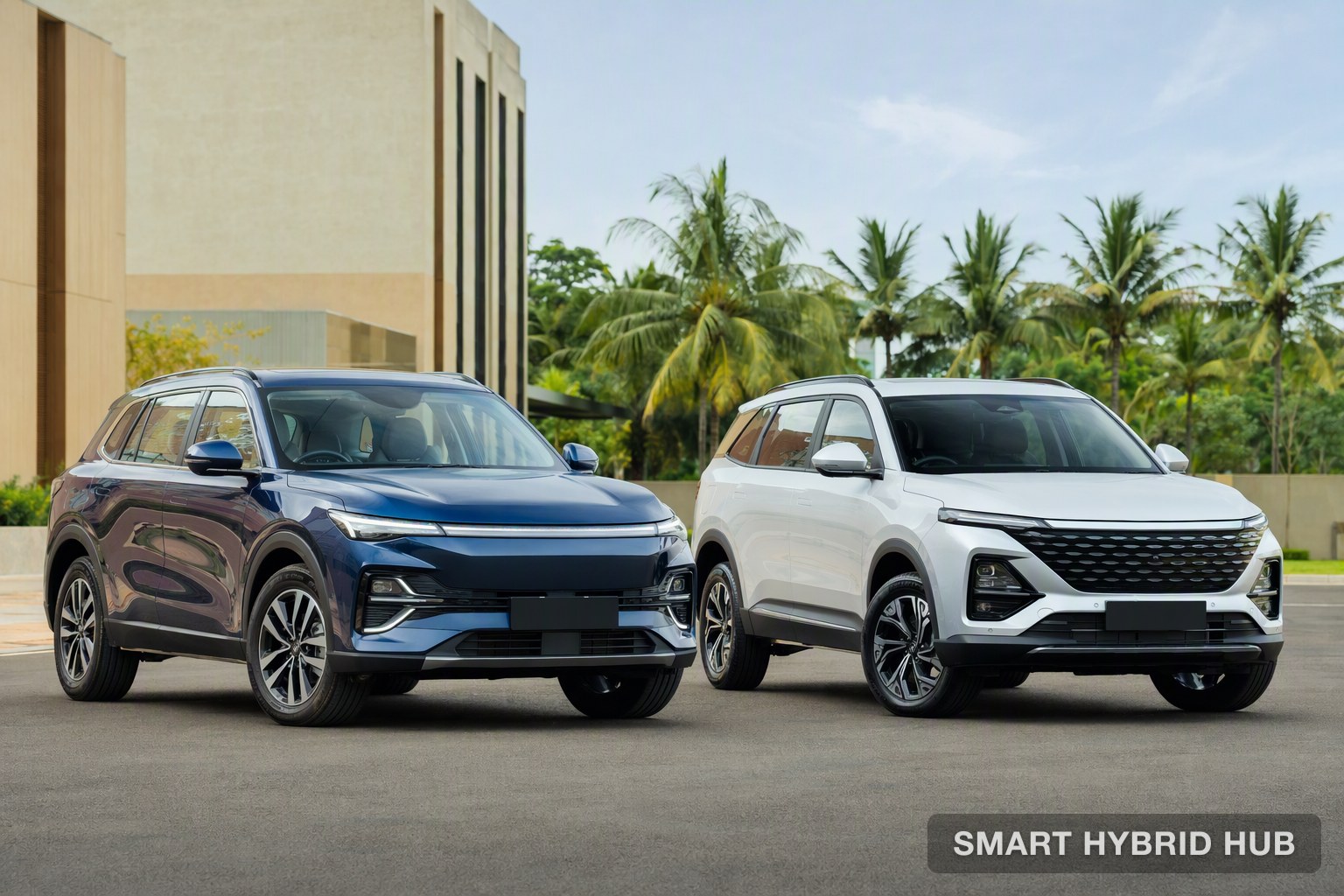
6 Best Hybrid SUVs in India (2026): Prices and Mileage
India's hybrid SUV field is small and clusters tightly. The Maruti Fronx is the only mild-hybrid entry at ₹11.98 lakh, with Smart Hybrid on its 1.0 Turbo. The three strong hybrids are separated by just ₹44,000: the Maruti Grand Vitara at ₹19.55 lakh and 27.97 km/l, the Maruti Victoris at ₹19.99 lakh and 28.65 km/l, and the Toyota Urban Cruiser Hyryder at ₹19.99 lakh and 27.97 km/l, all sharing a combined 115.56 PS. On ADAS, only the Victoris offers Level 2, and on its Smart Hybrid petrol automatic rather than the strong hybrid; the Grand Vitara and Hyryder brochures list none. The Honda Elevate and Renault Duster hybrids are expected during 2026, with figures the makers quote rather than certify.
Six hybrid SUVs matter in India right now: the Maruti Fronx (₹11.98 lakh, Smart Hybrid, 100.06 PS), the Maruti Grand Vitara (₹19.55 lakh for the Alpha+ hybrid, ₹19.77 lakh at the top of the range, Strong Hybrid, 115.56 PS, 27.97 km/l), the Maruti Victoris (₹19.99 lakh, Strong Hybrid, 115.56 PS, 28.65 km/l), the Toyota Urban Cruiser Hyryder (₹19.99 lakh, Strong Hybrid, 115.56 PS, 27.97 km/l), and two that haven't launched yet, the Honda Elevate Hybrid (6 October 2026, price unannounced) and the Renault Duster Hybrid (around Diwali 2026, a claimed 160 PS). The Victoris holds the best ARAI km/l figure of the lot; the Grand Vitara is the cheapest of the three Strong Hybrids actually on sale; the Fronx is the only Smart Hybrid here and costs about ₹7.5 lakh less than any of them.
Ask for a hybrid SUV in India and you could walk away with anything from a car that barely sips less fuel than its petrol twin to one that can drive on electric power alone in traffic. Both wear the same word on the badge, and the SUVs on sale or confirmed for India right now span nearly the entire width of that gap, from a small motor that just nudges the engine along to a genuine Strong Hybrid system with a battery big enough to matter.
This list covers the hybrid SUVs genuinely available in India today, plus two with confirmed, dated launches close enough to plan around, compared on price, power, mileage, and exactly what kind of hybrid each one is, so there's no confusion between assistance and the real thing. The 1 to 6 numbering below is grouped, not ranked, the entries run in ascending order of price and then by launch status, so the best-mileage car on the list sits third, not first.
Key takeaways
- Maruti Fronx: the only Smart Hybrid on this list, and by far the cheapest at ₹11.98 lakh.
- Maruti Grand Vitara: the cheapest of the three genuine Strong Hybrids on sale here, at ₹19.55 lakh for the Alpha+ hybrid trim, rising to ₹19.77 lakh for the dual-tone Alpha+(O) that tops the whole range.
- Maruti Victoris: the best ARAI km/l figure of any car on this list at 28.65 km/l, and the only one of the three Maruti/Toyota Strong Hybrid SUVs whose range includes Level 2 ADAS at all, on a Smart Hybrid petrol automatic trim, not on the Strong Hybrid.
- Toyota Urban Cruiser Hyryder: shares its Strong Hybrid platform with the Grand Vitara, priced identically to the Victoris at ₹19.99 lakh, with no ADAS on any variant.
- Honda Elevate Hybrid: launching 6 October 2026, with pricing still unannounced.
- Renault Duster Hybrid: the most powerful hybrid on this list at a claimed 160 PS, due around Diwali 2026.
What are the benefits of having a hybrid SUV?
- Noticeably better fuel efficiency than the same SUV in pure petrol form, since the electric motor takes over some of the engine's load in traffic and at low speeds
- Lower running costs over years of ownership, even though the upfront price sits higher than a comparable petrol trim
- A smoother, quieter ride in stop-start city traffic, as the engine cuts out and the electric motor takes over more often than in a regular petrol SUV
- Access to a manufacturer's newest safety and comfort tech first, since hybrid trims often get features before they trickle down to petrol-only variants
- Better resale value than an equivalent petrol SUV, as demand for genuinely fuel-efficient used cars keeps climbing with fuel prices, though resale is a market estimate, not a published manufacturer figure
Best hybrid SUVs available in India
| Model | Price (ex-showroom) | Hybrid type | Combined power | Mileage | Status |
|---|---|---|---|---|---|
| Maruti Fronx | ₹11.98 lakh | Smart Hybrid | 100.06 PS | 20.01 km/l (1.0 Turbo AT) | On sale |
| Maruti Grand Vitara | ₹19.55 lakh (Alpha+); ₹19.77 lakh (Alpha+(O), range top, also hybrid) | Strong Hybrid | 115.56 PS | 27.97 km/l | On sale |
| Maruti Victoris | ₹19.99 lakh | Strong Hybrid | 115.56 PS (85 kW) | 28.65 km/l | On sale |
| Toyota Urban Cruiser Hyryder | ₹19.99 lakh | Strong Hybrid | 115.56 PS | 27.97 km/l | On sale |
| Honda Elevate Hybrid | Not announced | Strong Hybrid (expected) | ~125 PS (Honda's City e:HEV figure, as quoted) | ~26.5 km/l (targeted, uncertifiable) | Upcoming, 6 Oct 2026 |
| Renault Duster Hybrid | ₹19-25 lakh (reported) | Strong Hybrid (E-Tech) | 160 PS (claimed) | 24-26 km/l (targeted) | Upcoming, ~Diwali 2026 |
Prices are ex-showroom, for the trim named in each entry below. The Elevate Hybrid and Duster Hybrid haven't launched yet, so their prices, power, and mileage are pre-launch estimates or manufacturer targets, not confirmed figures.
Where these numbers come from. The prices, power outputs, ARAI mileage figures and airbag counts for the Fronx, Grand Vitara and Victoris are taken from Maruti Suzuki's own published brochures, and the Hyryder's from Toyota's. Where a brochure and a news report disagree, the brochure wins here. Honda and Renault are a different matter: neither publishes a brochure this article could read directly, so every Elevate Hybrid and Duster Hybrid number below is a quoted, reported or targeted figure rather than a verified one, and none of it should be read as confirmed. Two categories are third-party by nature no matter which brand is involved. Boot space for a Strong Hybrid is rarely published at all, because the battery sits under the floor and manufacturers often stop quoting a litre figure for that trim, Toyota, for instance, publishes no official boot figure for the Hyryder Strong Hybrid, and Maruti publishes none for the Grand Vitara or Victoris hybrids, so any number you see is a measurement or an estimate from a magazine, not a manufacturer spec. Resale value is the same: it comes from used-car market data, never from a brochure. Extended warranty terms, such as the six-year cover sold through Maruti's Solitaire plan, are programme details rather than brochure specs and are quoted here as reported.
The order below runs from cheapest to dearest among the cars on sale, then the two upcoming models. It is a grouping, not a ranking, none of the six is being called the best.
1. Maruti Fronx
Pricing: ₹11.98 lakh (Alpha 1.0L Turbo Smart Hybrid AT)
Hybrid type: Smart Hybrid
The Fronx is the only Smart Hybrid on this list, and by a wide margin the cheapest way onto it. Its motor only assists the turbo-petrol engine rather than driving the car by itself, so don't expect the mileage jump the Strong Hybrids further down this list deliver; what you get instead is a sub-₹12 lakh price and a genuinely quick engine for the class. If that price band is the reason you're here, the wider set of hybrid SUVs under ₹20 lakh is worth reading alongside this.
Features:
- 22.86 cm (9-inch) SmartPlay Pro+ touchscreen with wireless Android Auto and Apple CarPlay
- Cruise control, automatic climate control with rear AC vents
- Wireless phone charging, 360-degree camera
Engine: 1.0-litre turbo-petrol Smart Hybrid, 100.06 PS at 5,500 rpm and 147.6 Nm, paired with a 6-speed torque-converter automatic on this trim; a naturally aspirated 1.2-litre and a CNG version are also sold.
Mileage: 20.01 km/l (ARAI) on this 1.0 Turbo automatic trim. The same turbo engine with the manual gearbox is rated 21.5 km/l, the naturally aspirated 1.2 at 21.79 km/l with the manual and 22.89 km/l with the AMT, and the CNG at 28.51 km/kg. The trim priced here is, in other words, the least efficient Fronx you can buy.
Seating: 5.
Boot space: 308 litres, the largest published boot figure among the four hybrid SUVs actually on sale here. The 700 litres Renault quotes for the Duster and the 458 litres Honda quotes for the Elevate are both petrol-body numbers for cars whose hybrid versions haven't launched.
Transmission: Manual, AMT, or 6-speed torque-converter automatic, depending on engine; CNG is manual only.
Warranty: 3 years/100,000 km standard, extendable up to 6 years/160,000 km through Maruti's Solitaire plan.
Safety:
- 6 airbags standard across the range, including this trim
- No sunroof at any price, no ADAS on any trim
2. Maruti Grand Vitara
Pricing: ₹19.55 lakh (Alpha+ Hybrid CVT). The range runs to ₹19.77 lakh for the dual-tone Alpha+(O), itself a Strong Hybrid, so the hybrid tops the line-up rather than sitting below a dearer petrol.
Hybrid type: Strong Hybrid
The Grand Vitara is the cheapest of the three genuine Strong Hybrid SUVs on sale in India, and the first car on this list that can actually drive on electric power alone at low speed rather than just assist the engine. What it cannot do is offer you a driver-assistance package: Maruti's brochure lists no ADAS on any Grand Vitara trim, hybrid or petrol. If that feature is a deal-breaker, the hybrid SUVs with ADAS under ₹20 lakh comparison is the more useful shortlist.
Features:
- 7-inch TFT digital instrument cluster, panoramic sunroof
- Wireless phone charging, 360-degree camera
- Head-Up Display, which the brochure lists on this Alpha+ hybrid trim as well as the top Alpha petrol trim
- Steering-mounted controls, auto-dimming IRVM
Engine: 1.5-litre Strong Hybrid petrol-electric system, a combined output of 115.56 PS, paired with an e-CVT automatic; no manual option exists for the Strong Hybrid.
Mileage: 27.97 km/l (ARAI), among the best figures of any car on this list.
Seating: 5.
Boot space: Not officially published by Maruti for this Strong Hybrid trim. Autocar India's advice column on this exact question puts it at under 300 litres, down from the 373-litre figure quoted for the petrol Grand Vitara, since the battery pack sits under the boot floor. Treat both as third-party numbers rather than specs.
Transmission: e-CVT automatic only on the Strong Hybrid; the Smart Hybrid petrol range separately offers a 5-speed manual or 6-speed torque-converter automatic.
Warranty: 3 years/100,000 km standard, extendable up to 6 years/160,000 km through Maruti's Solitaire plan.
3. Maruti Victoris
Pricing: ₹19.99 lakh (ZXi Plus (O) Strong Hybrid e-CVT)
Hybrid type: Strong Hybrid
The Victoris posts the best ARAI km/l figure of any car on this list, Strong or Smart Hybrid. It is also the only one of the three Maruti/Toyota Strong Hybrid SUVs whose range offers Level 2 ADAS at all, and that package sits on a Smart Hybrid petrol automatic trim, not on the Strong Hybrid e-CVT priced here. The Grand Vitara it shares its hardware with doesn't offer ADAS anywhere in its range.
Features:
- Panoramic sunroof, Infinity 8-speaker audio with Dolby Atmos
- SmartPlay Pro X touchscreen, 64-colour ambient lighting
- Smart Powered Tailgate with gesture control
- Steering-mounted controls, auto-dimming IRVM
Engine: 1.5-litre Strong Hybrid petrol-electric system, the same underlying hardware as the Grand Vitara, a 92.45 PS engine plus an 80.2 PS motor, for a combined system output of 115.56 PS (85 kW), paired with an e-CVT automatic. Add the two figures and you get 172.65 PS, which is not what the car makes: the engine and the motor peak at different speeds, and the battery limits how much the motor can contribute at any one moment, so the certified system output lands well below the sum of its parts. This is normal for a Strong Hybrid, and it's why comparing motor ratings between hybrids tells you very little.
Mileage: 28.65 km/l (ARAI), the best km/l figure of any car on this list. The Fronx CNG's 28.51 km/kg is a higher-looking number, but it's a different unit and a different fuel, so the two don't compare. For the wider field, see the most fuel-efficient hybrid SUVs in India.
Seating: 5.
Boot space: Not officially published by Maruti for this Strong Hybrid trim; expect a reduction similar to the Grand Vitara's, down from the 439-litre figure quoted for the petrol Victoris, because of the underfloor battery pack. That is an inference, not a published number.
Transmission: e-CVT automatic only on the Strong Hybrid; the Smart Hybrid petrol range separately offers a 5-speed manual or 6-speed automatic.
Warranty: 3 years/100,000 km standard, extendable up to 6 years/160,000 km through Maruti's Solitaire plan.
4. Toyota Urban Cruiser Hyryder
Pricing: ₹19.99 lakh (V Hybrid, e-CVT)
Hybrid type: Strong Hybrid (e-Drive)
The Hyryder shares its Strong Hybrid system and platform with the Grand Vitara, and lands at exactly the same ₹19.99 lakh price as the Victoris. Toyota's brochure lists no ADAS on any Hyryder variant, not on the Strong Hybrid, and not on the mild-hybrid Neo Drive petrol trims either. On that count it matches the Grand Vitara and trails the Victoris, whose petrol automatic trim does carry Level 2 ADAS.
Features:
- Panoramic sunroof, 360-degree camera, Head-Up Display
- 9-inch touchscreen, wireless phone charging
- Ventilated front seats
Engine: 1.5-litre e-Drive Strong Hybrid system, a 3-cylinder 92.45 PS petrol engine plus an 80.2 PS electric motor, for a combined output of 115.56 PS (Toyota's own figure), paired with an e-CVT automatic.
Mileage: 27.97 km/l (ARAI), matching the Grand Vitara it's mechanically related to. Toyota publishes no EV-only range figure for the Hyryder, so claims about how far it will travel on the battery alone are not manufacturer numbers.
Seating: 5.
Boot space: Toyota publishes no official boot figure for the Hyryder. The commonly cited 265 litres for the Strong Hybrid, down from 373 litres for the mild-hybrid Neo Drive petrol version, are third-party measurements, not Toyota specs. The direction is right, the Strong Hybrid's battery pack does sit under the boot floor, but the litres aren't certified.
Transmission: e-CVT automatic only on the Strong Hybrid; the Neo Drive petrol range separately offers a 5-speed manual or 6-speed torque-converter automatic.
Warranty: 3 years/100,000 km standard, extendable to 5 years/220,000 km; the hybrid battery carries its own 8-year/160,000 km cover.
5. Honda Elevate Hybrid
Pricing: Not officially announced; reported as likely to undercut Honda's own ZR-V (around ₹47.99 lakh) by a wide margin. Launch confirmed for 6 October 2026.
Hybrid type: Strong Hybrid (expected)
The Elevate Hybrid would be Honda's third hybrid model for India, after the City e:HEV and the ZR-V e:HEV, and it's expected to carry over that car's powertrain in full, including the roughly 125 PS combined output Honda quotes for the City. Honda does not publish a brochure this article could read directly, so treat that figure as quoted rather than verified. Everything below is a pre-launch expectation based on the City's specifications and early reporting, not a confirmed figure for the Elevate itself.
Expected features:
- Likely to carry over Honda Sensing ADAS from the standard Elevate facelift, though this isn't confirmed for the hybrid trim specifically
- Expected touchscreen infotainment and connected-car features in line with the current Elevate range
Expected engine: A 1.5-litre Atkinson-cycle Strong Hybrid system shared with the Honda City e:HEV, quoted at approximately 125 PS combined in the City; Honda hasn't given an Elevate-specific figure.
Expected mileage: Approximately 26.5 km/l, taken from the City e:HEV's claimed figure. This one cannot be certified at all: there is no Elevate-specific ARAI number, and no Honda brochure figure this article can verify against, so read it as a reported claim.
Seating: 5 (expected, matching the standard Elevate).
Expected boot space: Not announced; the standard petrol Elevate is quoted at 458 litres, though a hybrid variant would likely lose some of that to battery packaging, following the pattern across the Strong Hybrids on this list.
Expected transmission: e-CVT automatic, matching the City e:HEV's setup; no manual option is expected on the hybrid trim.
Warranty: Not announced for the hybrid specifically; Honda's standard warranty terms in India are reported at 3 years/unlimited km, extendable further through paid plans.
6. Renault Duster Hybrid
Pricing: Not launched; reported expected range of ₹19-25 lakh. Expected around Diwali 2026.
Hybrid type: Strong Hybrid (E-Tech, a distinct clutchless multi-mode system)
The Duster Hybrid is the most powerful car on this list by a wide margin, and Renault claims it can run on electric power alone for up to 80% of city driving, a genuinely different proposition from the Toyota-derived systems on the three on-sale Strong Hybrids here. Renault publishes nothing this article can verify against a brochure, so every number here is a Renault claim or a press report, not a confirmed figure.
Expected features:
- Expected to carry over the standard Duster's touchscreen infotainment and connected features
- Specific hybrid-trim feature differentiation not yet announced by Renault
Expected engine: A 1.8-litre petrol engine paired with two electric motors through Renault's E-Tech system, with Renault claiming a combined output of 160 PS and 172 Nm, run off a 1.4 kWh battery pack.
Expected mileage: 24-26 km/l (targeted); no official ARAI figure has been released, and Renault is reportedly aiming for close to 1,000 km of range on a full tank.
Seating: 5 (expected, matching the standard Duster).
Expected boot space: Not confirmed for the hybrid. Renault has quoted 700 litres for the new-generation Duster on sale in petrol form, the largest figure any brand claims in this segment, though it isn't clear whether that number carries over unchanged to the hybrid, and it is a claim rather than a verified spec.
Expected transmission: Renault's E-Tech multi-mode automatic, a clutchless dual-motor gearbox unique to its hybrid models; no manual option is expected.
Warranty: Not announced for the hybrid specifically; Renault's standard warranty in India is reported at 3 years/100,000 km.
Conclusion
The word "hybrid" stretches further in India than most showroom conversations let on. At one end, a hybrid SUV costs just under ₹12 lakh, with fuel savings modest enough that the extra cost over a plain petrol trim takes a while to earn back. At the other, a genuine Strong Hybrid, one that can actually drive short distances without the engine running, starts closer to ₹20 lakh and doesn't get meaningfully cheaper whichever brand you pick, because only three Strong Hybrid SUVs are on sale below ₹20 lakh today and the whole spread between them is ₹44,000: ₹19.55 lakh for the Grand Vitara's top hybrid trim against ₹19.99 lakh for the Victoris and the Hyryder. If your ceiling sits a little above that, the Strong Hybrid SUVs under ₹30 lakh list opens the field up.
None of the three offers ADAS on its Strong Hybrid trim, but they don't all fail the same way. The Victoris range does include Level 2 ADAS, on a Smart Hybrid petrol automatic trim; the Grand Vitara and the Hyryder don't list ADAS on any variant at all. The two upcoming options don't close that gap so much as add new flavours to it: one a familiar, proven system at a still-unannounced price, the other the most powerful engine on this list with real uncertainty over whether it stays affordable once official pricing lands. Knowing which kind of hybrid is actually being paid for matters more than the badge on the tailgate.
FAQs
What's the real difference between the Fronx's hybrid system and the others on this list?
The Fronx is a Smart Hybrid, meaning its motor only assists the turbo-petrol engine and can never drive the car by itself. Every other car on this list is a Strong Hybrid, with a bigger motor and battery that can genuinely move the car on electric power alone for short stretches.
Which hybrid SUV in India has the best mileage?
The Maruti Victoris leads at 28.65 km/l (ARAI), narrowly ahead of the Grand Vitara and the Toyota Urban Cruiser Hyryder at 27.97 km/l each. The Fronx CNG is rated 28.51 km/kg, but that's a different fuel and a different unit, so it isn't a like-for-like comparison.
Do any hybrid SUVs in India offer ADAS?
Not on their Strong Hybrid trims. The Victoris range offers Level 2 ADAS on a separate, cheaper Smart Hybrid petrol automatic trim; the Grand Vitara and the Hyryder list no ADAS on any trim at all, and the Fronx doesn't offer it either. The hybrid mid-size SUVs under ₹25 lakh comparison covers where the feature does show up.
When does the Honda Elevate Hybrid launch, and how much will it cost?
Honda has confirmed a launch date of 6 October 2026 but hasn't announced pricing. It's expected to use the same strong-hybrid powertrain as the Honda City e:HEV, at a price below Honda's more premium ZR-V.
Is the Renault Duster Hybrid confirmed for India?
Yes, Renault has announced the powertrain and its claimed specifications, with a launch expected around Diwali 2026. Reported pre-launch estimates put its starting price between ₹19 lakh and ₹25 lakh, though official pricing hasn't been announced and no ARAI mileage figure has been published.
Last verified: 2026-09-24