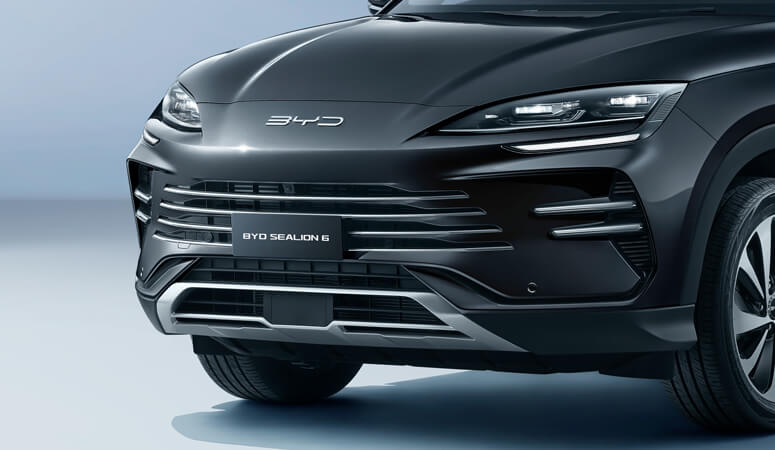

The BYD Sealion 6 DM-i plug-in hybrid has been spotted testing in India and is expected to launch in 2026 via CBU, with 126 km EV range and 1,200 km combined range.
BYD Sealion 6 Plug-In Hybrid Launch in India 2026: Expected Price and Specs
The BYD Sealion 6 DM-i is a plug-in hybrid electric vehicle (PHEV) — meaning it can be charged from an external power source and driven on battery power alone for meaningful distances, while also carrying a petrol engine to eliminate range anxiety. Test mules of the Sealion 6 PHEV have been spied testing on Indian public roads in September 2026, with prominent "BYD DM-i" and "Super Plug-In Hybrid" decals on the bodywork — making this BYD India's most concrete signal yet that the country's first BYD PHEV launch is imminent.
The Sealion 6 packs a 1.5L turbocharged petrol engine mated to an 18.3 kWh Blade Battery, offering a manufacturer-claimed pure electric range of 126 km and a combined range of 1,200 km on a full tank and full charge. No ARAI-certified figures are available for India yet; all range figures quoted here are manufacturer claims from international markets.
Before diving into the details, here is how the Sealion 6 PHEV stacks up against the most relevant hybrid SUVs available or incoming in India:
| Model | Hybrid Type | Engine | Battery | EV-Only Range (claimed) | Combined Range (claimed) | Approx. India Price |
|---|---|---|---|---|---|---|
| BYD Sealion 6 DM-i | Plug-In Hybrid (PHEV) | 1.5L Turbo Petrol | 18.3 kWh Blade | 126 km (NEDC) | 1,200 km | ~₹40–50 lakh (est., CBU) |
| Maruti Suzuki Grand Vitara (Strong Hybrid) | Strong Hybrid | 1.5L Atkinson Petrol | ~0.76 kWh (no plug) | ~1 km (EV creep only) | ~600–700 km (tank) | ₹19.0–20.5 lakh (ex-showroom) |
| Toyota Urban Cruiser Hyryder (Strong Hybrid) | Strong Hybrid | 1.5L Atkinson Petrol | ~0.76 kWh (no plug) | ~1 km (EV creep only) | ~600–700 km (tank) | ₹19.5–21.0 lakh (ex-showroom) |
| Honda City e:HEV | Strong Hybrid | 1.5L Atkinson Petrol | ~1.05 kWh (no plug) | ~2 km (EV creep only) | ~600 km (tank) | ₹20.0–21.5 lakh (ex-showroom) |
| MG Hector Tomahawk PHEV | Plug-In Hybrid (PHEV) | Petrol + Electric | Not confirmed for India | Not confirmed | Not confirmed | ₹25.70 lakh (launched Aug '26) |
Note: Grand Vitara, Hyryder, and City e:HEV ARAI fuel efficiency figures are 27.97 km/l, 27.97 km/l, and 26.5 km/l respectively — manufacturer claims. BYD Sealion 6 India ARAI figures are not yet available. Prices are ex-showroom estimates or confirmed launch prices as of September 2026.
What exactly is BYD's DM-i technology, and why does it matter for India?
BYD's DM-i (Dual Mode – intelligent) is a plug-in hybrid system that prioritises electric drive as the primary mode, using the petrol engine mainly as a range extender and generator — rather than the traditional approach of using the engine as the primary driver with electric assistance. This architecture differs fundamentally from the strong hybrids sold by Maruti Suzuki and Toyota in India, which cannot be plugged in and rely on a much smaller battery that recovers charge only through regenerative braking.
The DM-i system in the Sealion 6 pairs a 1.5L turbocharged petrol engine — which BYD claims achieves a thermal efficiency of 43.04%, described as the highest in the world for a mass-production petrol engine — with two electric motors (one starter motor, one traction motor) drawing power from an 18.3 kWh Blade Battery pack. The motors are rated at 97.5% efficiency according to BYD's specifications.
For an Indian buyer, the practical implications are significant. On a typical urban commute of under 60–80 km, the Sealion 6 could theoretically run entirely on electricity if charged overnight, with the petrol engine never firing up. For longer highway runs, the engine kicks in, and the combined system delivers a claimed 1,200 km of total range — enough to drive from Delhi to Mumbai on a single fuel fill, assuming the battery starts fully charged.
Autocar India reported in May 2026 that BYD's teaser explicitly confirmed the DM-i powertrain for India, and subsequently confirmed a debut date of June 9, 2026 for the company's first PHEV in the country. The September 2026 spy shots of the Sealion 6 with DM-i badging now confirm which model has been chosen.
What are the full specs of the BYD Sealion 6 DM-i?
The Sealion 6 is sold in international markets in multiple configurations. Based on the spy shots and BYD's global product pages, the variant most likely headed to India is the 1.5L turbo-petrol DM-i setup, which is the more performance-oriented and range-capable of the two available powertrains.
Powertrain (1.5L Turbo DM-i, as spied in India):
- Engine: 1.5L turbocharged petrol, 43.04% thermal efficiency (manufacturer claim)
- Battery: 18.3 kWh BYD Blade Battery (LFP chemistry)
- Pure electric range: 126 km (NEDC, manufacturer claim; real-world likely 90–100 km)
- Combined range: 1,200 km (manufacturer claim, full tank + full charge)
- Drive: AWD available on turbo variant (international spec)
- System output: up to 344 hp on the turbo AWD variant (Autocar India)
A naturally aspirated 1.5L version exists globally with FWD, 218 hp combined output, and up to 140 km electric range with the larger 26.6 kWh battery, according to Autocar India. Whether BYD India offers both variants or just one remains unconfirmed.
Dimensions:
- Length: 4,775 mm
- Width: 2,085 mm
- Height: 1,670 mm
- Wheelbase: 2,765 mm
These measurements place the Sealion 6 squarely in the mid-size SUV segment, slightly larger than the Hyundai Tucson and considerably bigger than the Maruti Grand Vitara or Toyota Hyryder. The long wheelbase of 2,765 mm should translate to generous rear legroom — a genuine selling point for Indian buyers who often prioritise rear passenger comfort.
Features expected for India (based on international spec):
- Rotating touchscreen infotainment system
- TFT instrument cluster
- Advanced ADAS suite
- NFC card key access
- Keyless entry and start
- Heated and ventilated front seats
- Panoramic sunroof with retractable shade
- Wireless Apple CarPlay and Android Auto
The BYD Kenya product page confirms the NFC key, panoramic sunroof, and wireless connectivity as standard on the Sealion 6 DM-i internationally. India-specific feature trimming will only be confirmed at launch.
How does the Sealion 6 compare to the Maruti Grand Vitara strong hybrid?
This comparison matters most for the Indian buyer trying to decide between hybrid options. The honest answer is that these two cars serve different needs and price points — but both target the environmentally conscious, fuel-efficiency-focused buyer.
The Maruti Suzuki Grand Vitara strong hybrid is a self-charging hybrid — it cannot be plugged in, and its battery (approximately 0.76 kWh) charges exclusively through regenerative braking and the engine. It can drive on battery power alone only at very low speeds and for very short distances (essentially EV creep in traffic). Its ARAI-certified fuel efficiency of 27.97 km/l is genuinely impressive and translates to real-world figures of around 20–22 km/l in mixed driving — making it one of the most fuel-efficient SUVs in India.
The Grand Vitara strong hybrid starts at approximately ₹19 lakh (ex-showroom), making it accessible to a far wider buyer base than the Sealion 6 PHEV, which will arrive via the CBU (completely built unit) import route and is expected to be priced in the ₹40–50 lakh range, based on BYD's existing CBU pricing strategy for models like the Sealion 7.
The Sealion 6 PHEV wins decisively in pure electric capability. A buyer who charges the Sealion 6 at home every night could cover their entire weekly urban commute without burning a drop of petrol — something the Grand Vitara simply cannot offer. For a buyer doing 40–50 km daily in a city with a home charger, the Sealion 6's running costs could be dramatically lower than even the fuel-efficient Grand Vitara.
The Grand Vitara's weaknesses are real: the strong hybrid system adds cost over the base petrol (the hybrid premium is roughly ₹2–3 lakh over the equivalent petrol variant), the boot space is reduced by the battery pack placement, and there is no plug-in capability. Its strengths — dealer network, service costs, and resale value — are equally real and should not be glossed over.
The Sealion 6's weaknesses are also significant: CBU pricing means high import duties inflate the cost, BYD India's service network remains limited compared to Maruti's 4,000+ touchpoints, and resale value for Chinese PHEVs in India is an unknown quantity. The battery's long-term health in India's climate and charging infrastructure gaps outside major cities are legitimate concerns.
How does the Sealion 6 PHEV compare to other PHEVs entering India?
India's PHEV market is at an inflection point in 2026. The MG Hector Tomahawk PHEV launched in August 2026 at ₹25.70 lakh, making it the most affordable PHEV SUV in the country at launch. The BYD Sealion 6, expected to be priced significantly higher due to its CBU import status and larger battery, will target a more premium buyer.
The Jetour T2 PHEV, expected to arrive under the JSW brand, has been cited as a direct rival to the Sealion 6 in the Indian market. Rushlane noted that the Sealion 6 PHEV will take on the JSW-branded Jetour T2 PHEV specifically.
Toyota's Innova Hycross strong hybrid deserves a mention as a premium hybrid alternative, though it is a strong hybrid MPV rather than a PHEV SUV. The Hycross strong hybrid is priced from approximately ₹24–30 lakh and offers ARAI-claimed efficiency of 21.1 km/l — impressive for a 7-seater, but with no plug-in capability. For buyers considering the Sealion 6 who need 7-seat capability, the Invicto strong hybrid from Maruti Suzuki (which shares its platform with the Hycross) is worth evaluating.
The Honda City e:HEV is a strong hybrid sedan — not an SUV — but it competes for the same hybrid-conscious buyer in the ₹20–22 lakh range. Like the Grand Vitara and Hyryder, it cannot be plugged in, and its EV-only capability is limited to low-speed creep.
What is the expected price of the BYD Sealion 6 PHEV in India?
No official price has been announced. A range of ₹40–50 lakh (ex-showroom) is a reasonable estimate based on these factors:
CBU import duty: India levies 100% customs duty on CBU imports for vehicles priced above $40,000. BYD's existing CBU models — the Seal sedan and Sealion 7 EV — are priced in the ₹41–53 lakh range. The Sealion 6 PHEV, being a newer and more complex powertrain, is unlikely to be cheaper.
International positioning: In markets like Kenya and Tanzania, the Sealion 6 DM-i is positioned as a premium offering above the Sealion 7 EV. BYD's international product pages confirm the Sealion 6 DM-i as a premium model within the Ocean series.
PHEV complexity: PHEVs globally command a premium over equivalent EVs or petrol models due to the dual powertrain complexity. The 18.3 kWh Blade Battery alone represents significant cost.
Market positioning: At ₹40–50 lakh, the Sealion 6 PHEV would sit above the MG Hector Tomahawk PHEV (₹25.70 lakh) and well above the Maruti Grand Vitara strong hybrid (₹19–20.5 lakh), targeting a buyer who is specifically seeking PHEV capability in a premium, well-equipped package.
If BYD eventually localises production in India — a possibility the company has discussed publicly — prices could fall meaningfully. For the 2026 launch, CBU pricing is confirmed.
When will the BYD Sealion 6 PHEV launch in India?
The timeline has been progressively narrowing. Autocar India confirmed in June 2026 that BYD's first PHEV for India would debut on June 9, 2026. The September 2026 spy shots of the Sealion 6 with full DM-i badging suggest that testing and homologation are ongoing, with a commercial launch likely before the end of 2026.
BYD India has not issued an official launch date for the Sealion 6 specifically. The June 9 debut may have been a show or reveal event, with the actual commercial launch and pricing announcement to follow. This is consistent with BYD's approach for the Sealion 7 in India, which was showcased at Auto Expo 2025 before its commercial launch.
The Sealion 6 was also showcased at Auto Expo 2025 to gauge buyer interest — a step BYD typically takes before committing to a market launch. The subsequent spy shots and teaser campaign confirm that interest was sufficient to proceed.
What does the Sealion 6 look like, and how practical is it?
The Sealion 6 belongs to BYD's Ocean series — the same design family as the Sealion 7 EV already on sale in India. However, Rushlane noted that the Sealion 6 has a more European aesthetic with sharp body creases and a more upright, traditional SUV silhouette compared to the sportier, more coupe-like Sealion 7. This makes the Sealion 6 more practical in terms of headroom and boot access.
The rotating touchscreen is a signature feature — a large display that can pivot between landscape and portrait orientations depending on the function in use. This is a feature BYD has deployed across several of its premium models globally and is likely to be a talking point in India.
One honest caveat on practicality: the 18.3 kWh Blade Battery pack in a PHEV occupies more space than the small battery in a strong hybrid. Boot space in PHEVs is typically reduced compared to equivalent petrol or strong hybrid models. BYD has not published India-specific boot volume figures, and this is a weakness buyers should verify at the time of launch.
Should you wait for the BYD Sealion 6 PHEV or buy a strong hybrid now?
This depends entirely on your use case, budget, and access to home charging.
The case for waiting for the Sealion 6 PHEV:
If you have a home charger or reliable access to charging infrastructure, the Sealion 6's 126 km electric range could make it nearly free to run on daily commutes. If you regularly drive 500+ km intercity, the 1,200 km combined range eliminates range anxiety completely. For buyers seeking a premium, feature-rich SUV with modern technology and comfortable with the ₹40–50 lakh price bracket, this vehicle makes sense.
The case for buying the Grand Vitara strong hybrid now:
At ₹19–20.5 lakh, the Grand Vitara strong hybrid delivers 27.97 km/l (ARAI) with zero charging infrastructure dependency. Maruti's 4,000+ service touchpoints across India mean maintenance is straightforward anywhere in the country. Resale value for Maruti hybrids is well-established; for BYD PHEVs in India, it remains an open question. If you don't have home charging, a PHEV's electric range advantage largely disappears — you'd be paying a large premium for a heavy car running primarily on petrol.
The Toyota Urban Cruiser Hyryder strong hybrid occupies the same space as the Grand Vitara and is worth considering alongside it — both share the same Toyota hybrid system and deliver identical ARAI efficiency figures.
For buyers in the ₹25–35 lakh range who want PHEV capability without the Sealion 6's premium, the MG Hector Tomahawk PHEV at ₹25.70 lakh is now a live option, though its specifications for the Indian market are still being detailed.
What is BYD's broader PHEV strategy for India?
BYD entering the PHEV space in India is strategically significant. The company has been exclusively an EV player in India since its entry, but globally, PHEVs — particularly DM-i models — account for a substantial portion of BYD's sales volume. In China, BYD's PHEV lineup outsells its pure EV lineup in several months.
Autocar India reported that the Atto 2 DM-i was also a contender for India's first BYD PHEV launch. The Atto 2 is dimensionally similar to the Hyundai Creta and would compete in a more affordable segment. Its 1.5L naturally aspirated PHEV setup offers up to 998 km combined range (WLTP) and 39 km electric-only range with the 18 kWh battery. The Atto 2 DM-i has not been ruled out for a subsequent India launch even if the Sealion 6 arrives first.
The Sealion 6's arrival also signals that India's PHEV market is maturing enough for premium players to commit serious investment. With the MG Hector Tomahawk PHEV already launched and the Jetour T2 PHEV incoming, 2026 is shaping up as the year PHEVs move from niche curiosity to genuine market segment in India.
For Indian buyers who have been waiting for a capable, long-range PHEV SUV with serious technology credentials, the BYD Sealion 6 DM-i represents the most compelling option announced so far — provided the final India price and specifications justify the premium over the strong hybrid alternatives that have already proven themselves in the market.
Sources
- Upcoming BYD Sealion 6 Plug-In Hybrid Spied Testing In India
- BYD Sealion 6 DM-i | Advanced Plug-in Hybrid SUV (BYD Kenya)
- BYD Sealion 6 DM-i | Advanced Plug-in Hybrid SUV (BYD Tanzania)
- BYD teases its first plug-in hybrid SUV for India
- First BYD plug-in hybrid for India to debut on June 9
- Best 7-Seater Hybrid MUV Under ₹30 Lakh (2026) — SmartHybridHub