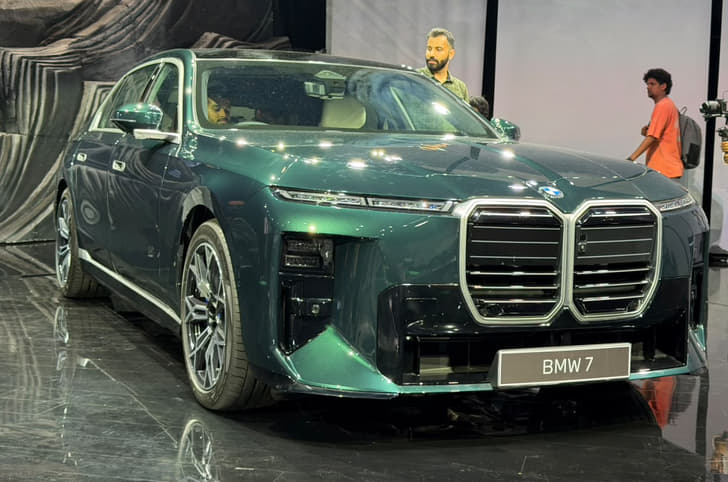

The 2026 BMW 7 Series 740 costs ₹1.95 crore and uses a 48V mild hybrid — engine-assist only, no EV mode — delivering 400hp, a 31.3-inch Theatre Screen, and 5.4-second 0–100kph, but no electric-only range unlike the rival Mercedes S-Class PHEV.
The 2026 BMW 7 Series 740 is priced at ₹1.95 crore (ex-showroom) and is equipped with a 48V mild-hybrid system — a technology defined as one where a small lithium-ion battery and belt-integrated starter-generator assist the combustion engine during acceleration and energy recovery, but cannot drive the car on electricity alone. That distinction matters enormously at this price point, especially when its only direct rival, the Mercedes-Benz S-Class, now comes exclusively with a plug-in hybrid powertrain in India.
Before diving into whether the 7 Series earns its asking price, here is how it stacks up against its flagship rivals and, for context, against Maruti Suzuki's mild-hybrid strategy at the affordable end of the market:
| Model | Hybrid Type | Engine | Power | 0–100kph | Boot Space | India Price (ex-showroom) | Key Weakness |
|---|---|---|---|---|---|---|---|
| BMW 7 Series 740 | Mild Hybrid (48V) | 3.0L 6-cyl turbo-petrol | 400hp / 540Nm | 5.4 sec | 540 litres | ₹1.95 crore | No EV-only mode; no ARAI mileage figure published |
| Mercedes-Benz S-Class S450e | Plug-In Hybrid (PHEV) | 3.0L 6-cyl turbo-petrol + 22kWh battery | 435hp / 680Nm | 5.7 sec | 345 litres | ₹2.20–2.38 crore | 195 litres less boot space; ₹25–43 lakh pricier |
| BMW i7 50 xDrive | Full Electric (BEV) | 112.5kWh dual-motor AWD | 449hp / 660Nm | 5.5 sec | — | ₹1.95 crore | Higher running costs if charging infrastructure is limited |
| Maruti Suzuki XL6 (Smart Hybrid) | Mild Hybrid (Smart Hybrid) | 1.5L NA petrol | ~103hp / 138Nm | ~12 sec (est.) | 209 litres (3rd row up) | ~₹12–15 lakh | Cannot drive on battery alone; modest efficiency gain of ~1–2kpl over non-hybrid |
The Maruti XL6 appears here not as a competitor to the 7 Series — it emphatically is not — but because it illustrates the same mild-hybrid technology deployed at opposite ends of the price spectrum, which is the central tension this article explores.
What exactly is a 48V mild hybrid, and how does it work in the 7 Series?
A mild hybrid is defined as a powertrain in which an electric motor-generator assists the combustion engine but cannot independently propel the vehicle. In the BMW 7 Series 740, this takes the form of a 48-volt belt-integrated starter-generator (BISG) that recovers kinetic energy under braking and stores it in a small lithium-ion battery. That stored energy is then deployed to provide a brief torque boost — BMW quotes an 18hp and 200Nm contribution from the mild-hybrid system — during acceleration, reducing the load on the combustion engine and marginally cutting fuel consumption.
The combustion engine itself is a 3.0-litre inline six-cylinder turbo-petrol unit. Combined system output is 400hp and 540Nm, routed to the rear wheels through an eight-speed torque-converter automatic gearbox. BMW claims a 0–100kph time of 5.4 seconds and a top speed of 250kph — impressive numbers for a car that weighs over two tonnes and stretches 5,395mm in length.
The 48V system does not allow the 7 Series to travel even a metre on electricity alone. There is no EV mode, no plug socket, and no meaningful electric-only range. The mild-hybrid assist is invisible to the driver; it simply makes the engine feel slightly more responsive at low revs and, in theory, reduces fuel consumption by a few percentage points compared to a non-hybrid version of the same engine. BMW has not published an ARAI-certified mileage figure for the India-spec 740, which makes it difficult to quantify the real-world benefit.
How does the 7 Series 48V mild hybrid compare with the Mercedes S-Class PHEV?
The most instructive comparison for a buyer at this price point is with the Mercedes-Benz S-Class S450e. The S-Class received its India facelift in June 2026 and, for the first time, comes exclusively with a plug-in hybrid powertrain. A plug-in hybrid combines a combustion engine with a large battery that can be charged from an external power source and can drive the car on electricity alone for a meaningful distance.
The S450e's 22kWh battery pack gives it a claimed electric-only range of approximately 115km — enough for most urban commutes in India's major cities without burning a drop of petrol. Mercedes claims a WLTP fuel-efficiency figure of 32.3kpl when the battery is charged, a number that makes the 7 Series's mild-hybrid efficiency gains look marginal by comparison. The S-Class also produces 435hp and 680Nm, making it more powerful than the 7 Series on paper, though the BMW is quicker to 100kph (5.4 seconds versus 5.7 seconds).
The trade-off is stark in the boot. The S-Class's 22kWh battery pack eats into luggage space, leaving just 345 litres — 195 litres less than the 7 Series's 540-litre boot. For a car whose rear seat is its primary selling point, that is a meaningful compromise. The S-Class is also priced at ₹2.20–2.38 crore, making it ₹25–43 lakh more expensive than the 7 Series.
The choice between the two comes down to this: if your chauffeur-driven lifestyle involves mostly urban driving and you can charge at home or at the office, the S-Class PHEV's running-cost advantage and electric-only capability may justify the premium and the smaller boot. If you value boot space, a slightly quicker 0–100kph time, and a lower sticker price, the 7 Series makes more sense — even if its mild-hybrid system is more of a marketing footnote than a genuine green credential.
What does the 7 Series facelift actually change over the outgoing model?
The 2026 update is a mid-lifecycle facelift, not a generation change. The exterior changes are meaningful but not dramatic: slimmer split LED headlights flank a squared-off illuminated kidney grille, the tail-lamps are longer and slimmer, and the rear bumper has been redesigned. New 20-inch wheels are standard on the 740. The overall silhouette — the long-wheelbase proportions, the monolithic flanks, the polarising kidney grille — remains unchanged.
The interior is where the facelift makes its biggest statement. BMW has introduced its Neue Klasse-inspired display architecture, comprising a pillar-to-pillar Panoramic Vision display, a 17.9-inch central touchscreen, and a 14.6-inch passenger-side display. The operating system has been updated to BMW OS X, which supports over-the-air updates, AI-powered voice controls, and Alexa integration. The rear cabin retains the 31.3-inch 8K Theatre Screen — a genuine showstopper — paired with a 35-speaker Bowers & Wilkins sound system and touch controls integrated into the rear doors.
Comfort equipment includes powered, heated, ventilated, and massaging seats front and rear, powered rear leg rests, four-zone climate control, a fixed panoramic glass roof, adaptive air suspension, rear-wheel steering, and Level 2 ADAS. For a single-variant, single-price car, the 7 Series 740 is extraordinarily well-equipped.
The diesel variant has been dropped for India with this update. The India-spec car is now offered solely as the petrol-powered 740, locally assembled at BMW's Chennai plant — a fact that helps keep the on-road price more competitive than a fully imported equivalent would be.
Is the 7 Series locally assembled, and does that affect the price?
Yes. BMW locally assembles the 7 Series at its Chennai facility, and India is one of the first markets outside Germany where the facelifted 740 is being assembled. Local assembly under the CKD (completely knocked down) route reduces import duties compared to a CBU (completely built unit) import, which is why the 7 Series can be priced at ₹1.95 crore ex-showroom while the on-road price in Delhi works out to approximately ₹2.08 crore.
This local assembly also makes BMW eligible for government incentives tied to domestic manufacturing. However, the 48V mild-hybrid system does not attract the same concessional GST rates that apply to strong hybrids (which are taxed at 12% GST in India, versus 28% plus cess for conventional petrol vehicles). Mild hybrids like the 7 Series 740 are taxed at the same rate as conventional petrol cars. This is a significant distinction: the tax advantage that makes strong hybrids like the Maruti Suzuki Grand Vitara or Toyota Urban Cruiser Hyryder more price-competitive in the mass market does not apply here.
How does the 7 Series's mild-hybrid strategy compare with Maruti Suzuki's approach?
Maruti Suzuki uses mild-hybrid technology — which it markets as Smart Hybrid — across several of its volume models, including the XL6 (1.5-litre petrol), the Fronx (1.0-litre turbo), and the Invicto (which is actually a strong hybrid, co-developed with Toyota). The Smart Hybrid system in models like the XL6 is defined as a mild-hybrid setup where a small lithium-ion battery and an integrated starter-generator assist the engine during acceleration and enable idle stop-start, but cannot drive the car on electricity alone.
In the XL6, this translates to an ARAI-claimed mileage of approximately 20.97kpl — a meaningful improvement over a non-hybrid equivalent, achieved at a price point of roughly ₹12–15 lakh. The efficiency gain is modest in absolute terms (perhaps 1–2kpl over a non-hybrid equivalent), but at ₹12–15 lakh, even a small fuel saving matters to the buyer. Maruti's Smart Hybrid strategy is explicitly about making a tangible difference to the total cost of ownership for a price-sensitive buyer.
BMW's 48V mild-hybrid strategy in the 7 Series serves a different purpose. At ₹1.95 crore, fuel economy is not a primary purchase consideration. The mild-hybrid system here is about refinement — smoother stop-start, imperceptibly better low-end torque, and a marginal reduction in CO2 emissions that helps BMW meet European fleet-average targets. The buyer of a 7 Series is not calculating payback periods on fuel savings. They are buying the Theatre Screen, the Bowers & Wilkins sound system, and the 5.4-second 0–100kph time.
The irony is that Maruti's affordable mild hybrids deliver more tangible real-world benefit to their buyers — in percentage terms — than BMW's luxury mild hybrid does to its buyers. A ₹1kpl improvement in mileage matters far more to someone spending ₹12 lakh on an XL6 than it does to someone spending ₹1.95 crore on a 7 Series. BMW's mild-hybrid system is a powertrain engineering choice; Maruti's is a value proposition.
For buyers who want genuine hybrid efficiency in the luxury segment, the Maruti Suzuki Invicto — which uses a strong hybrid system co-developed with Toyota and can drive on electricity alone at low speeds — represents a different philosophy entirely, even if it operates in a completely different vehicle category (MPV, priced around ₹25–30 lakh). A strong hybrid is defined as a system where the electric motor is powerful enough to propel the car independently at low speeds, with the combustion engine cutting in at higher loads. The Invicto's strong hybrid delivers ARAI-claimed mileage of around 23.24kpl, a figure the 7 Series's mild hybrid cannot approach.
What are the 7 Series's genuine strengths at ₹1.95 crore?
The 7 Series earns its price tag in several areas where the numbers are hard to argue with.
Performance stands out immediately. A 3.0-litre six-cylinder engine producing 400hp, a 0–100kph time of 5.4 seconds, and a 250kph top speed are genuinely impressive for a car of this size and weight. The eight-speed torque-converter gearbox is smooth and responsive, and the mild-hybrid system's torque-fill at low revs makes urban driving feel effortless.
The rear cabin is exceptional. Autocar India's review gives the 7 Series a 9/10 for interior space and comfort, noting that the rear seats offer recline, massage, heating, ventilation, and the Theatre Screen experience. The 31.3-inch 8K display, paired with the Bowers & Wilkins sound system, is a genuine differentiator in this segment.
Boot space is another concrete advantage over the S-Class: 540 litres versus 345 litres. For a chauffeur-driven executive who also needs to carry luggage, this matters.
Local assembly at Chennai keeps the price competitive. At ₹1.95 crore, the 7 Series is ₹25–43 lakh cheaper than the S-Class PHEV. The BMW i7 50 xDrive — a full battery-electric version of the same car — is also priced at ₹1.95 crore, which means buyers who want zero-emission capability can get it at the same price point without stepping up.
The 7 Series also scores a 9/10 overall from Autocar India, with the reviewer highlighting performance and the tech-laden cabin as its strongest suits.
What are the 7 Series's honest weaknesses?
The mild-hybrid system is the most significant one. At ₹1.95 crore, a buyer has every right to ask why the 7 Series does not offer a plug-in hybrid option, especially when the S-Class has moved entirely to PHEV. The 48V system provides no electric-only range, no meaningful fuel economy headline, and no ability to charge from the grid. In a world where luxury buyers are increasingly conscious of their carbon footprint — and where the S-Class can cover 115km on electricity alone — the 7 Series's mild-hybrid system feels like a minimum viable concession to electrification rather than a genuine commitment to it.
The exterior design remains polarising. Autocar India's review explicitly lists "polarising looks" as a weakness, and the squared-off illuminated grille — while attention-grabbing — is not universally admired. This is a subjective point, but it is worth noting for buyers who prioritise understated luxury.
The diesel variant has been dropped. For buyers who valued the 3.0-litre diesel's 286hp, 650Nm, and presumably better real-world fuel economy, there is no longer an option in India. The petrol-only lineup simplifies the choice but removes flexibility.
No ARAI mileage figure has been published for the India-spec 740. This makes it impossible to calculate a fuel-cost comparison or a payback period for the mild-hybrid system. Given that the mild-hybrid is part of the car's identity, the absence of a certified efficiency figure is a gap that buyers should press their dealers on.
Finally, the on-road price in Delhi is approximately ₹2.08 crore, which is meaningfully higher than the ex-showroom figure. Buyers should factor in registration costs, insurance, and any optional extras before comparing the headline price with the S-Class.
Should you consider the BMW i7 instead?
The BMW i7 50 xDrive is priced identically to the 740 at ₹1.95 crore (ex-showroom) and represents a different proposition. It is a full battery-electric vehicle with a 112.5kWh battery pack, dual-motor all-wheel drive, 449hp, and a claimed range of 728km (WLTP). It does 0–100kph in 5.5 seconds — just 0.1 seconds slower than the 740.
For a buyer who can charge at home or at the office, the i7 makes a compelling case. The running costs of an EV are significantly lower than a petrol car, and the i7's electric powertrain is whisper-quiet — more appropriate for a luxury limousine than a six-cylinder petrol engine, however refined. The i7 also qualifies for lower registration costs in states like Delhi and Maharashtra that offer road-tax concessions on EVs (buyers should verify current state-specific incentives with their dealer, as these policies change).
The i7's weakness is charging infrastructure anxiety on long highway runs, though a claimed 728km range mitigates this considerably. The i7 M70, the top-spec variant, is priced at ₹2.65 crore and produces 671hp and 1,100Nm — figures that belong in supercar territory.
For buyers who want the 7 Series experience but are genuinely concerned about fuel costs and emissions, the i7 is the more honest choice than the 740's mild-hybrid system. The 740's 48V system is not a green powertrain; it is a performance-enhancement tool that happens to recover some energy under braking.
The verdict: does the mild hybrid justify the price?
The 2026 BMW 7 Series 740 at ₹1.95 crore justifies its price — but not because of the mild-hybrid system. It justifies the price because of the 31.3-inch Theatre Screen, the Bowers & Wilkins audio, the 540-litre boot, the 5.4-second 0–100kph time, the adaptive air suspension, the rear-wheel steering, and the sheer breadth of comfort and technology packed into a single variant. These are the reasons to buy a 7 Series.
The 48V mild-hybrid system is best understood as a powertrain refinement tool, not an efficiency or green-credentials argument. It makes the engine smoother and the stop-start system less intrusive. It does not make the 7 Series a hybrid in any meaningful consumer sense of the word. If you are buying a 7 Series because you want hybrid efficiency, the S-Class PHEV — at ₹2.20 crore — is the more honest choice, even if it costs more and offers a smaller boot. If you want zero-emission luxury at the same price, the i7 50 xDrive at ₹1.95 crore is the better answer.
The contrast with Maruti Suzuki's mild-hybrid strategy is instructive precisely because it reveals what mild-hybrid technology can and cannot do. In the XL6 or the Fronx, Maruti's Smart Hybrid system delivers a real, measurable benefit to buyers who count every rupee of fuel spending. In the 7 Series, the same category of technology serves a different master: refinement, torque-fill, and regulatory compliance. Neither application is dishonest — they are just answering different questions for different buyers.
For a buyer spending ₹1.95 crore, the 7 Series 740 is an excellent luxury limousine. The mild hybrid is a feature, not a reason. Buy it for the Theatre Screen and the six-cylinder soundtrack. Just don't buy it expecting the efficiency of a strong hybrid — for that, you would need to look at something like the Maruti Suzuki Grand Vitara strong hybrid or the Toyota Urban Cruiser Hyryder, both of which can genuinely drive on electricity alone at low speeds, at a fraction of the price.
Prices quoted are ex-showroom unless stated otherwise. On-road price in Delhi for the 740 M Sport is approximately ₹2.08 crore as of September 2026. ARAI mileage figure for the India-spec 740 has not been published at the time of writing; the WLTP figure for the S-Class PHEV is a manufacturer claim. Buyers should verify current state-specific EV road-tax concessions independently.
Sources
- 2026 BMW 7 Series facelift image gallery | Autocar India
- BMW 7 Series (2026) – Price, Mileage & Expert Reviews | Autocar India
- 2026 Mercedes S-Class vs BMW 7 Series: Specs, price compared | Autocar India
- BMW India launches its latest flagship sedans, priced from ₹1.95 crore | Evo India
- 2026 BMW 7 Series unveiled with updated design, Neue Klasse tech and multiple powertrain options | Evo India
- BMW India – Official Site
- Best Hybrid MPVs in India (2026): Every Strong and Mild Hybrid on Sale | SmartHybridHub
- Best Hybrid SUV Under ₹20 Lakh With ADAS (2026) | SmartHybridHub