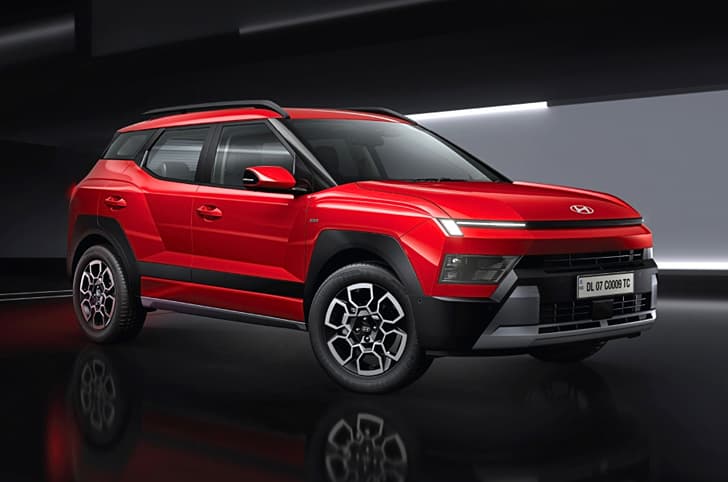

The Bayon (from ₹9.99 lakh) leads on tech and ADAS but has no hybrid; the Grand Vitara, Hyryder and Victoris all offer strong hybrids with significantly better real-world fuel economy.
The Hyundai Bayon, launched on 26 October 2026 at ₹9.99 lakh (ex-showroom), is a petrol-only compact SUV at launch — a deliberate contrast to the Maruti Suzuki Grand Vitara strong hybrid, Toyota Urban Cruiser Hyryder strong hybrid and Maruti Suzuki Victoris strong hybrid, all of which can drive on electric power alone at low loads and deliver fuel efficiency figures that the Bayon's conventional engine simply cannot match.
This comparison covers all four models across price, powertrain type, fuel efficiency, dimensions, features and the honest trade-offs that buyers need to weigh before signing a booking form.
| Model | Starting Price (ex-showroom) | Top Price (ex-showroom) | Hybrid Type | Engine Output | ARAI Mileage (best variant) | Boot Space |
|---|---|---|---|---|---|---|
| Hyundai Bayon | ₹9.99 lakh | ₹18.15 lakh | None (petrol only at launch) | 115 PS / 143.8 Nm | 18.6 km/l (iVT) | 505 litres |
| Maruti Suzuki Grand Vitara | ₹10.77 lakh | ₹19.77 lakh | Strong hybrid (e-CVT) + petrol + CNG | 103 PS petrol / 116 PS combined (hybrid) | 27.97 km/l (strong hybrid, ARAI) | ~373 litres (hybrid; battery intrudes) |
| Toyota Urban Cruiser Hyryder | ₹10.94 lakh | ₹20.19 lakh | Strong hybrid (e-CVT) + petrol + CNG | 103 PS petrol / 116 PS combined (hybrid) | 27.97 km/l (strong hybrid, ARAI) | ~373 litres (hybrid) |
| Maruti Suzuki Victoris | ₹10.49 lakh | ₹20.21 lakh | Strong hybrid (e-CVT) + petrol + S-CNG | 103 PS petrol / 116 PS combined (hybrid) | ~27.97 km/l (strong hybrid, ARAI) | Larger than Grand Vitara hybrid (underbody CNG tank preserves boot) |
All prices ex-showroom India, indicative as of October 2026. ARAI figures are manufacturer claims; real-world mileage for strong hybrids in city conditions typically ranges 18–22 km/l depending on traffic and driving style.
What exactly is the Hyundai Bayon, and where does it sit in the market?
The Hyundai Bayon is a mid-size SUV positioned between the Venue and Creta in Hyundai's India portfolio, measuring 4,245 mm in length, 1,810 mm in width and 1,605 mm in height (with roof rails), with a 2,600 mm wheelbase. That makes it a genuine above-four-metre SUV, competing directly with the Grand Vitara, Hyryder and Victoris on footprint.
Hyundai's two-model strategy mirrors Maruti's approach: the Victoris and Grand Vitara occupy different price and powertrain positions in the same segment. The Bayon serves buyers who want a feature-rich, tech-forward petrol SUV at a lower entry price, while the Creta (which is expected to get a hybrid option in its next generation due in 2027) holds the premium slot. Autocar India notes that Hyundai deliberately kept turbo-petrol and diesel engines out of the Bayon to prioritise value and urban efficiency.
The critical gap in the Bayon's launch line-up is the absence of any hybrid powertrain. A factory-fitted CNG variant is expected in January 2027, which would make it Hyundai's first CNG SUV above four metres — a meaningful milestone, but still not a hybrid.
What are the powertrain options in each car, and which hybrid type do they use?
This is the most consequential difference in this comparison.
Hyundai Bayon runs a single 1.5-litre four-cylinder naturally aspirated petrol engine producing 115 PS and 143.8 Nm, paired with either a 6-speed manual or an Intelligent Variable Transmission (iVT, which is a CVT). It is a conventional petrol SUV — no mild-hybrid assist, no strong hybrid, no plug-in capability. Hyundai's official launch material confirms the ARAI mileage at 18.6 km/l for the iVT variant; the manual figure had not been published at launch.
Maruti Suzuki Grand Vitara comes in three distinct powertrain configurations: a 1.5-litre petrol (103 PS, 139 Nm) with 6-speed manual or 6-speed automatic, a 1.5-litre strong hybrid (116 PS combined system output) with e-CVT, and a CNG variant with manual gearbox. A strong hybrid is defined as a system where the electric motor can propel the vehicle independently at low speeds and under light loads, without the petrol engine running — meaningfully different from a mild hybrid, which only assists the engine and cannot drive the car on electricity alone. The Grand Vitara's strong hybrid carries an ARAI claim of 27.97 km/l, though real-world figures in mixed city-highway driving typically land between 18 and 22 km/l. The AWD variant pairs the conventional petrol engine with a 6-speed automatic and is available on select trims. One honest weakness: the hybrid battery pack is housed in the boot, reducing cargo space to approximately 373 litres — noticeably less than the Bayon's 505 litres.
Toyota Urban Cruiser Hyryder shares its platform, powertrain and hybrid system with the Grand Vitara under the Suzuki-Toyota alliance. It offers the same 1.5-litre petrol (103 PS, 136.8 Nm), the same strong hybrid (116 PS combined, 27.97 km/l ARAI), CNG and AWD configurations. The Hyryder's strong hybrid is mechanically identical to the Grand Vitara's — the differences between the two cars are primarily in styling, features and brand preference. Boot space in the hybrid variant carries the same penalty as the Grand Vitara.
Maruti Suzuki Victoris presents the broadest powertrain menu in this group: 1.5-litre petrol (103 PS, 139 Nm) with manual or 6-speed automatic, strong hybrid (116 PS combined) with e-CVT, S-CNG with manual, and AllGrip AWD on select automatic petrol variants. The Victoris's strong hybrid uses the same Toyota-sourced system as the Grand Vitara. Where the Victoris has a practical edge over the Grand Vitara hybrid is its CNG tank placement: the Victoris uses an underbody-mounted CNG tank, preserving boot space, whereas the Grand Vitara's CNG tank sits in the boot. The Victoris's strong hybrid battery is also in the boot, so the boot-space penalty applies to the hybrid variant here too — but the CNG variant at least keeps a full-size boot.
For buyers whose primary concern is running costs, the strong-hybrid variants of the Grand Vitara, Hyryder and Victoris are in a different league from the Bayon. At 27.97 km/l (ARAI) versus 18.6 km/l (ARAI), the gap is substantial — though both figures are manufacturer claims, and real-world conditions will narrow the difference somewhat. If you're covering 1,500 km a month in city traffic, the strong hybrid's ability to run on the electric motor at low speeds is where the efficiency advantage is most pronounced. On highways, the gap shrinks considerably because the petrol engine runs more continuously.
How do the prices compare, and what does each rupee buy you?
The Bayon's ₹9.99 lakh entry price is the lowest in this group, but that base variant is a manual-gearbox petrol with a relatively sparse feature set. GaadiWaadi's comparison rightly flags that comparing starting prices is misleading — the automatic gearbox, hybrid system and premium features you actually want are all in higher variants.
A more useful comparison is at the variant level where features converge:
- The Grand Vitara strong hybrid starts at roughly ₹16–17 lakh (ex-showroom) depending on trim, representing a meaningful premium over a comparable petrol Grand Vitara variant.
- The Hyryder strong hybrid is priced similarly to the Grand Vitara hybrid, typically within ₹20,000–₹40,000 of each other at equivalent trims.
- The Victoris strong hybrid occupies a similar price band, with its top-end variant reaching ₹20.21 lakh.
- The Bayon's top variant at ₹18.15 lakh is a petrol iVT with the full ADAS and feature suite.
The Bayon's price premium over its own base variant is therefore driven by features, not powertrain technology. The Grand Vitara and Hyryder's price premium over their petrol siblings is driven by the hybrid system itself — and that system pays back over time through fuel savings. Whether the payback period makes financial sense depends on your annual mileage; for buyers covering fewer than 10,000 km a year, the strong hybrid's premium is harder to justify purely on economics.
If you're interested in how the strong hybrid pricing stacks up against other options in the segment, our guide to cheapest strong hybrid SUVs in India has a detailed breakdown. For buyers who also want AWD alongside hybrid capability, AWD and hybrid SUVs under ₹20 lakh covers the Grand Vitara and Hyryder AWD variants in detail.
What features does the Bayon offer, and how does it compare to the hybrid trio?
The Bayon's technology package is its strongest argument. Hyundai's official launch document confirms:
- Dual 12.3-inch curved panoramic displays (instrument cluster + touchscreen), powered by an NVIDIA-accelerated Connected Car Navigation Cockpit
- HMIL's first-ever Generative AI Voice Assistant, featuring Intelligence by Perplexity and Voice AI powered by SoundHound AI
- Hyundai SmartSense Level 2 Pro ADAS with 23 advanced driver assistance features, including Highway Driving Intelligence
- Over 70 Hyundai Bluelink connected features
- Up to 19 controllers for Over-the-Air (C-OTA) updates
- Bose Premium Sound system
- 360-degree camera
- Panoramic sunroof
- Ventilated front seats
- Powered driver's seat
- 6 airbags standard across all variants
- 69% Advanced Multi-Grade High-Strength Steel body structure, engineered for 5-Star Indian Safety Standards
The ADAS suite is a genuine differentiator. Among the four cars here, the Bayon and Victoris offer Level 2 ADAS on selected variants; the Grand Vitara and Hyryder do not offer an ADAS suite at all. If highway safety technology matters to you, the Bayon and Victoris have a clear advantage over the Grand Vitara and Hyryder in this respect.
The Grand Vitara's feature highlights include a panoramic sunroof, ventilated front seats, a head-up display, a 360-degree camera and wireless smartphone connectivity. Its head-up display is a feature the Bayon does not offer. The Hyryder's equipment list is broadly similar to the Grand Vitara's, with a panoramic sunroof, ventilated seats and connected-car technology.
The Victoris stands out with a 10.25-inch digital instrument cluster, panoramic sunroof, powered tailgate, Infinity audio system, ambient lighting and Level 2 ADAS on selected variants. Its underbody CNG tank is a practical engineering decision that preserves boot space on CNG variants — a meaningful advantage over the Grand Vitara's in-boot CNG arrangement.
In summary: the Bayon leads on AI-driven connectivity, ADAS sophistication and screen technology. The Grand Vitara leads on head-up display and hybrid efficiency. The Victoris offers the broadest powertrain menu with ADAS. The Hyryder sits between the Grand Vitara and Victoris on features, with the same hybrid credentials.
What are the dimensions and practicality differences?
The Bayon is a five-seat SUV with a 505-litre boot — the largest boot in this comparison for a non-hybrid variant. Its 205 mm of ground clearance and 43-litre fuel tank are competitive for the segment.
The Grand Vitara and Hyryder hybrid variants carry a boot-space penalty of roughly 130 litres compared with their petrol siblings, because the hybrid battery pack occupies boot floor space. This brings the hybrid boot down to approximately 373 litres — functional, but noticeably smaller than the Bayon's 505 litres. If you regularly carry luggage for a family of four or five, this is a real-world compromise worth factoring in.
The Victoris's strong hybrid has the same boot-space constraint as the Grand Vitara hybrid. However, the Victoris's underbody CNG tank means the CNG variant retains a full-size boot — a practical advantage if CNG is your preferred fuel.
On wheelbase, all four cars are broadly comparable, ranging from 2,600 mm (Bayon) to approximately 2,600 mm for the Grand Vitara, Hyryder and Victoris. Rear legroom and cabin width are therefore similar across the group.
Is there an AWD option, and which cars offer it?
The Bayon does not offer AWD at launch. It is front-wheel drive only, with both the manual and iVT variants.
The Grand Vitara and Hyryder both offer AWD on select petrol automatic variants — not on the strong hybrid. The Victoris offers Maruti's AllGrip AWD system on select petrol automatic variants. If AWD is a priority alongside hybrid efficiency, none of these cars currently combines both in a single variant; you have to choose between AWD (petrol) or strong hybrid (FWD). Our guide to AWD and hybrid SUVs under ₹20 lakh explores this trade-off in detail.
What about CNG options across these four cars?
CNG is available on the Grand Vitara, Hyryder and Victoris at launch. The Bayon's CNG variant is expected in January 2027, which would make it Hyundai's first factory-fitted CNG SUV above four metres in length, as India Today reported ahead of the launch.
The Victoris's underbody CNG tank is worth highlighting: it preserves boot space, which is a practical advantage over the Grand Vitara's in-boot CNG cylinder. If the Bayon follows a similar underbody tank approach (as Autocar India suggested ahead of launch), it could match the Victoris's practicality advantage on CNG variants.
CNG running costs are lower than petrol but higher than strong hybrid in city traffic, where the hybrid's electric motor does most of the work at low speeds. On highways, CNG and petrol costs converge, and the strong hybrid's advantage narrows.
Which car should you choose based on your priorities?
There is no single right answer here, because these four cars serve genuinely different buyer profiles.
Choose the Hyundai Bayon if: you want the most advanced cabin technology in the segment — generative AI voice assistant, dual 12.3-inch screens, Level 2 Pro ADAS with 23 features, OTA updates — and you're comfortable with a conventional petrol powertrain. The 505-litre boot and 18.6 km/l ARAI mileage are competitive for a naturally aspirated petrol SUV. The ₹9.99 lakh entry price is the lowest here, though the variant with the full feature set costs considerably more. The absence of a hybrid is a genuine gap if fuel efficiency is your primary concern.
Choose the Maruti Suzuki Grand Vitara strong hybrid if: fuel efficiency and long-term running costs are the priority, and you can live with a smaller boot (approximately 373 litres in the hybrid variant). The 27.97 km/l ARAI claim (manufacturer figure) and the ability to run on electric power alone in city traffic make it the most efficient petrol-powered option in this group. The lack of an ADAS suite is a weakness compared with the Bayon and Victoris. The head-up display is a feature the Grand Vitara offers that the Bayon does not.
Choose the Toyota Urban Cruiser Hyryder strong hybrid if: you prefer Toyota's after-sales network and brand positioning over Maruti's, but want the same strong-hybrid technology. The Hyryder and Grand Vitara are mechanically near-identical in hybrid form; the choice between them often comes down to dealer proximity, colour preferences and marginal feature differences.
Choose the Maruti Suzuki Victoris strong hybrid if: you want the broadest powertrain menu — strong hybrid, petrol, CNG and AWD all in one model family — plus Level 2 ADAS and a powered tailgate. The Victoris's underbody CNG tank is a practical engineering advantage. Its strong hybrid delivers the same efficiency credentials as the Grand Vitara hybrid. The Victoris's top-end price of ₹20.21 lakh makes it the most expensive option in this comparison at the top of the range.
For buyers who are still deciding whether a strong hybrid makes financial sense for their usage pattern, our guide on the best first hybrid car to buy on a budget in India walks through the mileage and payback calculation in detail.
What are the key weaknesses of each car that buyers often overlook?
Honest buying decisions require acknowledging the downsides.
Hyundai Bayon: No hybrid option at launch. The 18.6 km/l ARAI figure (iVT) is a manufacturer claim; real-world mileage for naturally aspirated petrol CVTs in city traffic is typically 12–14 km/l. No AWD option. CNG not available until January 2027. The top variant at ₹18.15 lakh is priced close to the strong-hybrid variants of its rivals, without the efficiency advantage.
Maruti Suzuki Grand Vitara strong hybrid: Boot space drops to approximately 373 litres in the hybrid variant — the battery pack sits in the boot floor. No ADAS suite. The strong-hybrid premium over the petrol Grand Vitara is significant; buyers covering fewer than 12,000–15,000 km a year may not recover the premium through fuel savings within a typical ownership cycle. The 27.97 km/l ARAI figure is a manufacturer claim; real-world city mileage is typically 18–22 km/l, and highway mileage is closer to 20–23 km/l.
Toyota Urban Cruiser Hyryder strong hybrid: Same boot-space penalty as the Grand Vitara hybrid. No ADAS. Priced slightly higher than the Grand Vitara at equivalent trims. The choice between Hyryder and Grand Vitara is genuinely marginal for most buyers.
Maruti Suzuki Victoris strong hybrid: Boot space in the hybrid variant carries the same penalty as the Grand Vitara hybrid. The Victoris is the most expensive car in this comparison at the top of the range (₹20.21 lakh). Its 10.25-inch instrument cluster is smaller than the Bayon's 12.3-inch unit. The Infinity audio system is competitive but not at the level of the Bayon's Bose system.
What is the verdict on hybrid type labelling in this segment?
A note on terminology that matters for buyers: aggregator portals occasionally mislabel these cars. To be precise about hybrid types in this comparison:
- The Grand Vitara strong hybrid, Hyryder strong hybrid and Victoris strong hybrid are all strong hybrids — a strong hybrid is defined as a system where the electric motor can drive the vehicle independently at low speeds without the petrol engine running, and the hybrid battery is recharged through regenerative braking and the engine, not from an external plug.
- None of these cars is a plug-in hybrid (PHEV), which is defined as a hybrid that can charge its battery from an external power source and typically offers a longer electric-only range.
- The Bayon is not a hybrid of any type at launch. Maruti's Smart Hybrid system, found on models like the XL6 petrol and Fronx 1.0 turbo, is a mild hybrid — a mild hybrid is defined as a system where the electric motor assists the engine under acceleration and recovers energy under braking, but cannot drive the car on electricity alone. None of the four cars in this comparison uses a mild hybrid system; the Grand Vitara, Hyryder and Victoris use full strong-hybrid systems, not mild hybrids.
This distinction matters because the fuel efficiency gap between a strong hybrid and a mild hybrid is substantial — typically 8–12 km/l in city conditions. Buyers comparing the Grand Vitara or Victoris strong hybrid against a mild-hybrid alternative should not expect equivalent efficiency from the mild-hybrid car.
Final summary: the numbers that matter
The Hyundai Bayon enters a segment where the technology bar has been raised by the Grand Vitara, Hyryder and Victoris, but it raises the bar further on cabin connectivity and ADAS. Its 115 PS engine is the most powerful conventional petrol unit here, its 505-litre boot is the largest, and its dual 12.3-inch screens and generative AI voice assistant are genuinely new to the segment.
What it cannot offer — at least at launch — is the strong hybrid's ability to run on electric power in city traffic, delivering 27.97 km/l (ARAI) versus the Bayon's 18.6 km/l (ARAI). For buyers who cover significant city kilometres, that gap translates into meaningful monthly savings. For buyers who prioritise technology, safety features and a lower entry price, the Bayon is a compelling proposition.
Compare variants at the same price point rather than entry prices. At ₹16–18 lakh, you are choosing between the Bayon's technology suite and the Grand Vitara or Victoris strong hybrid's efficiency credentials. That is the real decision this comparison comes down to.
Sources
- Hyundai Motor India launches Hyundai BAYON at INR 9,99,900 — Official Press Release
- What to expect from Hyundai Bayon ahead of October 26 launch? — Autocar India
- Hyundai Bayon Specifications — Autocar India
- Hyundai Bayon likely to become brand's first CNG SUV above four metres — India Today
- Hyundai Bayon vs Grand Vitara vs Hyryder vs Victoris – Specs Comparison — GaadiWaadi
- Maruti Suzuki Grand Vitara — Official Product Page
- Toyota Urban Cruiser Hyryder — Official Product Page
- Maruti Suzuki Victoris — Official Product Page