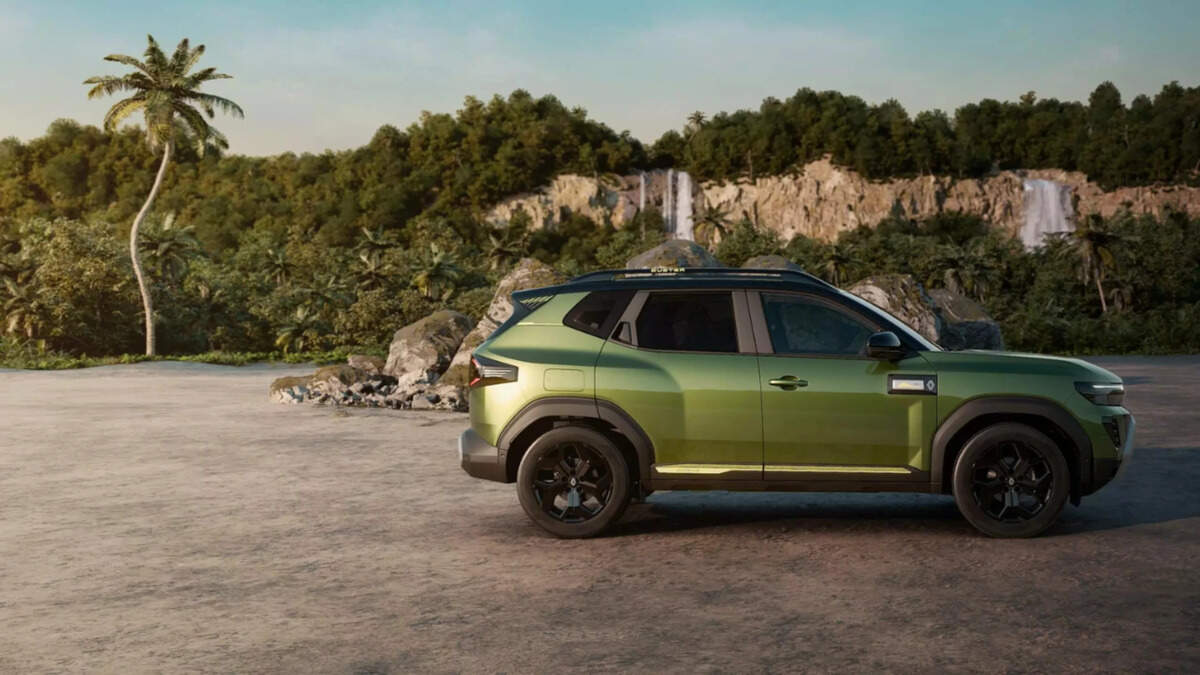

Renault Duster E-Tech strong hybrid launches October 17, 2026 at an expected price above ₹19 lakh, claiming 29 km/l ARAI — higher than the Grand Vitara strong hybrid's 27.97 km/l.
The Renault Duster E-Tech strong hybrid launches in India on October 17, 2026, claiming an ARAI-certified fuel efficiency of 29 km/l — the highest figure declared by any mid-size SUV hybrid in the segment at the time of writing.
Bookings opened on October 9, 2026, at a token amount of ₹21,000 through Renault India's website and authorised dealerships. Pricing has not been officially announced; industry observers expect the hybrid to be priced upwards of ₹19 lakh (ex-showroom), which would make it the top-of-range variant in the Duster line-up.
Before diving into the technical details and segment comparison, here is how the Duster hybrid stacks up against its two most direct rivals at a glance:
| Feature | Renault Duster E-Tech (Strong Hybrid) | Maruti Suzuki Grand Vitara (Strong Hybrid) | Toyota Urban Cruiser Hyryder (Strong Hybrid) |
|---|---|---|---|
| Hybrid type | Strong hybrid (no external charging) | Strong hybrid (no external charging) | Strong hybrid (no external charging) |
| Engine | 1,789cc NA petrol + 2 electric motors | 1,490cc NA petrol + electric motor | 1,490cc NA petrol + electric motor |
| Combined power | 160 hp / 172 Nm | ~116 hp system output | ~116 hp system output |
| ARAI mileage (manufacturer claim) | 29 km/l | 27.97 km/l | 27.97 km/l |
| Transmission | Multi-mode automatic | e-CVT | e-CVT |
| Battery | 1.4 kWh | ~0.76 kWh (NiMH) | ~0.76 kWh (NiMH) |
| Expected price (ex-showroom) | ₹19 lakh+ (TBC at launch) | ₹19.99–21.45 lakh | ₹19.99–21.45 lakh |
| Boot space | 518 litres (1.3T variant; hybrid TBC) | 373 litres | 373 litres |
| Key weakness | Pricing unconfirmed; no diesel option | Smaller boot than Duster; higher price premium over petrol | Smaller boot than Duster; higher price premium over petrol |
ARAI figures are manufacturer claims. Real-world mileage will vary. Grand Vitara and Hyryder prices are indicative based on current on-road data.
What exactly is the Renault Duster E-Tech hybrid, and how does it work?
A strong hybrid is defined as a powertrain in which the vehicle can propel itself on electric power alone — without the petrol engine running — under suitable conditions such as low-speed city driving or light acceleration. The Renault Duster E-Tech is classified as a strong hybrid by this definition, and Renault confirms it carries no external charging port. The battery is replenished entirely through the petrol engine and regenerative braking while the car is in motion.
The system architecture uses a 1,789cc four-cylinder naturally aspirated petrol engine at its core, as described by Renault and confirmed by Motorbeam. Two electric motors are integrated into the drivetrain: one is a 20 hp generator, and the second — producing 49 hp — drives the wheels. Combined system output is rated at 160 hp and 172 Nm. A 1.4 kWh lithium-ion battery pack stores electrical energy.
Renault calls the transmission a "multi-mode automatic," which uses multiple fixed gear ratios to manage the interaction between the petrol engine and the electric motors. This represents a meaningful technical distinction: the Toyota Urban Cruiser Hyryder, Maruti Suzuki Grand Vitara and Maruti Suzuki Victoris all use an e-CVT-based hybrid system, which operates on a different principle. Renault's fixed-ratio approach is derived from its Formula 1 hybrid experience and is also used in the Renault Clio E-Tech and Captur E-Tech in European markets.
Depending on driving conditions, the Duster E-Tech can operate in three modes: pure electric, petrol-only, or a combination of both. Renault claims that up to 80 percent of typical city driving can be completed in electric mode — a figure that, if borne out in real-world use, would represent a meaningful reduction in urban fuel consumption. That said, the 80 percent figure is a manufacturer claim under specific test conditions and will vary with traffic density, battery state of charge, air-conditioning load, and driving style.
What is the Duster hybrid's claimed mileage, and what can buyers realistically expect?
The ARAI-certified fuel efficiency figure for the Duster E-Tech is 29 km/l, as announced by Renault ahead of the October 17 launch. ARAI testing is defined as a standardised laboratory cycle that does not replicate real-world driving conditions — it provides a consistent benchmark for comparison between vehicles, not a guarantee of on-road economy.
For context, Autocar India's real-world test of the Duster 1.3 DCT (the existing turbo-petrol automatic) returned 9.97 km/l against an ARAI claim of 18.45 km/l — a gap of roughly 46 percent. Strong hybrids typically fare better in real-world versus ARAI comparisons than conventional petrols, because the ARAI cycle's low-speed, stop-start character suits hybrid operation. However, buyers should treat the 29 km/l figure as a ceiling rather than an everyday expectation.
A realistic real-world estimate for the Duster E-Tech in mixed city-highway Indian driving would be somewhere in the 18–22 km/l range, based on how comparable strong hybrids like the Grand Vitara and Hyryder perform in independent tests. No independent real-world test of the Duster hybrid has been published at the time of writing.
The existing Duster petrol variants, for reference, return 19.41 km/l (1.0T manual) and 17.75–18.45 km/l (1.3T manual/DCT) on the ARAI cycle. The hybrid's 29 km/l claim therefore represents a roughly 57–63 percent improvement over the 1.3T DCT on paper — a gap that will narrow considerably in real-world use but should still be substantial, particularly in city traffic where the electric motor does most of the work.
How does the Duster hybrid compare to the Maruti Suzuki Grand Vitara strong hybrid?
The Maruti Suzuki Grand Vitara strong hybrid is currently the segment benchmark for electrified mid-size SUVs in India, and the Duster E-Tech is its most direct new challenger. Both are strong hybrids — defined as systems capable of driving on electric power alone without external charging — but they take different engineering approaches.
The Grand Vitara strong hybrid uses a Toyota-sourced 1,490cc naturally aspirated petrol engine paired with an electric motor and a nickel-metal hydride (NiMH) battery pack. The e-CVT transmission provides smooth power delivery but limits the system's peak output to around 116 hp. Its ARAI-certified mileage is 27.97 km/l — a figure that has been independently tested by multiple outlets and typically returns 18–20 km/l in real-world mixed driving.
The Duster E-Tech counters with a larger 1,789cc engine, higher combined output (160 hp versus ~116 hp), a lithium-ion battery (versus NiMH in the Grand Vitara), and a higher ARAI claim of 29 km/l. On paper, the Duster offers more power and better claimed efficiency simultaneously — a combination that is possible because the multi-mode fixed-ratio transmission allows the electric motor to contribute more aggressively at higher speeds than a traditional e-CVT.
The Grand Vitara strong hybrid benefits from an established track record. It has been on sale in India since late 2022, has accumulated real-world ownership data, and benefits from Maruti Suzuki's service network — the largest in the country. The Duster hybrid is brand new, and Renault's service network, while improved, remains smaller than Maruti's.
Boot space is another area where the Duster has a structural advantage. The existing 1.3T Duster offers 518 litres of boot space. The Grand Vitara strong hybrid's boot is 373 litres — the hybrid battery pack occupies space that the petrol variant uses for luggage. Renault has not confirmed the Duster hybrid's boot volume at the time of writing, and it is possible the 1.4 kWh battery will reduce the figure from the 518-litre baseline. This is a genuine unknown that buyers should clarify at the dealership.
The price premium of the Grand Vitara strong hybrid over its petrol variants is significant: the strong hybrid starts at approximately ₹19.99 lakh (ex-showroom) versus ₹10.99 lakh for the base petrol, a gap of roughly ₹9 lakh. The Duster hybrid is expected to be priced above ₹19 lakh, which would place it at a similar or slightly lower premium over the Duster's base petrol (₹10.49 lakh). Exact figures will only be known after the October 17 launch.
How does the Duster hybrid compare to the Toyota Urban Cruiser Hyryder strong hybrid?
The Toyota Urban Cruiser Hyryder strong hybrid shares its powertrain architecture with the Grand Vitara — both use the Toyota THS II (Toyota Hybrid System II) with a 1,490cc petrol engine, e-CVT, and NiMH battery. The Hyryder strong hybrid is ARAI-rated at 27.97 km/l, identical to the Grand Vitara.
Toyota's hybrid pedigree is a meaningful advantage for the Hyryder. The THS II system has been in production globally since 1997 and has a well-documented reliability record. Toyota also offers the Hyryder with an AWD option on certain variants, which the Duster hybrid is not expected to match (the current Duster range is front-wheel drive only in India).
The Duster hybrid's advantages over the Hyryder mirror those over the Grand Vitara: higher power output, a larger engine, a different transmission approach, and a larger boot in the petrol variants. If the hybrid's boot space is preserved close to the 518-litre figure, it would be a meaningful practical advantage over the Hyryder's 373 litres.
For buyers specifically interested in AWD hybrid options in the mid-size SUV segment, the AWD hybrid SUV space under ₹20 lakh is limited — the Duster hybrid, priced above ₹19 lakh and without AWD, sits at the edge of this consideration.
What about the Maruti Suzuki Victoris strong hybrid — is it a rival too?
The Maruti Suzuki Victoris is a strong hybrid mid-size SUV that shares its platform and powertrain with the Grand Vitara. It can run on electric power alone without external charging. The Victoris uses the same Toyota THS II architecture — 1,490cc petrol engine, e-CVT, NiMH battery — and is rated at a similar ARAI efficiency figure.
The Victoris is positioned as a slightly more premium offering than the Grand Vitara, with a different exterior design and feature set. It competes in the same price band as the Grand Vitara strong hybrid and the expected Duster hybrid. The Duster's larger engine and higher power output give it a performance edge, but the Victoris benefits from the same Maruti service network advantage as the Grand Vitara.
What are the Duster hybrid's powertrain strengths and weaknesses?
Strengths worth noting:
The 160 hp combined output makes the Duster E-Tech the most powerful strong hybrid in the mid-size SUV segment at launch. Rivals top out at around 116 hp. This matters for highway overtaking and load-carrying — scenarios where the Grand Vitara and Hyryder can feel strained.
The multi-mode automatic transmission, derived from Renault's Formula 1 hybrid programme, is designed to keep the petrol engine in its efficiency sweet spot more consistently than a conventional e-CVT. Whether this translates to real-world gains over the Toyota system remains to be tested independently.
The 1.4 kWh lithium-ion battery is larger and more energy-dense than the NiMH packs used in the Grand Vitara and Hyryder. Lithium-ion chemistry generally allows faster charge and discharge rates, which can improve regenerative braking effectiveness.
Weaknesses that buyers should weigh honestly:
Pricing is unconfirmed. The "above ₹19 lakh" estimate from industry sources could mean ₹19.5 lakh or ₹22 lakh — a wide range that makes direct value comparison impossible until October 17. Buyers should not commit based on pre-launch speculation.
The Duster has no diesel option in its current India line-up. Renault's teaser — "Dear Diesel, thank you for the ride, we will take it from here" — signals that the hybrid is meant to replace diesel buyers' expectations of efficiency and low running costs. Whether a strong hybrid can fully substitute for a diesel on long highway runs is debatable; diesel engines maintain an efficiency advantage at sustained high speeds that hybrids do not fully replicate.
Duster sales declined for four consecutive months from May to August 2026, suggesting the existing petrol range has not fully captured the market. The hybrid needs to be priced competitively to reverse this trend.
Renault's service network, while growing, does not match Maruti Suzuki's reach. For buyers in smaller cities or towns, this is a practical consideration that goes beyond the spec sheet.
Boot space impact from the hybrid battery is unknown at the time of writing. If the 1.4 kWh pack significantly reduces the Duster's 518-litre boot — one of its strongest selling points — the practical advantage over the Grand Vitara narrows.
What is the full Duster powertrain line-up after the hybrid launch?
After October 17, the Renault Duster will be available with three engine options in India, as confirmed by Autocar India:
The 1.0-litre three-cylinder turbo-petrol (999cc), available only with a six-speed manual transmission, is ARAI-rated at 19.41 km/l. It is the entry point to the Duster range, starting at ₹10.49 lakh (ex-showroom).
The 1.3-litre four-cylinder direct-injection turbo-petrol (1,333cc) is available with a six-speed manual (17.75 km/l ARAI) or a seven-speed DCT automatic (18.45 km/l ARAI). The DCT automatic is the variant Autocar India tested at 9.97 km/l in real-world conditions. This engine produces 163 hp and 280 Nm, making it the most powerful petrol option in the range.
The 1.8-litre strong hybrid (1,789cc) is the new addition, rated at 29 km/l ARAI and producing 160 hp combined system output. It is paired with the multi-mode automatic transmission only — no manual option is offered, which is consistent with how strong hybrids are sold across the segment.
The Duster is sold in five trim levels: Authentic, Evolution, Techno, Techno+, and Iconic. The hybrid variant is expected to be offered in the higher trims only, though Renault has not confirmed the specific variant mapping ahead of the launch.
Should buyers wait for the Duster hybrid, or buy a Grand Vitara strong hybrid now?
This depends on what the buyer prioritises. Here is an honest breakdown:
If service network reliability and resale value are the primary concerns, the Maruti Suzuki Grand Vitara strong hybrid has a four-year head start in the Indian market, a proven Toyota-sourced powertrain, and Maruti's unmatched service reach. These are not trivial advantages for a car that will be owned for five to eight years.
If power and claimed efficiency are the priority, the Duster E-Tech's 160 hp and 29 km/l ARAI figure are the segment's best numbers on paper. Buyers who regularly carry four adults on highway runs will appreciate the extra power headroom.
If boot space matters — for families, frequent travellers, or anyone who carries significant luggage — the Duster's 518-litre boot (petrol variant) is substantially larger than the Grand Vitara's 373 litres. The hybrid variant's boot figure needs confirmation, but even a reduced figure is likely to remain competitive.
If price is the deciding factor, buyers should wait for the October 17 announcement. A Duster hybrid priced below ₹20 lakh would be genuinely disruptive; one priced above ₹21 lakh would overlap with the Grand Vitara's top-spec strong hybrid territory and make the value case harder to make.
Buyers considering their first hybrid car and uncertain about the technology can find a broader framework in our guide to the best first hybrid car to buy on a budget in India. For those specifically comparing strong hybrid SUV options by price, the cheapest strong hybrid SUVs in India guide provides a segment-wide view.
What features does the Duster hybrid offer beyond the powertrain?
The 2026 Duster range — across all variants — comes with a feature set that Autocar India rates at 9 out of 10. Highlights include Level 2 ADAS, a 360-degree camera, Google built-in infotainment, dual digital displays, ventilated seats, a panoramic sunroof, an electronic parking brake with auto hold, and a powered tailgate. The Duster also received a 5-star Bharat NCAP crash safety rating in April 2026.
The hybrid variant is expected to carry most or all of the Iconic trim's features, given it will be the range-topper. Specific feature differences between the hybrid and the top petrol variants will be confirmed at the October 17 launch.
Ground clearance is 212mm across the Duster range — competitive for the segment and useful for Indian road conditions. The Duster's rugged exterior design, with muscular skid plates and 18-inch alloy wheels, gives it a visual identity that differs from the more urban-styled Grand Vitara and Hyryder.
Are there any state-level tax benefits for the Duster hybrid?
Strong hybrids — defined as vehicles capable of electric-only propulsion without external charging — attract GST at 28 percent plus a 15 percent cess in India, compared to 28 percent plus 20–22 percent cess for conventional petrol SUVs. This federal GST differential applies to the Duster E-Tech, the Grand Vitara strong hybrid, and the Urban Cruiser Hyryder equally. For a detailed breakdown of which hybrid cars qualify for the lowest GST slab, see our dedicated guide on hybrid car GST rates in India.
At the state level, several states offer reduced road tax or registration fee concessions for hybrid vehicles, but these vary significantly by state and are subject to change. No state-specific concession for the Duster hybrid has been announced at the time of writing. Buyers should verify the applicable road tax rate with their local Renault dealership before finalising the on-road price.
What happens after October 17?
The October 17 launch will confirm three critical unknowns: the ex-showroom price, the variant line-up, and the boot space figure for the hybrid. These three data points will determine whether the Duster E-Tech is a genuine disruptor in the segment or a premium addition that overlaps with the Grand Vitara's existing strong hybrid pricing.
Renault's broader strategy is clear. The company is positioning the E-Tech hybrid as the answer to buyers who previously chose the Duster diesel — a segment that no longer exists in the current Duster line-up. The hybrid's city-driving efficiency and electric-mode capability are designed to replicate the low running costs that diesel owners valued, while adding the refinement and lower maintenance of a petrol-electric system.
Whether that argument lands with Indian buyers will depend heavily on the price. The mid-size SUV segment is intensely competitive, and the Grand Vitara and Hyryder have established strong hybrid ownership communities with documented real-world data. The Duster E-Tech enters with better numbers on paper and a more powerful drivetrain, but it will need competitive pricing and Renault's continued investment in its service network to convert those numbers into sales.
This article will be updated with confirmed pricing, variant details, and boot space figures after the October 17 launch event.
Sources
- Renault Duster Hybrid Bookings Open Ahead of October 17 Launch, Fuel Efficiency Revealed — Motorbeam
- Renault Duster (2026) - Price, Mileage & Expert Reviews | Autocar India
- Renault Duster Mileage (2026) - ARAI & Autocar Tested Mileage | Autocar India
- Renault Duster Strong Hybrid Launch On October 17: 158 BHP E-Tech To Take On Grand Vitara, Hyryder | Times of India Auto
- Top five car launches this week: Renault Duster Hybrid, new Audi Q3, Mahindra XUV 3XO CNG and more | WionDrive
- Renault India Official Website
- Maruti Suzuki Grand Vitara Official Page