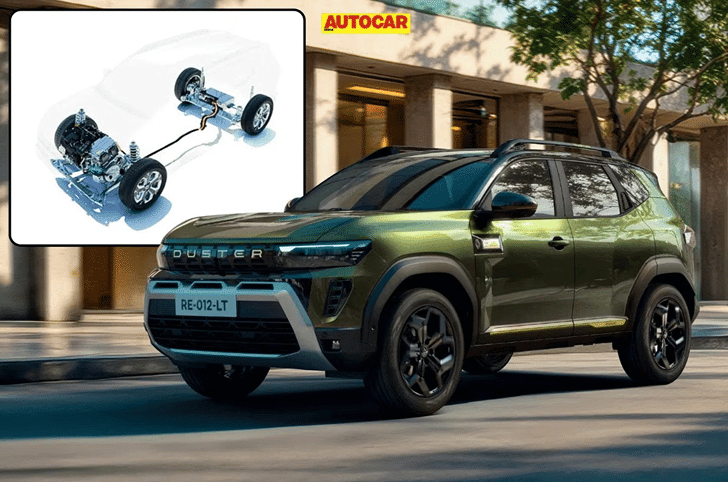

Renault Duster Strong Hybrid E-Tech 160 launches October 17, 2026, with 29 km/l ARAI mileage, 160 hp, and bookings open at ₹21,000 ahead of pricing reveal.
The Renault Duster Strong Hybrid E-Tech 160 launches on October 17, 2026, carrying an ARAI-certified fuel efficiency of 29 km/l — the highest mileage claim in the mid-size SUV segment at the time of writing. Bookings opened on October 9 for ₹21,000, through Renault India's website and authorised dealerships. The hybrid is the third powertrain option for the new-generation Duster, slotting above the existing 1.0-litre and 1.3-litre turbo-petrol engines and listed as the top variant at ₹23.21 lakh (ex-showroom) on Autocar India.
This is a strong hybrid, defined as a system where the vehicle can propel itself on battery power alone without any external charging. That distinction matters in a segment where buyers often conflate mild hybrids with full hybrids — and where Maruti Suzuki's Smart Hybrid badge covers a very different technology.
How does the Duster Hybrid compare with the Grand Vitara and Hyryder?
Before diving into the powertrain details, here is how the Duster Strong Hybrid stacks up against its two most direct rivals — the Maruti Suzuki Grand Vitara strong hybrid and the Toyota Urban Cruiser Hyryder strong hybrid — on the numbers that matter most to a mid-size SUV buyer.
| Feature | Renault Duster Strong Hybrid | Maruti Suzuki Grand Vitara Strong Hybrid | Toyota Urban Cruiser Hyryder Strong Hybrid |
|---|---|---|---|
| Hybrid type | Strong hybrid (no external charging) | Strong hybrid (no external charging) | Strong hybrid (no external charging) |
| Engine | 1.8L NA petrol + 2 electric motors | 1.5L NA petrol + electric motor | 1.5L NA petrol + electric motor |
| Combined power | 160 hp / 172 Nm | ~116 hp | ~116 hp |
| ARAI mileage | 29 km/l (manufacturer claim) | 27.97 km/l (manufacturer claim) | 27.97 km/l (manufacturer claim) |
| Battery capacity | 1.4 kWh | ~0.76 kWh | ~0.76 kWh |
| Ex-showroom price (top hybrid trim) | ₹23.21 lakh (listed, final price Oct 17) | ~₹19–21 lakh (approx.) | ~₹19–21 lakh (approx.) |
| Boot space | 518 litres (turbo variants; hybrid may vary) | 373 litres (battery eats boot floor) | 373 litres (battery eats boot floor) |
| Ground clearance | 212 mm | 210 mm | 210 mm |
| Seating | 5 | 5 | 5 |
| Key weakness | Price premium over turbo-petrol siblings; no diesel | Boot space penalty; smaller engine | Boot space penalty; smaller engine |
ARAI figures are manufacturer claims. Real-world mileage will vary with traffic, speed, load and driving style. Grand Vitara and Hyryder figures are from their respective manufacturer disclosures.
The Duster hybrid's 29 km/l ARAI claim edges past the Grand Vitara's 27.97 km/l, though both figures should be treated as standardised benchmarks rather than everyday guarantees. What sets the Duster apart is significantly more power — 160 hp versus roughly 116 hp — which matters on highways and for overtaking. The trade-off, as always with strong hybrids, is price: the Duster hybrid is expected to carry a meaningful premium over its own 1.3-litre turbo-petrol DCT sibling, which retails at ₹16.81 lakh (ex-showroom) in the Evolution trim.
What exactly is the Duster's E-Tech strong hybrid system?
A strong hybrid is defined as a powertrain where the electric motor is powerful enough to drive the vehicle independently, without the petrol engine running, for meaningful distances and at usable speeds. The Renault Duster Strong Hybrid E-Tech 160 meets this definition squarely.
The system pairs a 1.8-litre four-cylinder naturally aspirated petrol engine with two electric motors. The first motor, rated at 20 hp, is a generator — it charges the battery and starts the petrol engine. The second motor, rated at 49 hp, drives the front wheels directly. Together with the petrol engine, the system produces a combined 160 hp and 172 Nm. A 1.4 kWh lithium-ion battery pack stores and supplies electrical energy.
Power reaches the wheels through a multi-mode automatic gearbox that uses fixed gear ratios — similar in concept to a conventional automatic but managed entirely by software that decides when to engage the petrol engine, the electric motor, or both. Renault says the system can operate in three modes: pure electric, petrol-only, and a blended combination. The battery is replenished through regenerative braking and by the generator motor when the petrol engine is running — no plug socket required.
Renault claims the Duster hybrid can cover 80 percent of typical city driving in electric mode. That is a significant claim and one that depends heavily on stop-start urban traffic where the electric motor's low-speed efficiency advantage is greatest. On highways, where the petrol engine runs more continuously, the efficiency gap over a conventional turbo-petrol narrows considerably.
The E-Tech name is not new — Renault has used this hybrid architecture on the Clio and Captur in Europe, and the company says the system draws on learnings from its Formula 1 programme, specifically energy recovery and deployment strategies. Whether that translates to tangible real-world gains over rival systems is something independent tests after launch will need to verify.
Why is Renault launching a hybrid Duster now?
The timing is deliberate. The current-generation Duster returned to India in April 2026 with only petrol engines — the 1.0-litre turbo and the 1.3-litre turbo — and no diesel option. That absence has been a sticking point for buyers who previously chose the original Duster partly because of its frugal diesel engine.
Francisco Hidalgo, Vice President of Sales and Marketing at Renault Group India, said: "The Duster strong hybrid E-Tech 160 brings both together in a versatile SUV, without requiring external charging. For customers considering alternatives to diesel, it offers a compelling new choice for everyday driving."
The hybrid's 29 km/l ARAI figure is the headline answer to the diesel question. A diesel mid-size SUV typically returns 18–22 km/l in real-world conditions; a strong hybrid in city traffic can genuinely approach or exceed that, particularly in congested urban driving where regenerative braking cycles are frequent. The Duster hybrid's 1.4 kWh battery is larger than the Grand Vitara's approximately 0.76 kWh unit, which theoretically supports longer electric-only running windows.
The launch also fits Renault's stated "futuREady" roadmap for India, which positions electrified powertrains as the company's growth lever in a market that is rapidly warming to hybrids. The mid-size SUV segment — where the Grand Vitara, Hyryder, and now the Duster hybrid compete — has become the proving ground for strong-hybrid technology in India.
What are the booking details and expected price?
Bookings opened on October 9, 2026, for a token amount of ₹21,000. Customers can book through the Renault India website or at any authorised dealership. The official price reveal is scheduled for October 17, 2026, at the formal launch event.
Autocar India lists the hybrid variant at ₹23.21 lakh (ex-showroom), though this figure may be updated at launch. For context, the full Duster petrol range currently spans ₹10.49 lakh to ₹18.49 lakh (ex-showroom), meaning the hybrid is expected to sit roughly ₹4.7–5 lakh above the top petrol variant. That is a substantial premium — comparable to the gap between the Grand Vitara's petrol-only and strong-hybrid variants — and it is the single biggest commercial question the launch needs to answer.
The Duster is sold in five trim levels for the petrol range: Authentic, Evolution, Techno, Techno+, and Iconic. The hybrid is expected to be offered in a single or limited trim configuration at launch, though Renault has not confirmed variant details ahead of October 17. The ₹21,000 booking amount is fully refundable if a buyer decides not to proceed after the price announcement.
How does the Duster Hybrid's mileage claim hold up against real-world expectations?
The 29 km/l figure is an ARAI-certified number — it is a manufacturer claim derived from a standardised test cycle conducted under controlled laboratory conditions. Motorbeam notes that "actual fuel consumption is likely to vary according to factors such as traffic, driving speed, road conditions, weather and driving style. The 29 km/l figure therefore provides a standardised benchmark rather than a guarantee of real-world economy."
For a realistic expectation, look at how comparable strong hybrids perform in Indian conditions. The Maruti Grand Vitara strong hybrid and Toyota Hyryder strong hybrid both carry ARAI claims of 27.97 km/l; independent real-world tests by publications including Autocar India have typically returned 18–22 km/l in mixed driving, with city-heavy cycles pushing closer to 22–24 km/l. The Duster hybrid's larger battery and higher-rated electric motor could give it a slight edge in pure city conditions, but highway figures will likely be more modest than the ARAI number suggests.
The Grand Vitara strong hybrid's real-world performance is a useful calibration point. Buyers who primarily drive in dense urban traffic — where the electric motor runs most of the time — will see the biggest efficiency gains. Those who spend most of their time on expressways at 100+ km/h will find the petrol engine doing most of the work, and the mileage advantage over the 1.3-litre turbo-petrol Duster will shrink.
How does the Duster Hybrid compare with the Maruti Grand Vitara strong hybrid specifically?
The Maruti Suzuki Grand Vitara strong hybrid is a full self-charging hybrid where the electric motor can independently drive the car at low speeds and in stop-start traffic, with the battery replenished through regenerative braking and the engine — exactly the same architecture as the Duster's E-Tech system. Both cars are strong hybrids; neither requires a charging point.
Where they differ is in powertrain character. The Grand Vitara's 1.5-litre Atkinson-cycle petrol engine and single electric motor produce around 116 hp combined — enough for urban use but noticeably less urgent on highway on-ramps. The Duster's 160 hp system, with its 49 hp wheel-driving motor and 1.8-litre engine, should feel meaningfully more capable in overtaking situations. Renault is effectively offering more performance alongside comparable or better efficiency — a combination that has not previously been available in this segment.
The Grand Vitara's honest weakness in the hybrid configuration is boot space: the battery pack sits under the boot floor, reducing luggage capacity to 373 litres. The standard Grand Vitara petrol offers more usable space. The Duster's turbo-petrol variants offer a generous 518-litre boot, but whether the hybrid's battery placement affects this figure has not been confirmed by Renault ahead of the October 17 launch — buyers should ask specifically at dealerships.
On price, the Grand Vitara strong hybrid currently retails in the ₹19–21 lakh range (ex-showroom, approximate), which would put it below the Duster hybrid's expected ₹23.21 lakh. Maruti's brand network, after-sales reach, and established hybrid track record in India give the Grand Vitara a practical advantage for buyers in smaller cities. The Duster counters with more power, a larger battery, and a fresher design — but Renault's service network remains thinner than Maruti's across India's tier-2 and tier-3 towns.
It is also worth noting that Maruti Suzuki's Smart Hybrid technology — used in models like the XL6 petrol and the Fronx 1.0 turbo — is a mild hybrid, not a strong hybrid. A mild hybrid is defined as a system where the battery and electric motor assist the petrol engine but cannot drive the vehicle independently on electric power alone. The Smart Hybrid badge should not be confused with the Grand Vitara or Victoris strong hybrid systems, which are genuinely comparable to the Duster's E-Tech setup.
The Maruti Suzuki Victoris strong hybrid, which competes in the same mid-size SUV space as the Grand Vitara, also uses a self-charging strong hybrid system and is a direct rival to the Duster hybrid on paper.
What are the Duster Hybrid's key features and safety equipment?
The Duster range already earned a 5-star Bharat NCAP crash safety rating in April 2026, and the hybrid variant is built on the same platform. Standard safety equipment across the Duster range includes six airbags, ABS with EBD, front and rear disc brakes, traction control, electronic stability control, Level 2 ADAS, a 360-degree camera, electronic parking brake with auto hold, front and rear parking sensors, TPMS, and hill hold control.
The Duster's design package is worth noting for buyers coming from older-generation SUVs. The exterior features LED headlights with eyebrow-shaped DRLs, muscular skid plates, black 18-inch alloy wheels, bold 'DUSTER' lettering on the grille, generous body cladding, and a sleek rear LED light bar. Ground clearance is 212 mm — fractionally more than the Grand Vitara's 210 mm — which matters for buyers who occasionally venture onto broken roads or light off-road terrain.
Inside, the Duster offers Google built-in infotainment, connected car technology, dual digital displays, ventilated seats, a panoramic sunroof, and a powered tailgate. Autocar India's expert review of the turbo-petrol Duster flagged the infotainment interface as not intuitive to use and the cabin as less spacious than some rivals — observations that are likely to carry over to the hybrid variant since the interior architecture is shared.
The absence of a spare tyre as standard is another practical weakness flagged by Autocar India. In India's road conditions, this is a real-world concern that buyers should factor in, particularly for longer highway trips.
Is the Duster Hybrid a good alternative to a diesel SUV?
This is the central question Renault is betting on. The diesel mid-size SUV has been the default choice for high-mileage Indian buyers for years, and the current Duster's lack of a diesel option has been a genuine gap. The hybrid's 29 km/l ARAI claim is designed to close that gap on paper.
In practice, a diesel SUV's real-world mileage of 18–22 km/l in mixed driving is competitive with a strong hybrid's real-world returns on highways, but the strong hybrid's city efficiency advantage is real and measurable. For buyers who drive primarily in urban traffic — particularly in congested metros — the Duster hybrid's electric-mode city running makes a genuine efficiency case.
The economics depend on the price premium. If the Duster hybrid is confirmed at ₹23.21 lakh and the 1.3-litre turbo-petrol DCT sits at ₹16.81 lakh, the gap is approximately ₹6.4 lakh. At current petrol prices, recovering that premium through fuel savings alone would take a very high annual mileage — likely 25,000–30,000 km per year or more in city conditions. Buyers who drive less than that may find the turbo-petrol Duster or even a rival diesel SUV more cost-effective over a five-year ownership cycle.
That said, the hybrid's case is not purely financial. Lower tailpipe emissions, smoother low-speed driving, reduced engine noise in traffic, and the potential for lower road tax in states that offer concessions for hybrid vehicles all contribute to the ownership experience. Buyers should check with their state's transport authority for applicable hybrid vehicle tax benefits — these vary by state and are not uniform across India.
For buyers exploring the broader strong-hybrid SUV space, our guide to cheapest strong hybrid SUVs in India provides a wider comparison, and those considering budget-conscious entry into hybrid ownership may find our first hybrid car buying guide useful context.
What should buyers watch for at the October 17 launch?
Several details remain unconfirmed ahead of the launch event:
The final ex-showroom price is the most critical unknown. The ₹23.21 lakh figure on Autocar India's variant listing may be revised upward or downward at launch. A price above ₹23 lakh would make the Duster hybrid significantly more expensive than the Grand Vitara strong hybrid, which could limit its appeal to buyers for whom the Maruti's brand assurance and service network are important.
Variant availability matters too. If the hybrid is offered only in a single top-spec trim, buyers who want the efficiency without the full premium feature set will have no option to step down. Renault has not confirmed whether a mid-spec hybrid variant will be offered.
Boot space in the hybrid configuration needs clarification. The 1.4 kWh battery pack has to go somewhere, and if it occupies the same under-floor space as in the Grand Vitara — reducing the 518-litre petrol-variant boot — that is a meaningful practical compromise buyers deserve to know before signing.
Real-world mileage data will take weeks to emerge after launch. The 29 km/l ARAI figure is a useful benchmark, but independent tests in Indian traffic conditions will be the definitive reference. Watch for first-drive reviews from Autocar India and ETAuto in the days following October 17.
For buyers interested in how the Duster hybrid fits into the broader mid-size hybrid SUV picture, our comparison of AWD and hybrid SUVs under ₹20 lakh covers the segment's lower price band, while the hybrid cars with cruise control guide is useful for highway-focused buyers evaluating ADAS features across the segment.
The Duster Strong Hybrid E-Tech 160 is a genuinely competitive entry into the mid-size strong-hybrid SUV segment. Its 160 hp output, 29 km/l ARAI claim, and 1.4 kWh battery give it a technical edge over the Grand Vitara and Hyryder on headline numbers. Whether the price announced on October 17 makes that edge worth paying for is the question that will determine how seriously it challenges Maruti's dominance in the segment.
Sources
- Renault Duster hybrid bookings open ahead of October 17 launch | Autocar India
- Renault Duster (2026) - Price, Mileage & Expert Reviews | Autocar India
- Renault opens bookings for Duster hybrid ahead of October 17 launch | ETAuto
- Renault Duster Hybrid Bookings Open Ahead of October 17 Launch | Motorbeam
- Renault Duster hybrid to launch this week: All you need to know | MSN
- Renault India Official Website