
Suzuki's new 1.2L engines — a 125 hp turbo and a 174 hp Series Hybrid — will power next-gen Maruti compact cars, rivalling Honda City e:HEV in the compact hybrid space.
Suzuki is developing two distinct 1.2-litre powertrains — a direct-injection turbocharged petrol unit rated at approximately 125 hp and 230 Nm, and a Series Hybrid unit capable of up to 174 hp in its higher specification — that are expected to define the next generation of Maruti Suzuki compact cars sold in India from around 2027 onwards.
These represent a fundamental rethink of how Suzuki powers its smallest vehicles, with multi-fuel capability, a new electrification architecture, and substantially higher outputs than anything currently on sale under the Maruti badge in the compact segment.
How do these new engines compare to what's already on sale?
To understand the significance of these powertrains, it helps to place them alongside the compact and near-compact hybrids currently competing in India's market.
| Model | Hybrid Type | Engine | System Output | ARAI Mileage (claimed) | Approx. Price (ex-showroom) | Key Weakness |
|---|---|---|---|---|---|---|
| Maruti Swift (current, 2024) | Mild Hybrid (Smart Hybrid) | 1.2L NA petrol | 89 hp / 113 Nm | 24.80 km/l (MT) | ₹6.49–9.64 lakh | Battery only assists; cannot drive on electric power alone |
| Maruti Fronx 1.0T (current) | Mild Hybrid (Smart Hybrid) | 1.0L turbo petrol | 100 hp / 148 Nm | 21.79 km/l (MT) | ₹8.54–13.04 lakh | Mild hybrid only; no EV-mode driving |
| Honda City e:HEV (current) | Strong Hybrid | 1.5L Atkinson + 2 motors | ~126 hp (system) | 26.5 km/l (ARAI) | ₹19.99–21.50 lakh | Significant price premium; no manual option |
| Hyundai i20 (current, non-hybrid) | No hybrid | 1.0L turbo / 1.2L NA | 120 hp / 83 hp | 20.35–22.4 km/l | ₹7.04–11.99 lakh | No hybrid powertrain available |
| Suzuki new 1.2L Turbo (upcoming) | Mild/No Hybrid (multi-fuel) | 1.2L DI Turbo | ~125 hp / 230 Nm | TBD | TBD | No confirmed India launch date; fuel-efficiency unverified |
| Suzuki new 1.2L Series HEV (upcoming) | Strong Hybrid | 1.2L + electric motors | Up to ~174 hp | TBD (targets ~29% lower CO₂ vs 2022) | TBD | Battery adds weight; cost premium likely |
Right now, a buyer seeking a genuine strong hybrid — where the car can propel itself on electric power alone without the petrol engine running — in the compact segment has essentially one option: the Honda City e:HEV, which starts at nearly ₹20 lakh. Maruti's current Smart Hybrid technology, fitted to models like the Swift and the Fronx 1.0 turbo, is a mild hybrid: the battery assists the engine and enables idle stop-start, but the car cannot drive on electric power alone. The new Series HEV architecture changes that entirely.
What exactly is the new 1.2L turbo engine, and why does multi-fuel matter for India?
The turbocharged unit is a 1.2-litre direct-injection petrol engine with forced induction, producing approximately 125 hp and 230 Nm of torque. Those figures represent a meaningful step up from Maruti's current 1.0-litre Boosterjet turbo (100 hp, 148 Nm in the Fronx) and from the naturally aspirated 1.2-litre K-series engine (89 hp in the Swift).
The 230 Nm torque figure stands out. It places this engine close to the territory occupied by 1.5-litre turbo petrol units in slightly larger SUVs, delivered from a smaller displacement. For compact cars where kerb weight is typically under 1,100 kg, that torque output would translate to genuinely brisk real-world performance.
Multi-fuel capability is where this engine becomes strategically important for India specifically. Suzuki's presentation confirms support for petrol, E100 ethanol, CNG, and compressed biogas (CBG). Maruti Suzuki already operates one of the largest factory-fitted CNG vehicle programmes in the world, and the company has invested directly in CBG production in India.
Maruti Suzuki's Annual Integrated Report 2025-26 explicitly names biogas as a strategic priority, with Chairman R.C. Bhargava stating the company's board has approved investment in four biogas plants in the first phase at a cost of ₹561 crore. The new 1.2L turbo engine, with its CBG compatibility, is the hardware that makes those fuel investments relevant to the passenger car buyer.
E100 ethanol support adds another dimension. India's ethanol-blending programme has been expanding steadily, and a flex-fuel-capable engine would allow Maruti to sell the same car across markets with very different fuel infrastructure — from Indian cities with CNG pumps to rural areas where ethanol is more accessible.
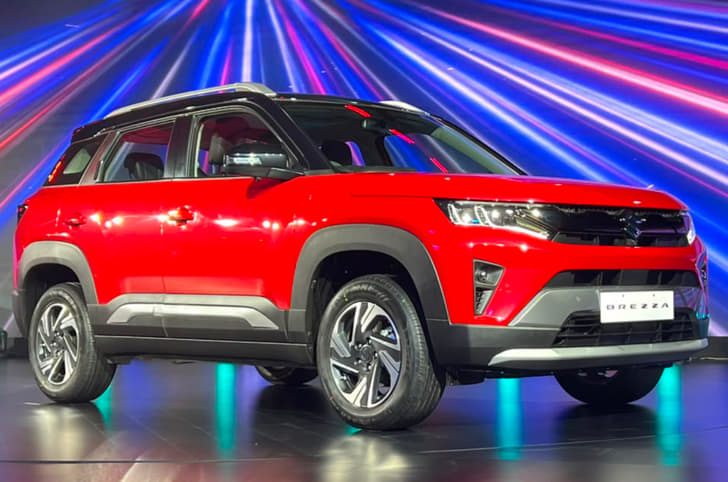
The 2026 Brezza facelift, which Autocar India confirmed launched at ₹7.40 lakh with a 1.0-litre direct-injection turbo producing 110 hp and 170 Nm, previews where Maruti's turbo direction is heading. The new 1.2L unit would sit above this, offering more displacement, more torque, and the multi-fuel flexibility that the current Boosterjet lacks.
What is the new Series Hybrid system, and how is it different from Maruti's current Smart Hybrid?
This distinction matters enormously for buyers, and it is one that aggregator portals frequently get wrong.
Maruti's current Smart Hybrid technology — fitted to the Swift, the XL6, and the Fronx 1.0 turbo — is a mild hybrid system. The 48V or 12V battery-and-motor setup assists the petrol engine during acceleration and enables regenerative braking, but the electric motor cannot independently propel the car. The engine must always be running when the car is moving. This is why the Swift's Smart Hybrid delivers a meaningful efficiency gain over a non-hybrid equivalent, but does not offer the EV-mode driving experience of a strong hybrid.
The new Series Hybrid architecture allows the petrol engine to operate primarily as a generator, with the electric motor handling propulsion for much of the drive cycle. This means the car can, in appropriate conditions, move on electric power alone with the petrol engine switched off. That is the technical definition of a strong hybrid — the same category as the Honda City e:HEV, the Maruti Grand Vitara strong hybrid, and the Toyota Urban Cruiser Hyryder strong hybrid.
Suzuki's technical roadmap shows this Series HEV architecture as the foundation for a progression toward REEV Light (range-extended electric vehicle) and PHEV (plug-in hybrid) variants, simply by adding external charging capability and a larger battery. The Series HEV targets approximately 29% lower CO₂ emissions compared to 2022 levels — equivalent to around 300 kg less CO₂ per 10,000 km. That is a substantial environmental claim, though it will need independent verification once production vehicles are tested.
The system output of up to 174 hp in the higher specification is striking. The Honda City e:HEV's combined system output is approximately 126 hp. If Suzuki's new Series HEV delivers close to its claimed 174 hp in a compact hatchback or small SUV body, it would be the most powerful strong hybrid in its price class in India — assuming pricing stays competitive.
Suzuki has also listed next-generation e-Axles in its presentation: 70 kW units for Mini/A-segment vehicles and 130 kW units for B-, C-, and D-segment models. A separate electric four-wheel-drive system with 10 kW and 30 kW outputs is also planned. This suggests the electrification architecture is being designed for scalability across Maruti's entire lineup, not just one flagship model.
Which Maruti models are most likely to get these engines first?
No official confirmation has been made about specific model applications. The engine specifications and Suzuki's stated strategy point clearly toward the compact and near-compact segments where Maruti dominates.
The Swift is the most obvious candidate for the Series Hybrid powertrain. The current Swift uses a 1.2-litre K-series engine with Smart Hybrid assistance — a mild hybrid setup. A next-generation Swift built around a 1.2-litre Series HEV would represent a genuine leap: from mild hybrid to strong hybrid, from 89 hp to 100+ hp system output, and from a car that cannot drive on battery alone to one that can. Maruti Suzuki's pipeline of upcoming models through 2027 suggests the timeline is realistic.
The Baleno is another strong candidate. Currently offered with the same 1.2L K-series engine and Smart Hybrid, the Baleno sits in the premium hatchback segment where the Honda City e:HEV's strong hybrid technology commands a significant price premium. A Baleno with a 1.2L Series HEV could undercut the City e:HEV by ₹5–8 lakh while offering comparable electrification credentials.
The 1.2L turbo engine, with its multi-fuel support, is more likely to appear in compact SUVs — a future Brezza or Fronx variant — where the higher torque output and CNG/CBG compatibility align with buyer priorities. The current Brezza facelift already uses a 1.0L turbo; a 1.2L unit with 125 hp and 230 Nm would be a natural step up for a future generation.
Maruti's existing strong hybrids — the Grand Vitara strong hybrid and the Invicto strong hybrid — use Toyota's THS (Toyota Hybrid System) technology under the Suzuki-Toyota alliance. The new Series HEV architecture appears to be Suzuki's own development, which could give Maruti more flexibility in pricing and application across smaller, more affordable models where Toyota's system would be cost-prohibitive.
How does this compare to what Honda and Hyundai are doing in the compact hybrid space?
Honda's City e:HEV is currently the benchmark for strong hybrid technology in India's near-compact segment. It uses a 1.5-litre Atkinson-cycle petrol engine paired with two electric motors in a series-parallel hybrid configuration. The ARAI-claimed mileage of 26.5 km/l is the highest of any non-plug-in hybrid sedan in India, and real-world figures typically land around 18–22 km/l in mixed urban-highway driving. The weakness is price: at ₹19.99–21.50 lakh, it is significantly more expensive than any Maruti compact car.
Hyundai does not currently offer a hybrid powertrain in the i20 or any compact hatchback in India. The i20's 1.0-litre turbo petrol (120 hp) is its performance option, and the 1.2-litre naturally aspirated petrol is the efficiency option. Neither carries hybrid assistance of any kind. If Suzuki's new Series HEV reaches the Swift or Baleno at a competitive price point, it would create a hybrid option in a segment where Hyundai currently has no answer.
Toyota's Urban Cruiser Hyryder strong hybrid — a sister car to the Maruti Grand Vitara strong hybrid — uses a 1.5-litre Atkinson engine with Toyota's THS. Its ARAI-claimed mileage of 27.97 km/l is class-leading among strong hybrid SUVs, but it sits in the ₹16–20 lakh range. The Hyryder and Grand Vitara strong hybrids demonstrate that Maruti already has experience selling strong hybrids in India; the new 1.2L Series HEV would extend that experience into a smaller, more affordable body style.
For buyers currently considering hybrid cars under ₹15 lakh, the current options are almost entirely mild hybrids. A Maruti compact with a genuine strong hybrid powertrain in that price bracket would be a first for the Indian market.
What does "Super Ene Charge" mean, and is it the same as the new Series HEV?
These are two distinct technologies within Suzuki's electrification programme, and conflating them leads to confusion about what buyers can actually expect.
Super Ene Charge is Suzuki's 48V mild hybrid architecture, designed to provide enhanced electric assistance — regenerative braking, torque fill during acceleration, idle stop-start — without the weight and cost of a large traction battery. It is an evolution of the existing Smart Hybrid concept, offering more electrical capacity but still falling within the mild hybrid category. The car cannot drive on electric power alone.
The Series Hybrid is a different architecture. As described above, it allows the electric motor to handle propulsion independently, with the petrol engine operating as a generator. The 174 hp system output figure comes from this Series HEV configuration, not from the Super Ene Charge system.
Suzuki's roadmap shows both technologies coexisting — Super Ene Charge for models where cost and weight constraints make a full strong hybrid impractical, and the Series HEV for models where the efficiency and performance benefits justify the additional complexity. For India, this likely means Super Ene Charge continues in entry-level variants while the Series HEV appears in mid-to-upper trim levels of future compact models.
What are the honest limitations and uncertainties buyers should know?
Several important caveats apply to everything discussed here.
No India launch dates have been confirmed for either engine. The source material is based on Suzuki's technical presentations and development roadmaps, not production announcements. The timeline of "around 2027" for compact model applications is an inference based on Maruti's stated pipeline, not a confirmed date.
The output figures — 125 hp and 230 Nm for the turbo, up to 174 hp for the Series HEV — are reported development targets, not ARAI-certified production figures. Real-world outputs and fuel efficiency will depend on how Suzuki tunes these engines for specific models, and ARAI certification numbers may differ from the development claims.
The price premium for the Series HEV over a conventional petrol or mild hybrid variant is unknown. The Grand Vitara strong hybrid currently commands a premium of approximately ₹2–3 lakh over its mild hybrid equivalent. A compact strong hybrid in the Swift or Baleno segment would need to be priced aggressively to compete with the City e:HEV from below while justifying the premium over Maruti's own mild hybrid variants.
Boot space represents a real consideration. The Grand Vitara strong hybrid's boot is reduced compared to the mild hybrid version due to battery placement. Whether Suzuki can package the new 1.2L Series HEV's battery without a similar compromise in a smaller hatchback body is an engineering challenge that remains unresolved in public information.
The multi-fuel CNG and CBG capability of the turbo engine is promising but depends on India's CBG infrastructure expanding meaningfully. CNG is already well-established in cities like Delhi, Mumbai, and Ahmedabad, but CBG availability is nascent. The engine's capability is only as useful as the fuel network supporting it.
What should a buyer do with this information right now?
If you are in the market for a compact car or hatchback today, these upcoming engines should inform your decision only at the margins. Buying decisions based on unconfirmed future products carry real risk — launch timelines slip, specifications change, and pricing often surprises.
What this development does confirm is that Maruti Suzuki's electrification ambitions extend well beyond the Grand Vitara and Invicto strong hybrids in the mid-size and MPV segments. The company's record annual sales of 24.22 lakh vehicles in FY 2025-26 give it the financial foundation to invest in new powertrain development, and the CBG and ethanol investments signal that this is a long-term strategic commitment rather than a one-off product.
For buyers who can wait 12–18 months, the compact hybrid space in India is about to become significantly more interesting. A strong hybrid Swift or Baleno at a competitive price would be a genuinely new proposition — not a rebadged Toyota system, not a mild hybrid dressed up as something more, but a purpose-built Series HEV in a body style that millions of Indian buyers already know and trust.
For buyers who need a car now and want hybrid efficiency, the Maruti Grand Vitara strong hybrid remains the most accessible strong hybrid in Maruti's current lineup, while the Honda City e:HEV leads the compact strong hybrid segment at a higher price point. If mild hybrid assistance is sufficient, the current Swift Smart Hybrid and Fronx 1.0 turbo Smart Hybrid both deliver meaningful real-world efficiency gains over their non-hybrid equivalents at competitive prices.
The 1.2L Series HEV, if it reaches Indian showrooms at the right price, could change that calculus entirely — bringing strong hybrid technology to a price bracket that currently has none.
Sources
- New Suzuki 1.2L Turbo & Hybrid Engines – Up To 174 HP, E100, CNG & CBG Support
- Maruti Suzuki Annual Integrated Report 2025-26
- Maruti Suzuki WagonR – Official Model Page
- 2026 Maruti Suzuki Brezza fuel efficiency figures revealed – Autocar India
- 2026 Maruti Brezza turbo petrol vs NA petrol: Differences explained – Autocar India
- Best Hybrid Cars Under ₹15 Lakh in India (2026) – SmartHybridHub
- Best Hybrid Cars Under ₹25 Lakh in India (2026) – SmartHybridHub
- These Maruti Suzuki Cars Are Coming To India By 2027 – GaadiWaadi