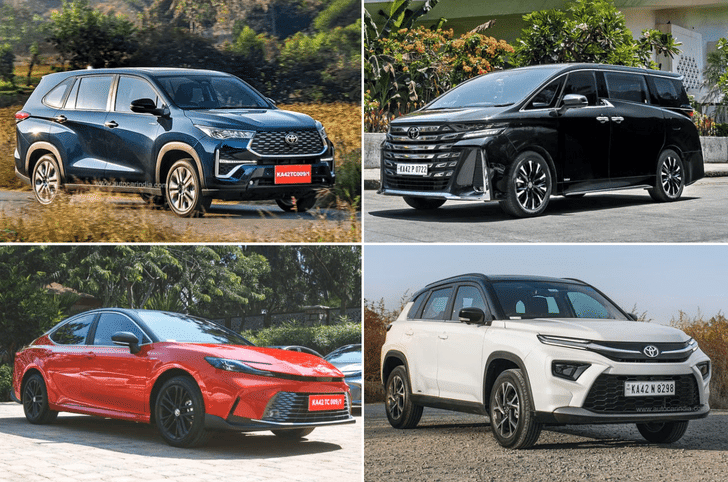

Toyota Innova HyCross topped India's hybrid sales in September 2026 with 3,143 units and 35.2% share, though volumes dropped 40% year-on-year. Toyota's four models held 70.9% of the market collectively.
Which Hybrid Car Dominated India's Sales in September 2026? Toyota Innova HyCross Leads With 35% Market Share
The Toyota Innova HyCross — a strong hybrid MPV — was India's highest-selling hybrid car in September 2026, with 3,143 units dispatched to dealers and a 35.2% share of the 8,918 hybrid vehicles tracked in AutoPunditz's monthly compilation. That headline number, however, sits alongside a sharp 40% year-on-year decline from 5,221 units in September 2025 — a fall large enough to drag the entire hybrid segment down 9% even as several individual models grew.
The numbers tell a story of a market still heavily concentrated around Toyota, increasingly contested by Maruti Suzuki, and beginning to attract new entrants like Kia. Here is how the top models stacked up in September 2026:
| Model | Type | Sep 2026 Units | YoY Change | Market Share | Starting Price (ex-showroom) | ARAI Mileage |
|---|---|---|---|---|---|---|
| Toyota Innova HyCross | Strong hybrid | 3,143 | -40% | 35.2% | ~₹26.76 lakh (VX 7-seat) | 23.24 km/l |
| Toyota Urban Cruiser Hyryder | Strong hybrid | 2,830 | +7% | 31.7% | ~₹19.99 lakh | 27.97 km/l |
| Maruti Suzuki Grand Vitara | Strong hybrid | 1,067 | +34% | 11.9% | ~₹19.99 lakh | 27.97 km/l |
| Kia Sorento | Strong hybrid | 947 | New entry | 10.6% | ~₹33.99 lakh | ~17.0 km/l (mfr claim) |
| Maruti Suzuki Victoris | Strong hybrid | 1,047* | Growing | ~11.7%* | ~₹24.99 lakh | ~27.0 km/l (mfr claim) |
| Maruti Suzuki Invicto | Strong hybrid | 272 | Declining | 3.0% | ~₹28.89 lakh | 23.24 km/l |
*Victoris September figure estimated from the trend between August 2026 (272 units) and the combined Maruti total of 1,553 units; individual September breakdown not separately reported in the primary source. The Invicto figure of 272 units is confirmed. All prices are approximate ex-showroom; verify with the manufacturer before purchase.
Why Did the HyCross Still Win Despite a 40% Sales Drop?
A strong hybrid is defined as a powertrain in which the electric motor can propel the vehicle independently of the petrol engine for short periods, without requiring the owner to plug the car into an external charger. The Toyota Innova HyCross is a strong hybrid by this definition — its 2.0-litre petrol engine works alongside an electric motor through an e-CVT, delivering a combined output of approximately 186PS and an ARAI-certified fuel efficiency of 23.24 km/l.
The HyCross's September 2026 lead over the second-placed Urban Cruiser Hyryder was just 313 units — a fraction of the 2,566-unit gap that separated them in September 2025. While the HyCross technically "dominated" with a 35.2% share, its dominance is narrowing fast. The Hyryder grew 7% year-on-year in the same month the HyCross fell 40%. That divergence matters.
Several factors likely contributed to the HyCross's volume decline. Dispatch figures reflect production allocations, dealer stock levels and order fulfilment pipelines, not just retail demand. Without Toyota's hybrid-specific booking or waiting-period data, it is not possible to attribute the drop cleanly to weaker demand versus constrained supply. What is clear: the HyCross can no longer be treated as a guaranteed volume anchor for the hybrid segment the way it was through 2024 and early 2025.
For buyers, this matters less than it does for market analysts. The HyCross remains a capable, well-equipped strong-hybrid MPV with genuine seven- or eight-seat practicality, a smooth e-CVT and the ability to glide on electric power in urban stop-start traffic. Its ARAI figure of 23.24 km/l is manufacturer-claimed; real-world efficiency in mixed urban-highway driving typically falls in the 16–20 km/l range depending on load and driving style.
How Does Toyota's Overall Hybrid Dominance Look in September 2026?
Toyota's four hybrid models — HyCross, Hyryder, Camry and Vellfire — collectively accounted for 6,325 units, or 70.9% of total hybrid dispatches in September 2026. All four are strong hybrids. This dominance has been consistent through 2026.
In August 2026, Toyota commanded 80.2% of India's hybrid market with 6,317 units, while Maruti Suzuki held 19.0% with 1,497 units and Honda accounted for just 0.8% with 63 units. September's figures show Toyota's share compressing to around 71% as Maruti's contribution grew and Kia's Sorento entered the rankings.
Toyota's cumulative hybrid vehicle sales in India crossed the 3 lakh unit milestone in May 2026, a figure driven primarily by the Hyryder and HyCross after they brought strong-hybrid technology into mainstream price segments. The Camry had been Toyota's hybrid flagship for years before that, but it remained a premium-segment product. The Hyryder and HyCross changed the equation by making strong hybrids accessible at ₹19–27 lakh.
Toyota's self-charging hybrid system — the company's term for its strong-hybrid architecture — charges the battery through regenerative braking and engine power, eliminating the need for external charging infrastructure. That positioning has resonated in India, where public charging networks remain patchy outside major metros.
Where Does Maruti Suzuki's Victoris Fit in This Picture?
The Maruti Suzuki Victoris is a strong hybrid SUV — not a mild hybrid — that competes in the same broad price band as the lower HyCross variants and the upper Hyryder variants. Its electric motor can drive the vehicle independently at low speeds without the petrol engine running, a capability that Maruti's Smart Hybrid mild-hybrid system (found in models like the XL6 petrol and Fronx 1.0 turbo) does not offer. Smart Hybrid is defined as a mild-hybrid system in which the battery assists the engine but cannot propel the car on electric power alone.
In August 2026, the Victoris recorded 272 strong-hybrid units — its first full month of tracked data given it was a new launch with no August 2025 comparison base. In the H1 2026 data, the Victoris sold 3,231 units across six months, placing it fourth in the strong-hybrid rankings behind the HyCross, Hyryder and Grand Vitara.
The Victoris's positioning is deliberate. It sits above the Grand Vitara in Maruti's lineup, offering a larger body and more premium equipment, while undercutting the HyCross on price. For buyers who want a strong-hybrid powertrain without committing to the HyCross's MPV format or its price premium, the Victoris is the most direct Maruti alternative.
Its honest weaknesses: monthly volumes are still modest compared with the HyCross, the brand does not yet have Toyota's established hybrid reputation in India, and the Victoris's strong-hybrid battery pack — like all strong hybrids — occupies boot space that the non-hybrid version retains. Maruti has not published a separate ARAI figure for the Victoris that has been independently verified; the manufacturer-claimed figure of approximately 27 km/l should be treated as provisional until confirmed.
How Does the Invicto Compare With the HyCross It's Based On?
The Maruti Suzuki Invicto is a strong hybrid MPV that shares its platform, powertrain and most of its engineering with the Toyota Innova HyCross. Both use the same 2.0-litre petrol strong-hybrid system with an e-CVT and deliver the same ARAI-certified 23.24 km/l. The Invicto is, in effect, a rebadged HyCross sold through Maruti's Nexa channel.
In September 2026, the Invicto recorded only 272 units — meaning the HyCross's hybrid dispatches were more than eleven times those of its Maruti counterpart. In August 2026, the Invicto recorded 260 units, up 10% year-on-year. In H1 2026, it sold 1,418 units, down 26% year-on-year.
The Invicto's low volumes relative to the HyCross reflect a pattern common to badge-engineered products: buyers who want this specific powertrain tend to prefer the original Toyota brand, which carries stronger resale value perception and a more established hybrid service network. The Invicto does carry a slight price advantage in some variants, and Maruti's larger dealership network provides broader geographic access, but neither advantage has translated into meaningful volume gains so far.
For buyers considering either, the mechanical experience is essentially identical. The decision comes down to brand preference, variant-level equipment differences and the dealer network in their city.
What Is the Grand Vitara's Role in Maruti's Hybrid Story?
The Maruti Suzuki Grand Vitara strong hybrid is an SUV in which the electric motor can drive the vehicle at low speeds without the petrol engine, using a battery charged through regenerative braking — no external charging required. It shares its strong-hybrid system with the Toyota Urban Cruiser Hyryder, in the same way the Invicto shares its system with the HyCross.
In September 2026, the Grand Vitara recorded 1,067 strong-hybrid units, up 34% year-on-year. That growth is notable because it came in a month when the overall hybrid market declined 9%. In August 2026, the Grand Vitara held 965 units, flat year-on-year. In H1 2026, it sold 4,086 units — but that represented a 54% decline year-on-year, suggesting the strong-hybrid variant lost share within the Grand Vitara lineup earlier in the year before recovering.
The Grand Vitara strong hybrid's ARAI figure of 27.97 km/l matches the Hyryder's, since they share the same powertrain. That figure is a manufacturer claim; real-world efficiency in urban conditions typically falls in the 18–22 km/l range. The strong-hybrid Grand Vitara carries a price premium over the non-hybrid petrol variants, and the battery pack reduces boot space — a trade-off buyers need to weigh against the fuel savings over their ownership period.
For buyers looking at the cheapest strong hybrid SUVs in India, the Grand Vitara and Hyryder sit at the accessible end of the strong-hybrid price spectrum, typically starting around ₹19.99 lakh ex-showroom.
How Does the Honda City e:HEV Fit Into the September 2026 Picture?
The Honda City e:HEV is a strong hybrid sedan — not an SUV or MPV — and it competes in a different body-style segment from the HyCross, Hyryder and Grand Vitara. In August 2026, the City e:HEV recorded 30 units, down 63% year-on-year. In H1 2026, it sold 659 units, up 22% year-on-year — a paradox explained by the fact that H1 growth came from a low base, while the August figure reflects a sharp single-month dip.
Honda's ZR-V, a strong-hybrid compact SUV, also appeared in the August 2026 data with 33 units — a new entry with no prior comparison base. Honda's total hybrid contribution in August was just 63 units, giving it a 0.8% market share. The City e:HEV's low volumes despite being a mainstream-priced strong hybrid illustrate that powertrain alone does not guarantee sales; body style, brand perception and the competitive set all matter.
Is the Hybrid Market Growing or Shrinking in India?
The September 2026 data presents a mixed picture. The overall hybrid market of 8,918 units was down 9% year-on-year, but that decline was driven almost entirely by the HyCross's 40% fall. Several models — the Hyryder (+7%), Grand Vitara (+34%) and Victoris (new entrant growing) — actually grew.
Looking at a longer horizon: in H1 2026, strong hybrid car sales totalled 57,885 units, essentially flat versus 57,847 units in H1 2025 — a gain of just 38 cars over six months. Battery electric passenger vehicles recorded 1,48,023 retail sales in H1 2026, a 79% year-on-year increase. Indians bought roughly 2.56 electric cars for every strong-hybrid car in the first half of 2026.
That ratio does not mean strong hybrids are failing — it means EVs are growing faster from a larger base, supported by a broader product range. The strong-hybrid market had only eight models contributing to its 57,885-unit H1 total. The EV market had 20 models in the top-20 list alone, with Tata, Mahindra, MG and Maruti all fielding multiple products.
The hybrid market's concentration risk is real. Toyota and Maruti together accounted for essentially 100% of strong-hybrid sales in August 2026 (Honda's 0.8% share being negligible). Kia's Sorento entry in September 2026 with 947 units is the first meaningful diversification of the supply side, but it is a premium product priced above ₹33 lakh that will not drive mass-market hybrid adoption on its own.
For the hybrid segment to grow, it likely needs more models in the ₹15–22 lakh range — the sweet spot where the Grand Vitara and Hyryder operate — and broader geographic availability. Renault has announced a Duster Hybrid with a larger battery pack, which could add another mainstream option if it reaches the market at competitive pricing.
What Does This Mean for a Buyer Choosing Between These Hybrids?
If you are considering a 7-seater hybrid MUV under ₹30 lakh, the HyCross and Invicto are the primary strong-hybrid options. The HyCross starts around ₹26.76 lakh (VX 7-seat, ex-showroom) and goes higher with premium variants. The Invicto is priced similarly, with marginal differences by variant. Both deliver 23.24 km/l on the ARAI cycle; real-world figures will be lower.
The HyCross's strengths: established hybrid reputation, strong resale value, wide service network, proven reliability data from years of sales. Its weaknesses: the strong-hybrid battery pack reduces boot space compared with the non-hybrid HyCross, the price premium over a diesel MPV is substantial, and the 40% year-on-year sales decline in September 2026 raises questions about whether the model is approaching a mid-cycle slowdown.
The Victoris is the more interesting competitive development. As a strong hybrid in a different body style from the Invicto, it gives Maruti a product that competes with the HyCross on price without being a direct copy of it. If Maruti can build the Victoris's hybrid volumes to match the Grand Vitara's trajectory — which grew 34% in September — it could meaningfully shift the competitive balance in the ₹22–28 lakh strong-hybrid space.
For buyers focused on the SUV segment rather than MPVs, the Hyryder and Grand Vitara remain the volume leaders in strong-hybrid SUVs, with the Grand Vitara's September growth suggesting renewed buyer interest. Both carry the same 27.97 km/l ARAI claim and the same strong-hybrid system. The choice between them comes down to brand preference, dealer proximity and variant-level equipment — not powertrain differentiation.
Buyers who want a strong hybrid at the lowest possible entry price should look at the cheapest strong hybrid SUVs in India, where the Grand Vitara and Hyryder are the benchmark options. Those who want mild-hybrid assistance at a lower price point can consider Maruti's Smart Hybrid models like the XL6 petrol or Fronx 1.0 turbo — but these are mild hybrids, meaning the battery assists the engine without being able to drive the car on electric power alone. That distinction matters for fuel savings expectations and the overall driving experience.
What Should You Watch in the Coming Months?
Three things will determine whether the hybrid market recovers or continues its year-on-year decline through the rest of 2026:
First, the HyCross's trajectory. If Toyota's production allocation normalises and the 40% year-on-year decline proves to be a supply-side anomaly rather than a demand signal, the segment's overall numbers will recover quickly. If the decline reflects genuine demand softening — perhaps as buyers weigh the HyCross against the growing EV options in the ₹25–30 lakh range — the recovery will be slower.
Second, the Victoris's ramp-up. Maruti's newest strong hybrid has shown consistent monthly volumes since launch, and the brand's distribution network gives it the reach to grow faster than the Invicto has managed. Watch whether Victoris monthly dispatches cross 500 units consistently, which would signal that it is genuinely adding to the hybrid market rather than cannibalising Grand Vitara or Invicto buyers.
Third, new entrants. Kia's Sorento contributed 947 units in September 2026 as a new entry. Renault's Duster Hybrid is in the pipeline. The 2027 Kia Seltos Hybrid has been spotted testing. If two or three new strong-hybrid models enter the ₹18–25 lakh range in 2027, the market's product concentration problem begins to ease and overall volumes could grow even if individual model shares shift.
For now, the Toyota Innova HyCross remains India's best-selling hybrid car by a clear margin — but its lead is narrower than it has been in years, its year-on-year volumes are declining sharply, and the competitive space around it is more active than at any point since the HyCross launched. That is a more complicated picture than the headline 35.2% share suggests.
Buyers interested in understanding how mild-hybrid technology compares with strong hybrids in the MPV segment can read more at Best MPVs With Mild-Hybrid Technology in India, and those evaluating the broader strong-hybrid SUV market will find context at AWD and Hybrid SUVs Under ₹20 Lakh in India.
Sources
- Toyota Innova HyCross Is India's Best Selling Hybrid Car – CarToq
- Toyota hybrid sales cross 3 lakh mark in India – Autocar India
- Hybrid Car Sales August 2026: Toyota Commands 80% Share – AutoPunditz
- Strong Hybrid Car Sales H1 2026 – Innova, Hyryder, Vitara, Victoris, City – RushLane
- Electric Cars Outsell Strong Hybrids by Over 2.5x in H1 2026 – AutoPunditz
- Toyota Innova HyCross – Official Toyota India Page
- Maruti Suzuki Victoris – Official Maruti Nexa Page