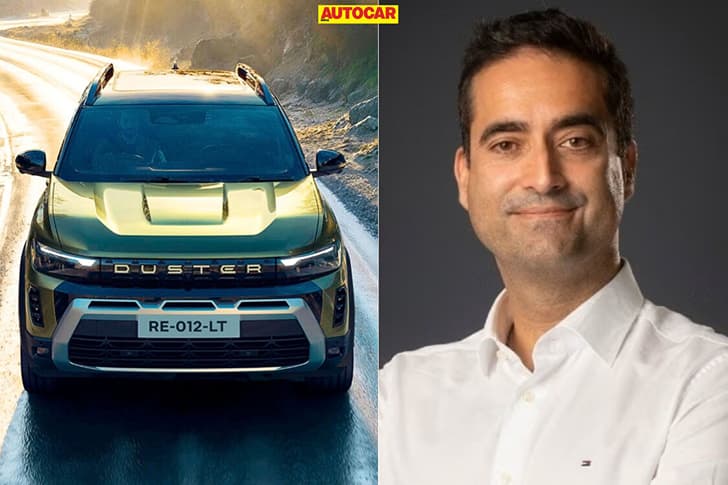

Renault is betting strong hybrids will dominate India's mid-size SUV segment for decades, launching its E-Tech 160 Duster hybrid on October 17 to challenge the Grand Vitara and Hyryder.
Renault India is launching its first strong-hybrid powertrain — the E-Tech 160 — in the Duster on October 17, 2026, with its VP of sales and marketing declaring strong hybrids will be "the main volume-making technology probably for the next 10, 15 or 20 years" in India. This is not a niche bet. It is a direct challenge to a segment already occupied by two well-established strong hybrids from the Maruti-Toyota alliance.
The mid-size hybrid SUV space in India currently has three serious players. Here is how the Duster E-Tech 160 stacks up on paper against them:
| Model | Hybrid Type | Engine | Combined Power | Battery Size | ARAI Mileage (claimed) | Price Range (ex-showroom) | Key Weakness |
|---|---|---|---|---|---|---|---|
| Renault Duster E-Tech 160 | Strong hybrid | 1.8L 4-cyl NA petrol + 2 e-motors | 160 hp / 172 Nm | 1.4 kWh | TBC at launch | ~₹16–20 lakh (expected) | Unproven reliability in India; boot space impact unknown |
| Maruti Grand Vitara (strong hybrid) | Strong hybrid | 1.5L 3-cyl petrol + e-motor | 116 hp | 0.6 kWh | 27.97 km/l (ARAI) | ₹16.99–19.99 lakh | Smaller battery; 3-cyl NVH; reduced boot space vs petrol variant |
| Maruti Victoris (strong hybrid) | Strong hybrid | 1.5L 3-cyl petrol + e-motor | 116 hp | 0.6 kWh | ~28 km/l (ARAI, manufacturer claim) | ₹16–20 lakh | Same powertrain limitations as Grand Vitara; newer, less proven |
| Toyota Urban Cruiser Hyryder (strong hybrid) | Strong hybrid | 1.5L 3-cyl petrol + e-motor | 116 hp | 0.6 kWh | 27.97 km/l (ARAI) | ₹16.99–20.49 lakh | Premium pricing; 3-cyl engine; smaller battery than Duster |
Duster E-Tech 160 pricing and mileage are pre-launch estimates based on Renault's stated localisation efforts and segment benchmarks. All mileage figures are ARAI claims unless noted.
What exactly is Renault's E-Tech 160, and how does it differ from existing strong hybrids?
A strong hybrid is defined as a system in which the electric motor is powerful enough to propel the vehicle on battery power alone for meaningful distances, without any input from the combustion engine. This distinguishes it from a mild hybrid, where the battery only assists the engine and cannot drive the wheels independently.
The Duster's E-Tech 160 pairs a 1.8-litre four-cylinder naturally aspirated petrol engine with two electric motors and a 1.4 kWh battery pack, delivering a combined output of 160 hp and 172 Nm through a segment-first 8-speed dedicated hybrid transmission. Renault claims the system can handle 80 percent of urban driving in all-electric mode — a figure that, if it holds up in Indian traffic conditions, would be genuinely impressive.
The Maruti Grand Vitara, Maruti Victoris, and Toyota Urban Cruiser Hyryder all use a different approach: a 1.5-litre three-cylinder petrol engine mated to a single electric motor and a 0.6 kWh battery, sending power through an e-CVT. The Duster's battery is more than twice the size (1.4 kWh versus 0.6 kWh), and the four-cylinder engine should deliver smoother refinement than the three-cylinder units in the Maruti-Toyota trio, which have drawn criticism for NVH (noise, vibration, harshness) at higher revs.
The 8-speed dedicated hybrid transmission is also a genuine differentiator. The e-CVT in the Grand Vitara and Hyryder is efficient but can feel elasticated under hard acceleration — a known complaint among owners. Renault's multi-speed gearbox promises a more conventional driving feel, though real-world validation will have to wait until post-launch tests.
One honest caveat: the E-Tech 160 is a proven powertrain in Europe (it underpins the Renault Austral and Captur), but its behaviour in India's specific conditions — sustained low-speed urban crawl in 40°C heat, the quality of local fuel — remains to be tested by Indian journalists and owners.
Why does Renault think strong hybrids will outlast diesel in India?
Francisco Marques was direct: "I see diesel declining; I see a strong hybrid growing very fast. And it's related to the offer." His logic is that as more strong-hybrid models enter the market at competitive prices, buyers who previously chose diesel for its fuel economy will migrate to strong hybrids.
The data tells a more complicated story. Diesel car sales grew 15 percent year-on-year in the first half of 2026, which suggests diesel remains far from dead. The original Duster's 1.5-litre K9K diesel was one of the most beloved engines in the segment's history, and the absence of a diesel option in the new Duster has been a consistent complaint from fans. Marques is essentially betting that the E-Tech 160 will satisfy the fuel-economy expectations of those diesel loyalists — a reasonable hypothesis, but one that requires the hybrid's real-world mileage to land close to its ARAI claim.
Strong hybrids have a structural advantage in city driving that diesel engines do not: regenerative braking and electric-only crawl mean fuel consumption drops sharply in stop-and-go traffic, exactly where diesel efficiency suffers most. On highways, diesel remains competitive. The Grand Vitara strong hybrid, for instance, returns around 27.97 km/l on the ARAI cycle but real-world highway figures from owner reports typically settle in the 18–22 km/l range — still strong, but less dramatic than the city numbers.
Marques also positioned hybrids explicitly as a bridge technology: "Hybrid is the perfect transition," he said, with EVs constrained by charging infrastructure and capacity in the near term. This framing aligns with Renault's global CEO Francois Provost's stated ambition to have EVs and hybrids account for about half of Renault's India sales by 2030, with India targeted as one of the brand's top three global markets.
How has the Duster performed in the market so far, and why does it need the hybrid?
The numbers are blunt. Since its March 2026 launch with turbo-petrol engines only, the Duster has sold fewer than 7,000 units total, including just 406 wholesales in August. For context, the Hyundai Creta averages 15,000–16,000 units a month, and the Kia Seltos moves 10,000–11,000 units monthly. The Duster is not just losing — it is being lapped.
The mid-size SUV segment is defined as the most competitive in India's passenger vehicle market, with buyers expecting a full menu of powertrain options: naturally aspirated petrol, turbo-petrol, diesel, CNG, hybrid, and increasingly electric. The Duster launched with only turbo-petrol variants, which immediately narrowed its addressable market. Buyers who wanted a diesel equivalent in fuel economy had nowhere to go within the Duster lineup.
The hybrid launch on October 17 is therefore less a product enhancement and more a market survival move. If the E-Tech 160 is priced within the ₹16–20 lakh band that the Grand Vitara and Hyryder occupy, it gives the Duster a genuinely competitive reason to exist in a segment it has so far struggled to crack.
Renault has been working on localising the E-Tech 160 specifically to hit that price window. Renault India CEO Stephane Deblaise has highlighted the modular RGMP platform's high local content as a key enabler of competitive pricing for both domestic sales and exports. If localisation has gone well, the Duster hybrid could undercut or match the Grand Vitara's strong-hybrid entry price of ₹16.99 lakh — which would be a significant market event.
Where does the Maruti Grand Vitara strong hybrid stand in this new competitive space?
The Grand Vitara strong hybrid is currently the default choice for buyers who want a strong hybrid mid-size SUV in India, and it has earned that position through Maruti's service network, proven reliability, and genuinely strong fuel economy. Its 27.97 km/l ARAI claim is among the highest in the segment, and real-world city figures of 20–24 km/l are consistently reported by owners.
However, the Grand Vitara's strong-hybrid system has known limitations that Renault is positioning the Duster to exploit. The 0.6 kWh battery is small by global standards, which limits the duration and speed of pure electric operation. The three-cylinder engine produces noticeable vibration at idle and under load. Boot space is reduced compared to the petrol variant because the battery pack occupies underbody space — a weakness that Maruti has acknowledged but not resolved. The e-CVT, while smooth in normal driving, can feel strained when pushed hard.
The Maruti Victoris, launched more recently, uses the same 116 hp strong-hybrid powertrain as the Grand Vitara. It is defined as a strong hybrid by Maruti Suzuki, capable of short-distance electric-only propulsion. The Victoris differentiates itself primarily through styling and positioning, not through a different powertrain. Both it and the Grand Vitara will face the same comparison point once the Duster hybrid arrives: a larger battery, more power, and a multi-speed transmission at a similar price.
Maruti also sells mild-hybrid variants of models like the Fronx (1.0-litre turbo) and XL6 under its Smart Hybrid branding. A mild hybrid is defined as a system where the electric component only assists the combustion engine — it cannot drive the wheels independently and delivers more modest fuel savings than a strong hybrid. These mild-hybrid models are not direct competitors in the strong-hybrid mid-size SUV space, but they do demonstrate Maruti's broader commitment to electrified powertrains across price points.
If you are evaluating AWD and hybrid SUVs under ₹20 lakh, the Grand Vitara currently offers an AWD option on its turbo-petrol variant — the strong-hybrid trim is front-wheel drive only, a limitation shared by the Hyryder strong hybrid. The Duster's E-Tech 160 is also expected to be front-wheel drive at launch.
What is Renault's broader India strategy, and is the hybrid just one piece of it?
The Duster hybrid is the most immediate product, but Renault's India ambitions are considerably larger. Global CEO Francois Provost has set a target of 5% market share in India by 2030, with seven models in the portfolio and approximately €2 billion in annual exports from India. Renault currently holds less than 1% market share — the gap between ambition and reality is substantial.
The platform strategy underpinning this push is genuinely interesting. Renault's RGMP (Renault Group Modular Platform) has been engineered to support ICE, flex-fuel, strong hybrid, and full electric drivetrains — the same architecture that underpins the Duster also supports the upcoming Bridger concept, positioned in the B-SUV segment. This means Renault can roll out hybrid variants across multiple models without starting from scratch each time, which is a meaningful cost and development advantage.
Renault is also planning CNG variants of the Kiger and Triber, acknowledging that India's powertrain market is genuinely multi-fuel. The Indian passenger vehicle market supports CNG, petrol, diesel, hybrid, and electric simultaneously — no single technology is displacing another at speed. Renault's strategy of covering multiple powertrain types reflects this reality more honestly than brands that have bet exclusively on EVs.
The Bigster, a larger SUV based on RGMP, is also expected to receive a hybrid variant — reportedly a 1.6-litre full hybrid with 155 hp combined output. If priced in the ₹15–20 lakh range as projected, it would extend Renault's hybrid presence into a slightly larger segment and compete with the Toyota Innova Hycross strong hybrid (which starts above ₹19 lakh) at the lower end. The Innova Hycross is a strong hybrid defined by Toyota as capable of electric-only propulsion, and it has established strong-hybrid MPV credentials in India — a space Renault has not yet entered.
Is the strong-hybrid price premium justified for Indian buyers?
This is the question that will ultimately determine whether Marques's prediction comes true. Strong-hybrid variants of the Grand Vitara and Hyryder carry a premium of roughly ₹2–3 lakh over their equivalent turbo-petrol variants. At current petrol prices, the break-even period for that premium — based on the fuel savings from 27+ km/l versus 15–17 km/l for a turbo-petrol — is typically 3–5 years for a buyer covering 15,000 km annually in predominantly urban conditions.
That break-even math works reasonably well for city-heavy users in metros. It is less compelling for buyers who drive predominantly on highways, where the strong hybrid's efficiency advantage narrows and the diesel's torque advantage becomes more relevant. This is why Marques's claim that diesel is declining deserves scrutiny: the 15% year-on-year growth in diesel sales in H1 2026 suggests a large cohort of buyers — particularly in Tier 2 cities and for long-distance use — still finds diesel the more rational choice.
The Duster hybrid's pricing will be the critical variable. If Renault can bring the E-Tech 160 to market at or below the Grand Vitara strong hybrid's entry price of ₹16.99 lakh, it changes the conversation. A more powerful, larger-battery strong hybrid at the same price as the established competition would give buyers a genuine reason to reconsider. If it lands above ₹18 lakh, the value becomes harder to make.
Some states offer registration or road-tax concessions on hybrid vehicles, which can meaningfully reduce the effective on-road price. Karnataka, for instance, has offered reduced registration fees for strong hybrids — buyers in those states should verify current concessions with their RTO, as these policies change and vary by state.
For buyers exploring hybrid cars under ₹25 lakh, the October 17 launch date is worth marking: the Duster hybrid's pricing announcement will reshape the value hierarchy in this segment almost immediately.
What should a buyer watch for at the Duster hybrid's October 17 launch?
Three things matter most at launch, in order of importance.
Pricing. Everything else is secondary. If the E-Tech 160 is priced below ₹17 lakh for the base strong-hybrid variant, it will put immediate pressure on Maruti and Toyota to respond. If it opens above ₹19 lakh, the Duster hybrid becomes a niche product rather than a volume driver.
ARAI mileage certification. Renault's 80% urban electric driving claim is a marketing figure, not a certified efficiency number. The ARAI-certified fuel economy figure — which will be published at launch — is the number to compare directly with the Grand Vitara's 27.97 km/l and the Hyryder's 27.97 km/l. A higher ARAI figure would be a significant marketing win; a lower one would require Renault to justify the premium through other means.
Variant structure and features. The Grand Vitara strong hybrid is available across multiple trims, including well-equipped mid-spec variants that offer good value. If Renault restricts the E-Tech 160 to top-spec trims only, the effective price of a reasonably equipped Duster hybrid could be considerably higher than the base price suggests.
Buyers who are also considering the Honda City e:HEV — a strong hybrid defined by Honda as a full self-charging hybrid sedan — should note that the City e:HEV operates in a different segment (premium sedan, priced around ₹19–21 lakh) and is not a direct SUV competitor, but it demonstrates that strong-hybrid technology is spreading across body styles in India, not just SUVs.
For those evaluating hybrid cars with the quickest acceleration, the Duster's 160 hp combined output is the highest in the mid-size hybrid SUV segment — the Grand Vitara and Hyryder produce 116 hp. Whether that translates to meaningfully quicker real-world acceleration will depend on how Renault has tuned the system, but the hardware advantage is clear.
The bottom line: is Renault's hybrid bet credible?
Marques's 10–20 year timeline for strong hybrids is ambitious but not unreasonable given India's infrastructure realities. EV adoption is real but concentrated in urban pockets with reliable charging access. For the vast majority of Indian buyers — particularly those outside the top eight metros — a strong hybrid offers the fuel economy of an EV in city conditions without the range anxiety or charging dependency. That is a genuinely compelling proposition.
What makes Renault's bet interesting rather than just aspirational is the hardware. The E-Tech 160 is not a rebadged version of the Maruti-Toyota system — it is a larger-battery, higher-power, multi-speed-transmission strong hybrid that has been proven in European markets. The localisation work done at Renault's Chennai facility gives it a plausible path to competitive pricing.
The risk is execution. Renault's India track record since the original Duster's peak is one of declining market share, and the new Duster's first seven months have been underwhelming. A strong-hybrid launch at the right price could reset that trajectory. A mispriced or delayed rollout would confirm the skeptics' view that Renault's India ambitions consistently outrun its India execution.
The mid-size hybrid SUV segment — currently anchored by the Grand Vitara and Hyryder — is about to get its most technically differentiated entrant. Whether that translates into sales volume is a question October 17 will begin to answer.
Sources
- Renault India believes strong hybrids can be major volume drivers | Autocar India
- Renault bets on EVs, hybrids to win over aspirational India buyers | Reuters
- Renault accelerates India push with CNG, hybrids and EVs | The Hindu BusinessLine
- Renault's India Offensive: Platforms, powertrains and a product plan built for scale | The Hindu
- New Renault Duster hybrid vs midsize cars spec comparison | Autocar India
- Maruti Suzuki Grand Vitara — Official Page
- Toyota Urban Cruiser Hyryder — Official Page
- 15 Upcoming Hybrid Cars in India 2026 | MyCarJunction