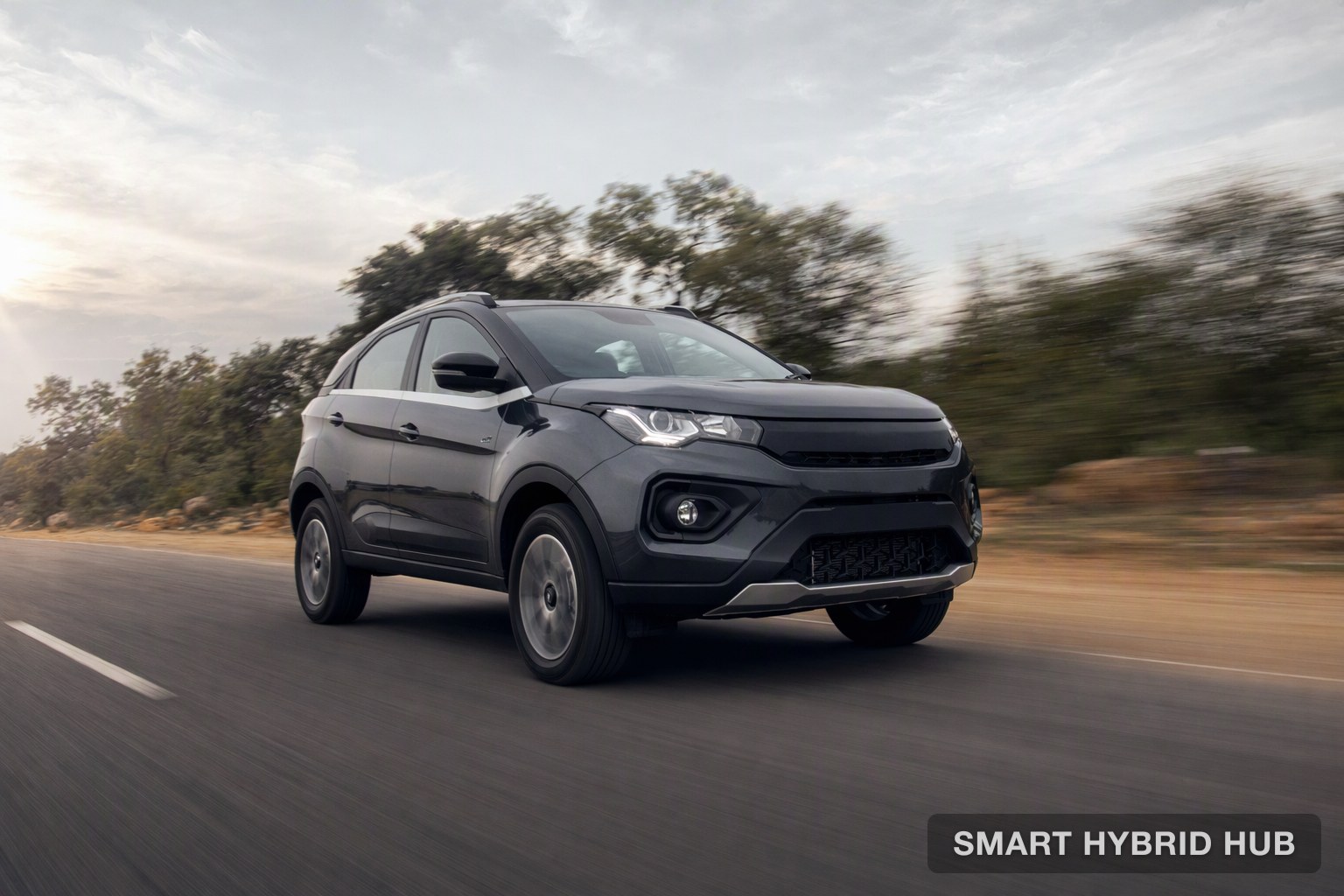
Hybrid Cars With the Quickest Acceleration in India (2026)
Powertrain layout decides this ranking, not price or badge. The Fronx is the cheapest car on the list and the quickest, because it is light and turbocharged, while the Strong Hybrids carry a battery and motor through an e-CVT tuned for economy. The Innova Hycross is the one car where claim and measurement diverge: Toyota states under 10 seconds and Autocar India recorded 10.69. The Maruti Victoris is left unranked because no tested figure exists for its Strong Hybrid variant.
The quickest hybrid car sold in India is a mild hybrid, not a strong hybrid. The Maruti Fronx 1.0 Turbo has been independently timed at 10.38 seconds to 100 km/h by CarDekho, ahead of the Honda City e:HEV at 10.54 seconds and the Toyota Innova Hycross Hybrid at 10.69 seconds, both timed by Autocar India. The Grand Vitara and Hyryder Strong Hybrids trail in the 12-second range.
Hybrids in India are bought for efficiency rather than speed, but that does not make them uniformly slow, and the ranking is not the one most buyers expect. Powertrain layout matters more than badge or price: a light car with a boosted small engine can out-accelerate a much larger and far pricier strong hybrid tuned around fuel economy.
This ranks hybrids on independently tested 0 to 100 km/h times rather than manufacturer claims, because on at least one car here the two differ by more than half a second.
How this list is built
Every time quoted is an independently measured road-test figure, attributed to the outlet that recorded it, rather than a manufacturer claim. Where no tested figure exists for a specific variant, the car is discussed without a number rather than being assigned one borrowed from a different variant. Power, torque and mileage figures come from each manufacturer's own brochure.
Key takeaways
- Maruti Fronx 1.0 Turbo, 10.38 seconds: the quickest hybrid here and the smallest engine on the list, timed by CarDekho on the manual.
- Honda City e:HEV, 10.54 seconds: the quickest genuine strong hybrid, timed by Autocar India.
- Toyota Innova Hycross Hybrid, 10.69 seconds: quick for a three-row MPV, but Toyota claims under 10 seconds and the tested figure is 0.7 seconds slower.
- Grand Vitara and Hyryder land around 12 seconds, a clear step behind despite costing more than the Fronx.
- Price predicts nothing here. The cheapest car on this list is the quickest, and the most expensive is mid-pack.
Hybrid cars ranked by tested acceleration
| Car | Hybrid type | Tested 0 to 100 km/h | Tested by |
|---|---|---|---|
| Maruti Fronx 1.0 Turbo (manual) | Smart Hybrid (mild) | 10.38 sec | CarDekho |
| Honda City e:HEV | Strong Hybrid | 10.54 sec | Autocar India |
| Toyota Innova Hycross Hybrid | Strong Hybrid | 10.69 sec | Autocar India |
| Maruti Grand Vitara Strong Hybrid | Strong Hybrid | about 12 sec | Autocar India and CarDekho |
| Toyota Hyryder Strong Hybrid | Strong Hybrid | just under 12 sec | Autocar India and CarDekho |
| Where these numbers come from. The acceleration times are independent road-test measurements by the outlets named, not manufacturer figures, and no manufacturer publishes a comparable tested 0 to 100 km/h number for these cars. Power, torque and certified mileage come from each manufacturer's own brochure. Toyota publishes no ex-showroom prices in India, so the Hyryder and Hycross prices are dealer-listed. |
Why the smallest engine wins
The result looks odd until the numbers are laid side by side. The Fronx weighs far less than any strong hybrid here and runs a turbocharger, so it makes 147.6 Nm from 2,000 rpm. The Grand Vitara and Hyryder Strong Hybrids make more total system power, 115.56 PS against the Fronx's 100.06, but carry a heavier body, a battery and a motor, and are geared through an e-CVT tuned for economy rather than response.
The Hycross sits between the two camps. It has by far the most power here at 186 PS, but it is also a three-row MPV carrying that mass, which is why 186 PS buys it third place rather than first.
1. Maruti Fronx 1.0 Turbo, 10.38 seconds
Price: from ₹9.76 lakh ex-showroom for the Zeta Turbo manual, rising to ₹12.03 lakh for the Alpha automatic in dual tone.
The Fronx is the quickest hybrid on this list and does it with the smallest engine, the 1.0-litre Turbo Boosterjet Smart Hybrid. Maruti's own brochure quotes a 0 to 60 km/h time of 5.3 seconds, a different metric from the 0 to 100 figures used here and not directly comparable.
Tested acceleration: 10.38 seconds, recorded by CarDekho on the manual.
Engine: 1.0-litre Turbo Boosterjet Smart Hybrid, 100.06 PS at 5,500 rpm and 147.6 Nm from 2,000 to 4,500 rpm.
Mileage: 21.5 km/l on the manual, 20.01 km/l on the automatic.
Key features: the Head-Up Display, 360 View Camera and cruise control all sit on the Alpha trim, so the ₹9.76 lakh Zeta Turbo tested here has none of them. Wireless charging, 6 airbags, ESP and hill-hold assist are fitted more widely.
Safety: there is no Bharat NCAP or Global NCAP result for the India-spec Fronx. A made-in-India Fronx sold in Japan scored 4 stars under Japan NCAP, and Australasian NCAP rated a Fronx 1 star. Neither is an India-spec result and the two disagree sharply.
2. Honda City e:HEV, 10.54 seconds
Price: from about ₹11.99 lakh ex-showroom for the City range, with the e:HEV sold at the top of it.
The City e:HEV is the quickest genuine strong hybrid here, using Honda's two-motor e:HEV system rather than a single motor assisting the engine. It gets within two-tenths of the Fronx while carrying a larger body and a full hybrid driveline.
Tested acceleration: 10.54 seconds, recorded by Autocar India.
Engine: 1.5-litre Atkinson-cycle petrol paired with two electric motors.
Key features: wireless charging in the centre console, electric parking brake with auto hold, Low Speed Follow, acoustic pedestrian alert, and Honda Sensing.
Safety: a 4-star Global NCAP rating is on record for the City, but it applies to the previous fourth-generation car. The current fifth-generation City e:HEV has not been tested by Global NCAP or Bharat NCAP, so that rating should not be read as describing the car on sale now.
3. Toyota Innova Hycross Hybrid, 10.69 seconds
Price: from about ₹22 lakh ex-showroom, a dealer-listed figure since Toyota publishes no ex-showroom prices in India.
The Hycross is quick for a three-row MPV, but there is a real gap between claim and measurement. Toyota has stated the Hycross Hybrid reaches 100 km/h in under 10 seconds. Autocar India's road test recorded 10.69 seconds, which is worth knowing before shopping on the claimed number.
Tested acceleration: 10.69 seconds, recorded by Autocar India, against Toyota's claim of under 10 seconds.
Engine: 2.0-litre Atkinson-cycle strong hybrid with a total system output Toyota rates at 186 PS, certified at 22.16 km/l. Maruti rates the same hardware at 188.9 PS in the Invicto, so the two figures describe identical mechanicals rated by different manufacturers.
Key features: dual-pane panoramic sunroof with ambient lighting, powered ottoman second-row seats, 9-speaker JBL audio, 10.1-inch touchscreen with wireless Apple CarPlay, 8-way powered driver's seat with memory.
Safety: 5-star Bharat NCAP rating.
Worth knowing: Toyota Safety Sense, the Hycross's Level 2 ADAS suite, is fitted to the top ZX(O) grade alone. The brochure's feature grid shows it absent on every grade below, including the VX and ZX, so it is not a feature of the Hycross Hybrid generally.
4. Maruti Grand Vitara Strong Hybrid, about 12 seconds
Price: from about ₹16.63 lakh ex-showroom for the Strong Hybrid range.
The Grand Vitara Strong Hybrid trades outright pace for efficiency and lands solidly in the 12-second bracket, roughly 1.5 seconds behind the top three despite costing considerably more than the Fronx.
Tested acceleration: about 12 seconds, per Autocar India and CarDekho road tests.
Engine: 1.5-litre Atkinson-cycle strong hybrid with a combined 115.56 PS, certified at 27.97 km/l. The petrol engine alone makes 92.45 PS and the motor contributes 141 Nm.
Key features: panoramic sunroof on the (O) variants, 360 View Camera, front ventilated seats, wireless charging from Zeta+, Head-Up Display on Alpha+, 6 airbags standard.
Safety: no published Bharat NCAP or Global NCAP rating.
Worth knowing: the Grand Vitara offers no ADAS on any trim, in any fuel. Its Head-Up Display arrives at the Alpha+ trim rather than at Zeta+ alongside the wireless charger.
5. Toyota Hyryder Strong Hybrid, just under 12 seconds
Price: from about ₹17.18 lakh ex-showroom, dealer-listed.
Sharing its powertrain with the Grand Vitara, the Hyryder performs almost identically in a straight line, which is what you would expect from the same engine, motor and transmission in a similar body.
Tested acceleration: just under 12 seconds, per Autocar India and CarDekho road tests.
Engine: 1.5-litre Atkinson-cycle strong hybrid with a combined 115.56 PS, identical to the Grand Vitara, certified at 27.97 km/l.
Key features: panoramic sunroof, Surround View Monitor on the V grade, front ventilated seats, wireless charging, Head-Up Display, cruise control standard across the Strong Hybrid range.
Safety: a 4-star Global NCAP result from 2022 exists for a "Toyota Urban Cruiser" but does not clearly identify the current-generation Hyryder, so it is not a verified rating for the car sold today.
Why the Victoris is not ranked here
The Maruti Victoris Strong Hybrid is the most efficient hybrid SUV sold in India at 28.65 km/l and shares the 115.56 PS combined output of the Grand Vitara and Hyryder, so it would be expected to land in the same 12-second bracket. No independently tested 0 to 100 km/h figure exists for the Strong Hybrid variant specifically, though, and the only tested figure in circulation is for a different, non-hybrid petrol variant. Assigning it a number borrowed from another powertrain would be misleading, so it is left out of the ranking rather than estimated.
Conclusion
The quickest hybrid in India is a mild hybrid costing under ₹10 lakh, and it beats every strong hybrid here, including vehicles more than twice its price. That is a function of mass and turbocharging rather than any weakness in the hybrid systems, all of which are tuned for economy rather than acceleration.
Among genuine strong hybrids the Honda City e:HEV leads, with the Innova Hycross close behind on a tested figure noticeably slower than its manufacturer's claim. The two Maruti-Toyota mid-size SUVs sit a clear step back, which is the trade-off for the best certified efficiency of the group. Anyone shopping a hybrid on pace should treat claimed figures with care and look for a tested one on the exact variant.
FAQs
Is the Fronx Turbo really the quickest hybrid in India?
On independently tested 0 to 100 km/h figures, yes. Its 10.38-second time from CarDekho beats every strong hybrid here, including much larger and more expensive vehicles.
Why is the Maruti Victoris not in the main ranking?
No independently tested 0 to 100 km/h figure exists for its Strong Hybrid variant. The only tested number in circulation belongs to a different, non-hybrid petrol variant, so including it would not be a fair comparison.
Does the Innova Hycross Hybrid really do 0 to 100 km/h in under 10 seconds?
That is Toyota's claim. Autocar India's road test recorded 10.69 seconds, about seven-tenths slower.
Is the Honda City e:HEV's NCAP rating for the current car?
No. The 4-star Global NCAP result on record is for the previous fourth-generation City. The current fifth-generation e:HEV has not been rated by Global NCAP or Bharat NCAP.
Do the Grand Vitara and Hyryder accelerate differently?
Not meaningfully. They use the same engine, motor and transmission with the same 115.56 PS combined output, and both road tests place them within a fraction of each other around the 12-second mark.
Last verified: 2026-09-28
Sources
- Maruti Fronx brochure: NEXA
- Maruti Fronx price: NEXA
- Maruti Grand Vitara brochure: NEXA
- Maruti Grand Vitara price: NEXA
- Toyota Urban Cruiser Hyryder specifications: Toyota Bharat
- Toyota Innova Hycross brochure: Toyota Bharat
- Maruti Invicto brochure: NEXA
- Maruti Victoris brochure: Maruti Suzuki Arena
- Honda City e:HEV: Honda Cars India
- Bharat NCAP star ratings
- Made-in-India Fronx awarded 4 stars by Japan NCAP
- Autocar India road tests
- CarDekho road tests