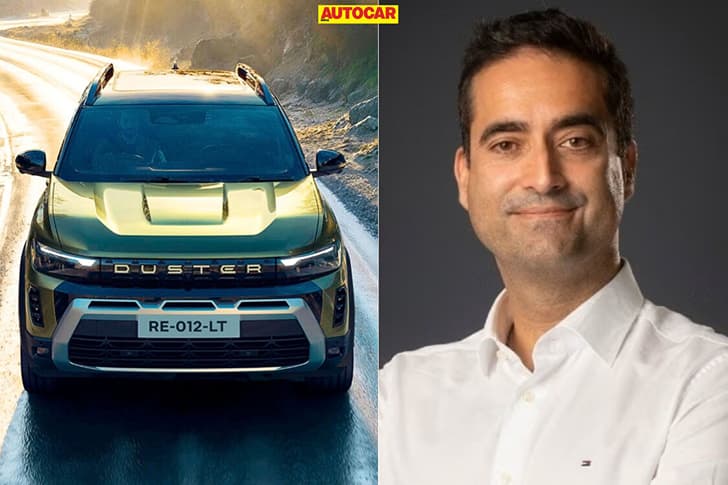

Renault India bets strong hybrids will drive volumes for 10–20 years; the Duster E-Tech 160 strong hybrid launches October 17, 2026 to challenge Maruti's Grand Vitara and Victoris.
Renault India's VP for sales and marketing, Francisco Marques, believes strong hybrids will be "the main volume-making technology probably for the next 10, 15 or 20 years to come" — and the company is putting that conviction into practice with the Duster Strong Hybrid E-Tech 160, launching on October 17, 2026. It is Renault's first strong-hybrid powertrain in India, entering a segment already anchored by Maruti Suzuki's Grand Vitara and Victoris — the current benchmarks for strong-hybrid SUVs in the country.
The timing is deliberate. The Duster has struggled since its March 2026 relaunch, managing just 406 wholesales in August and fewer than 7,000 units total — a fraction of the 10,000–11,000 units Kia Seltos moves monthly, and well behind the 15,000–16,000 units Hyundai Creta averages. A strong-hybrid variant is Renault's clearest answer to that gap.
How does the Duster E-Tech 160 compare with the Grand Vitara and Hyryder strong hybrids?
| Model | Hybrid Type | Engine | System Power | Battery | Gearbox | Price Range (ex-showroom) |
|---|---|---|---|---|---|---|
| Renault Duster E-Tech 160 | Strong hybrid | 1.8L 4-cyl NA petrol + 2 e-motors | 160hp / 172Nm | 1.4kWh | 8-speed DHT (segment-first) | TBA (Oct 17 launch) |
| Maruti Suzuki Grand Vitara | Strong hybrid | 1.5L 3-cyl petrol + e-motor | 116hp | 0.6kWh | e-CVT | ₹16–20 lakh |
| Maruti Suzuki Victoris | Strong hybrid | 1.5L 3-cyl petrol + e-motor | 116hp | 0.6kWh | e-CVT | ₹16–20 lakh |
| Toyota Urban Cruiser Hyryder | Strong hybrid | 1.5L 3-cyl petrol + e-motor | 116hp | 0.6kWh | e-CVT | ₹16–20 lakh |
On paper, the Duster's E-Tech 160 has a meaningful spec advantage: a larger engine, more power, a bigger battery, and a dedicated hybrid transmission that no rival in this segment currently offers. Renault also claims the E-Tech 160 can cover 80 percent of urban driving in all-electric mode — a figure that, like all manufacturer claims, will need real-world validation once the car is in buyers' hands.
The honest caveat: pricing is everything. If the Duster hybrid lands above ₹20 lakh, it faces a steeper fight against established, trusted nameplates. Renault has been actively localising the E-Tech 160 to keep costs competitive, but the final number on October 17 will determine whether the spec sheet advantage translates into actual sales momentum.
What exactly did Renault India's VP say — and why does it matter?
A strong hybrid is defined as a system where the electric motor can propel the vehicle independently of the combustion engine, even if only for short distances or at low speeds. This distinguishes it from a mild hybrid, where the battery only assists the engine and cannot drive the wheels alone.
Marques used precisely this distinction when he positioned the Duster hybrid against the diesel segment. "I see diesel declining; I see a strong hybrid growing very fast. And it's related to the offer," he told Autocar Professional, as reported by Autocar India. His logic: strong hybrids deliver diesel-like fuel efficiency in urban conditions without the maintenance complexity or the particulate emissions of a diesel engine, while also offering the smoothness of electric propulsion.
The broader framing was equally pointed. Marques described strong hybrids as "the perfect transition" between internal combustion and full electric — a bridge technology that can serve buyers for whom EVs remain impractical due to charging infrastructure gaps. "Until EVs become something more, then there will be hydrogen," he added, sketching a technology roadmap that places strong hybrids at the centre of Indian mobility for at least the next decade.
There is a counterpoint worth noting: diesel car sales in India actually grew 15 percent year-on-year in the first half of 2026, which suggests the diesel-to-hybrid migration Marques anticipates is not yet happening at scale. The demand for diesel remains real and persistent, particularly on highways where strong hybrids offer less of an efficiency edge than in city driving.
Why has the Duster struggled, and can the hybrid fix it?
The new-generation Duster returned to India in March 2026 with only turbo-petrol engines — a 1.0-litre and a 1.3-litre — and no diesel, no CNG, no hybrid. For a nameplate that built its original following partly on the back of a punchy 1.5-litre K9K diesel, that was a significant gap. Many of its midsize SUV rivals offer naturally aspirated petrol, diesel, CNG, hybrid, and electric variants, giving buyers far more choice.
The sales numbers reflect that mismatch. Fewer than 7,000 units in roughly six months is a slow pace for a segment where the Hyundai Creta alone sells 15,000–16,000 units every month. The Kia Seltos, another strong performer, averages 10,000–11,000 units monthly. The Duster is not competing in the same conversation yet.
The hybrid variant changes the competitive map. It gives Renault a direct entry into the strong-hybrid SUV subset — a smaller but fast-growing slice of the midsize SUV market where Maruti's Grand Vitara and Victoris, along with Toyota's Urban Cruiser Hyryder, currently operate without a French rival. If Renault prices the E-Tech 160 within the ₹16–20 lakh band that these models occupy, it immediately becomes a credible alternative with a spec advantage in power and battery size.
Renault India's overall sales have been trending upward: the company sold 35,378 units between January and September 2026, up 36.6 percent year-on-year from 25,886 units in the same period of 2025. September added 3,399 units, a 20 percent improvement over August. The brand is growing, but it needs the Duster to pull its weight in the volume stakes.
How does Maruti Suzuki's strong-hybrid lineup hold up against this new competition?
The Maruti Suzuki Grand Vitara strong hybrid is the segment benchmark in the Indian midsize SUV space — it was the first mass-market strong hybrid SUV from Maruti, establishing the price-to-efficiency formula that rivals have since tried to match. The Victoris, which shares the same 1.5-litre three-cylinder strong-hybrid system and e-CVT gearbox, extends that formula into a slightly different body style.
Both cars carry ARAI-claimed fuel efficiency figures in the range of 27–28 km/l (manufacturer claim), which is a significant advantage over turbo-petrol rivals in city driving. Real-world figures are typically lower — independent tests have placed them in the 18–22 km/l range in mixed conditions — but even that is competitive against the 12–15 km/l that most turbo-petrol SUVs return in urban use.
The weaknesses are real. The 116hp system, while adequate for urban use, feels less punchy than the 160hp Duster E-Tech 160 on paper. The 0.6kWh battery is smaller than the Duster's 1.4kWh unit, which limits the electric-only range. The e-CVT gearbox, while smooth, is not as engaging as a conventional automatic for drivers who want a more dynamic feel. And the strong-hybrid battery pack does eat into boot space — a practical compromise that buyers should factor in.
The Grand Vitara and Victoris also carry a price premium over their own mild-hybrid and turbo-petrol siblings. The strong-hybrid variants start at roughly ₹16 lakh, while the mild-hybrid (Smart Hybrid) versions of Maruti's lineup — such as the XL6 petrol and Fronx 1.0 turbo — are positioned at lower price points. A mild hybrid, by definition, uses a small battery and motor only to assist the engine during acceleration and to enable start-stop; it cannot drive the wheels independently. Buyers who want the full fuel-efficiency benefit of electric propulsion in city traffic need the strong-hybrid variants, and they pay for it.
For buyers considering AWD hybrid SUVs under ₹20 lakh, the Grand Vitara strong hybrid is front-wheel drive only; AWD is available only on the turbo-petrol variant. The Duster's AWD credentials on the hybrid variant have not been confirmed at the time of writing.
What is Renault's broader India strategy, and where does the hybrid fit?
The Duster hybrid is not a standalone move — it is part of a structured product and platform plan that Renault has been building since it repositioned India as a strategic market rather than a peripheral one. Renault's Chennai R&D facility is now central to the brand's global development work, and the RGMP (Renault Group Modular Platform) that underpins the Duster has been engineered from the ground up to support ICE, flex-fuel, strong hybrid, and full-electric drivetrains.
This built-in flexibility is significant. Unlike platforms tied to a single powertrain strategy, RGMP allows Renault to adapt models over time without extensive re-engineering — a practical advantage in a market like India where regulatory requirements and buyer preferences are shifting faster than product cycles. The upcoming Renault Bridger concept, positioned in the B-SUV segment, will be the second model on RGMP, and it too will carry multi-energy credentials.
Renault has also outlined a plan to expand its India portfolio to seven models by 2030, underpinned by two platforms: RGMP for its more technology-led products, and RGEP (Renault Group Entry Platform) — which already underpins the Kiger and Triber — for its accessible, volume-driven range. CNG versions of the Kiger and Triber are also in the pipeline, addressing the continued demand for lower running costs in Tier 2 and Tier 3 markets.
Globally, Renault Group sold 1,165,133 vehicles in the first half of 2026, with India among the standout growth markets at +61.2 percent year-on-year in PC + LCV sales. Electrified vehicles accounted for 52 percent of Group sales in Europe in H1 2026, with hybrids (HEV) playing a central role — Renault ranked No. 2 in the European hybrid market. The India hybrid push is consistent with that global direction, even if the product mix and price points are calibrated specifically for local conditions.
How does the E-Tech 160 system actually work, and is it genuinely a strong hybrid?
A strong hybrid powertrain is defined as one in which the electric motor has sufficient power and battery capacity to move the vehicle under electric power alone, without the combustion engine running. The Renault E-Tech 160 meets this definition: it uses two electric motors, a 1.4kWh battery pack, and a 1.8-litre four-cylinder naturally aspirated petrol engine, with an 8-speed dedicated hybrid transmission (DHT) managing the power split.
The DHT is the most technically distinctive element. Conventional strong hybrids in this segment — the Grand Vitara, Victoris, and Hyryder — use an e-CVT, which is a simpler, smoother but less mechanically engaging system. The Duster's 8-speed DHT is a segment first, and Renault claims it contributes to the 80 percent all-electric urban driving figure by optimising when the petrol engine cuts in and out.
The 1.4kWh battery is more than double the 0.6kWh unit in the Toyota/Maruti system. A larger battery means more energy available for electric-only propulsion and more capacity to recover energy under braking — both of which contribute to better city fuel efficiency. However, ARAI-certified mileage figures for the Duster E-Tech 160 had not been released at the time of writing (pre-launch). Renault's manufacturer claim of 80 percent electric urban driving is a usage-pattern figure, not a km/l number, and buyers should wait for the official ARAI figure before making direct comparisons with the Grand Vitara's claimed 27–28 km/l.
The larger battery also adds weight and cost — two factors that will influence where the Duster hybrid lands on the price sheet. Renault's localisation work on the E-Tech 160 is aimed at managing that cost, but the degree of localisation achieved will only become clear at launch.
If you are comparing hybrid cars under ₹25 lakh in the SUV space, the Duster E-Tech 160 is shaping up to be the most powerful and most technically differentiated option in the strong-hybrid midsize SUV category — provided the pricing lands in a competitive window.
Does Renault's diesel-to-hybrid thesis hold up in the current market?
Marques' prediction that strong hybrids will absorb diesel demand is a reasonable long-term thesis, but the near-term data complicates it. Diesel car sales in India grew 15 percent year-on-year in the first half of 2026 — not a declining segment, but one that is still growing. Buyers who cover high annual mileage on highways, particularly in Tier 2 cities and rural areas, still find diesel's combination of torque, highway efficiency, and fuel cost hard to beat.
Strong hybrids, by contrast, deliver their biggest efficiency gains in urban stop-start conditions, where the electric motor can carry more of the load. On the highway, the efficiency advantage narrows considerably, and the price premium over a diesel becomes harder to justify on a pure running-cost basis.
That said, the regulatory environment is shifting. BS6 Phase 2 emission norms have raised the cost and complexity of diesel engines, and several manufacturers have already exited the diesel segment in smaller vehicle classes. If diesel costs continue to rise — both in terms of vehicle price and fuel price — the strong hybrid's urban efficiency case becomes more compelling over time. Marques' 10–20 year horizon for strong-hybrid dominance is not unreasonable; it is the pace of that transition that remains uncertain.
What should buyers watch for at the October 17 launch?
Three things will determine whether the Duster E-Tech 160 becomes a genuine volume driver or a niche offering:
Price: If Renault can bring the strong-hybrid Duster in at or below the ₹18–20 lakh mark that the Grand Vitara and Hyryder occupy, it has a real case. A price above ₹20 lakh narrows the audience significantly, even with the spec advantage.
ARAI mileage figure: The 80 percent all-electric urban driving claim is a usage-pattern number, not a certified efficiency figure. The ARAI km/l number will be the basis for direct comparisons with the Grand Vitara's 27–28 km/l claim, and it will shape buyer perception of value.
Variant structure: Will the E-Tech 160 be available across multiple trim levels, or only in top-spec configurations? Broader availability at accessible price points is what drives volume, not a single flagship variant.
Renault India's sales recovery in 2026 — up 36.6 percent year-on-year through September — gives the brand momentum heading into the festive season launch. But the Duster needs to do more than add a powertrain option; it needs to establish itself as a credible alternative in a segment where Maruti's Grand Vitara has been the default strong-hybrid choice for buyers who want efficiency without the range anxiety of a full EV.
For buyers already researching this space, our guide to hybrid cars with the quickest acceleration in India puts the E-Tech 160's 160hp output in context against other electrified options — and the Duster's combined output is the highest in the strong-hybrid midsize SUV class by a clear margin. Whether that translates into a faster 0–100 km/h time than the Grand Vitara's e-CVT setup will be one of the more interesting data points to emerge from first drives after October 17.
The strong-hybrid midsize SUV segment is about to get more competitive. Maruti's Grand Vitara and Victoris have held the space largely unchallenged since their launch. The Duster E-Tech 160 is the first serious attempt by a non-Toyota, non-Maruti brand to enter that conversation with a technically differentiated product. Whether it succeeds will depend on price, but the intent — and the hardware — is genuine.
Sources
- Renault India believes strong hybrids can be major volume drivers | Autocar India
- Renault's India Offensive: Platforms, powertrains and a product plan built for scale | The Hindu
- Renault India Cumulative Sales Jump 36.6% In 2026; Duster Hybrid Is Next Big Test | Times of India Auto
- Renault Group prioritizes electrification of its vehicle lineup and sales quality | Renault Group Media
- Renault Duster | Autocar India
- Maruti Suzuki Grand Vitara | Maruti Suzuki India